If someone you love is being held by ICE, you can contact a habeas lawyer and ask for the detention situation to be reviewed even if you are not the person in custody. A family member can often provide the first information a lawyer needs, including the detainee’s A-Number, current facility, custody date, bond history, and any urgent transfer or removal concerns.
But requesting a habeas review for an ICE detainee is not the same as filing a federal habeas corpus petition on that person’s behalf. The detained person normally remains the person whose custody rights are at issue. If someone else must formally act for the detainee in court, a separate legal question may arise under the federal “next friend” doctrine.
For families, the practical first step is simpler: gather the basic facts, locate the person, and ask counsel whether the detention presents an issue that should be examined in federal court. This guide explains what family members can do, what information helps with an initial review, why the detainee may still need to speak directly with counsel, and when the narrower “next friend” rule may become relevant.
In This Article
- Can You Ask a Habeas Lawyer to Review a Family Member’s ICE Detention?
- What Can a Family Member Do Before the Detainee Speaks With a Lawyer?
- What Information Does a Habeas Lawyer Need for an Initial Review?
- What Is the Lawyer Actually Reviewing?
- Does the ICE Detainee Need to Speak With the Lawyer?
- What If the Detainee Cannot Act on Their Own Behalf?
- When Should a Family Treat the Situation as Urgent?
- What Happens After the Family Requests a Habeas Review?
- Frequently Asked Questions

Can You Ask a Habeas Lawyer to Review a Family Member’s ICE Detention?
Yes. A spouse, parent, adult child, sibling, or another concerned person can contact a lawyer, explain that someone is in ICE detention, and provide information for an initial review. ICE itself maintains legal-access resources that include information for family members seeking legal resources on behalf of people in detention.
You also do not need to decide for yourself whether the detention “qualifies” for habeas before making that call. Determining whether federal habeas corpus is an appropriate legal tool requires reviewing the custody authority, immigration proceedings, detention history, prior bond or custody decisions, and the relief that may actually be available.
What the family member should not assume is that asking for a review automatically makes that relative the petitioner or gives them authority to litigate the detainee’s rights. Those are separate questions. For a broader explanation of who may bring a petition and what habeas actually asks a federal court to decide, see our guide to habeas petitions for families of ICE detainees.
A family member can start the legal review without already knowing the legal answer. Requesting an evaluation, representing the detainee, and formally acting as a “next friend” are three different concepts.
What Can a Family Member Do Before the Detainee Speaks With a Lawyer?
Families often become the first source of reliable information because the detained person may have limited phone access, may have just been transferred, or may not yet know which attorney will represent them. You can help by creating a short, factual summary rather than trying to perform the legal analysis yourself.
- Confirm the person’s location. ICE’s Online Detainee Locator System can be searched using an A-Number or biographical information.
- Write down when custody began. Include where and how the person was taken into ICE custody if known.
- Identify upcoming events. Note immigration court hearings, bond hearings, ICE check-ins, transfer notices, or removal-related communications.
- Preserve government paperwork. Keep photographs or copies of ICE, EOIR, DHS, or court documents the family already has.
- Flag anything urgent. Tell counsel immediately about an expected transfer, imminent removal concern, serious access problem, or unusually long detention.
If you are still trying to determine where your loved one is being held and what to do first, our step-by-step guide for families after ICE detention covers those immediate practical steps in more detail.
What Information Does a Habeas Lawyer Need for an Initial Review?
An initial review does not require the family to arrive with a complete federal-court evidence file. The immediate goal is usually to understand who is detained, where the person is being held, what has happened in the immigration case, and why continued custody may require closer legal examination.
| Information | Why It Helps |
|---|---|
| Full legal name and A-Number | Helps identify the detainee and match available immigration records. |
| Current detention facility | Location can affect attorney access and the federal court analysis. |
| Date custody began | Establishes the starting point for the detention timeline. |
| Immigration court status | Shows whether proceedings are pending or a removal order may already be final. |
| Bond or custody history | Helps counsel understand what review has already occurred. |
| Transfer or removal concerns | May change how quickly legal review is needed. |
If some information is missing, that does not necessarily prevent a family from contacting counsel. ICE recommends an A-Number search when that number is available, but its locator also permits certain biographical searches. The lawyer can then identify which additional records may be needed before advising on a possible federal filing.
What Is the Lawyer Actually Reviewing?
A habeas review is not simply a calculation of how many days someone has spent in detention. Counsel may need to identify the legal basis for custody and the specific detention problem that a federal court could potentially address.
Federal habeas jurisdiction under 28 U.S.C. § 2241 can reach certain custody that violates federal law or the Constitution. In an ICE detention matter, the analysis may therefore include questions such as:
- What statute or legal authority is ICE relying on to continue detention?
- Has an immigration judge held a bond hearing, denied bond, or said the court lacks jurisdiction?
- How long has custody continued, and what explains that duration?
- Is there already a final removal order?
- If there is a final order, what is happening with the government’s removal efforts?
- Has a transfer changed the person’s access to counsel or relevant federal forum?
- What relief would the federal court actually be asked to provide?
These questions do not mean every unusual or lengthy detention supports a habeas petition. They help counsel determine whether the problem is truly about unlawful custody and whether federal habeas is the correct legal vehicle. Our separate guide to 28 U.S.C. § 2241 in immigration detention explains the statutory framework in greater depth.
Is your loved one currently being held by ICE?
Our team can review the detention history, current facility, bond or custody record, removal posture, and any urgent transfer or removal concerns to determine what legal options may be available.
Does the ICE Detainee Need to Speak With the Lawyer?
In many cases, yes. A family member can make the first call and supply important background, but counsel will often need direct communication with the person whose detention is being reviewed. The detainee may know facts that relatives do not, including what ICE officers said, which documents were signed, what happened at a bond hearing, whether removal paperwork was presented, and what communication has occurred with immigration authorities.
Direct contact can also help counsel confirm the detainee’s objectives and determine what representation is appropriate. ICE maintains attorney-access procedures that address communication with current and prospective clients, attorney visitation, legal calls, electronic document exchange where available, and other legal-access resources.
Difficulty reaching someone in detention therefore does not automatically mean a relative should file in that person’s place. Sometimes the immediate problem is simply locating the detainee, arranging a legal call, or identifying the facility’s attorney-access procedures.
What If the Detainee Cannot Act on Their Own Behalf?
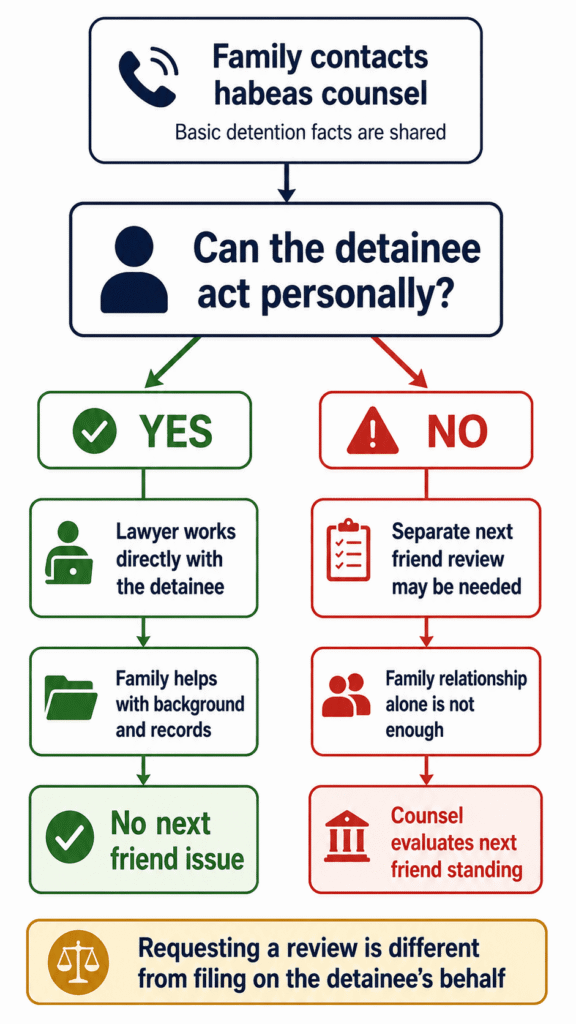
Federal habeas law recognizes that there are circumstances in which another person may need to act for the individual whose liberty is at stake. 28 U.S.C. § 2242 provides that an application may be signed and verified by the person seeking relief or by someone acting on that person’s behalf.
That language does not give every relative automatic authority to litigate. In Whitmore v. Arkansas, the Supreme Court described important limits on “next friend” standing.
The Detainee Must Be Unable to Litigate Personally
The person seeking next-friend status must adequately explain why the real party in interest cannot appear on their own behalf. The Court identified circumstances such as inaccessibility, mental incompetence, or another disability as examples of the type of barrier that can matter.
The Next Friend Must Be Genuinely Dedicated to the Detainee’s Interests
The person acting as next friend must be truly dedicated to the best interests of the person in custody. The Supreme Court also noted the relevance of a significant relationship between the two people. A close family connection may therefore be important evidence, but family status alone does not automatically establish next-friend standing.
| Situation | What It Usually Means for the Review |
|---|---|
| Family can reach the detainee | The relative may begin the intake while counsel communicates directly with the detainee. |
| Detainee is temporarily difficult to contact | Counsel may first work through facility and attorney-access procedures. |
| Detainee genuinely cannot act personally | Counsel may need to analyze whether next-friend standing is legally available. |
| Relative simply wants to help | The relative may request a review, but that alone does not create standing to file in federal court. |
When Should a Family Treat the Situation as Urgent?
Not every detention issue requires an emergency filing, but some facts make prompt review especially important. The family should tell counsel immediately if any of the following is happening:
- ICE appears to be preparing a transfer to another facility or state.
- Removal may be imminent or the detainee has recently received removal-related paperwork.
- Detention has continued for an extended period without a clear path to release or meaningful custody review.
- A bond hearing was unavailable or denied and the family does not understand what review remains.
- A final removal order exists but continued detention is raising separate custody concerns.
- Attorney access has become unusually difficult and an approaching event makes delay consequential.
These are reasons to obtain legal review, not automatic proof that a habeas petition should be filed. The legal significance of any one fact depends on the governing detention authority, procedural history, location, and applicable federal law.
What Happens After the Family Requests a Habeas Review?
The next step depends on what the initial facts show. A useful review usually narrows the situation rather than assuming from the beginning that a federal lawsuit is required.
| Step | Possible Next Action |
|---|---|
| Family provides the basic facts | Counsel identifies the detainee, facility, custody timeline, and immediate concerns. |
| More records are needed | The family or detainee may be asked for custody decisions, hearing records, or other relevant documents. |
| Direct detainee contact is needed | Counsel works to speak with the detained person and confirm key facts and objectives. |
| A federal custody issue appears possible | Counsel analyzes jurisdiction, legal authority, potential claims, and available relief. |
| Habeas is not the right tool | Another detention, immigration-court, administrative, or appellate option may need to be considered. |
If counsel determines that a federal petition should be considered, the process becomes more specific: the current facility and custodian must be confirmed, the factual record organized, the legal theory developed, and the proper federal court identified. Our guide to filing a habeas petition for ICE detention explains that later stage separately.
Frequently Asked Questions
Can I Contact a Habeas Lawyer if My Spouse Is Detained by ICE?
Yes. A spouse can contact counsel, explain the detention situation, and provide available information for an initial review. Whether the detained spouse ultimately needs to communicate directly with counsel or authorize representation is a separate step from the family’s first inquiry.
Can a Parent Request a Habeas Review for an Adult Child?
Yes. A parent may contact counsel about an adult child in ICE custody and provide information for review. That does not automatically make the parent the person entitled to file the federal petition on the child’s behalf.
Do I Need to Know the Detainee’s A-Number Before Calling a Lawyer?
No. An A-Number is very useful, but families can still begin by providing the detainee’s full legal name, country of birth, date of birth, known facility, and other identifying information. ICE’s locator system also permits a biographical search when the A-Number is unavailable.
What if I Cannot Locate My Family Member After ICE Detention?
Check the official ICE Online Detainee Locator System first. ICE notes that the system does not provide location information for every person in custody, so additional contact with ICE may sometimes be necessary if the person does not appear in the search results.
Can I File a Habeas Petition for My Detained Family Member?
Possibly, but not simply because you are related. Section 2242 permits someone to act on behalf of the person seeking habeas relief, while Whitmore v. Arkansas places limits on next-friend standing. Counsel should evaluate whether the detainee can act personally and whether the requirements for third-party standing are actually met.
Does Being Unable to Reach the Detainee Automatically Create Next-Friend Standing?
No. A communication problem may need to be addressed through the detention facility’s legal-access procedures first. Next-friend standing requires a legal showing; it is not automatically created whenever phone or visitation access is difficult.
Does Requesting a Habeas Review Mean a Lawsuit Will Be Filed?
No. A review is an evaluation of the detention facts and available legal options. Counsel may conclude that more information is required, another legal process should be pursued, or that a federal habeas petition should be considered.
Families Can Start the Review Without Having Every Legal Answer
If someone you love is in ICE detention, you do not need to determine the federal legal theory before asking for help. A family member can gather the basic custody facts, locate the detainee, preserve available paperwork, and request a habeas review so counsel can determine what the detention history actually presents.
The key distinction is that helping a loved one obtain legal review is not the same as automatically becoming the person who files in federal court. When the detainee can participate, counsel will ordinarily need to work with that person directly. When the detainee genuinely cannot act on their own behalf, the separate rules governing “next friend” standing may need to be evaluated.
A habeas lawyer can review those facts and determine whether the detention presents a federal custody issue, whether additional information is needed, and what legal path should be considered next.
Is your loved one in ICE detention?
Contact our team for a review of the current detention facility, custody history, bond or removal posture, and any urgent transfer or removal concerns. A family member can start the conversation even when important records are still being gathered.
Phone: (+1) 862-799-2200
Email: info@gozellaw.com
Legal Disclaimer: This article is provided for general informational purposes only and does not constitute legal advice. Every immigration case has unique circumstances. For legal guidance specific to your situation, we recommend consulting with an experienced immigration attorney. The information in this article reflects laws and policies as of the publication date; subsequent changes may affect its accuracy. Prior results do not guarantee a similar outcome.
Sources
- 28 U.S.C. § 2241 — Power to Grant Writ
- 28 U.S.C. § 2242 — Application
- Whitmore v. Arkansas, 495 U.S. 149 (1990)
- ICE — Attorney Information and Resources
- ICE — Online Detainee Locator System
Every day in detention is a day away from your family.
If the immigration system has failed you, federal court may be the only answer. Let us review your case for free.
Get a Free Case Evaluation