Your lawyer says the federal court has ordered a bond hearing. Then your family asks the next question: how much money will we need to bring our loved one home? The immigration bond amount after habeas is separate from the money spent on legal representation, and the court’s order may not set that amount.
There is no fixed price attached to a habeas win. First, read what the order requires. A hearing gives the immigration judge an opportunity to decide whether release is appropriate and, if so, on what terms. A direct release order may follow a different path.
This guide explains the minimum for one common type of immigration bond, what affects the amount, what to discuss with counsel if you cannot afford it, and how payment and refunds differ.

How Much Could the Immigration Bond Amount After Habeas Be?
For a monetary bond under 8 U.S.C. § 1226(a)(2)(A), the statutory minimum is $1,500. The provision does not set a maximum. That gives your family a legal starting point, but it does not tell you what to put aside: the judge must still decide whether release is appropriate and what conditions apply to the individual case.
The first document to read is the federal court’s order. If it requires a bond hearing, your loved one has gained access to a custody decision; the immigration judge may still deny bond or set an amount above the minimum. If it directs release on specified conditions, a separate monetary bond may not be required. Our guide to using habeas to obtain a bond hearing explains why those remedies lead to different next steps.
For budgeting purposes, separate the bond amount, the attorney fee, and any private financing charges. Paying for federal litigation does not automatically fund the bond. Likewise, a bond company’s advertised upfront charge may be only part of your contractual obligation. The habeas attorney fees and case timeline guide covers the legal expenses; this article concerns the money connected to release on bond.
| Figure | What it tells your family |
|---|---|
| $1,500 statutory minimum | The lowest monetary bond under § 1226(a), not a prediction or a guarantee of eligibility. |
| Amount in the bond decision | The amount to plan around, subject to any later change or stay. |
| Company’s initial payment | One part of a private agreement; check total charges and collateral terms. |
Key point: A habeas win does not come with a standard bond price. Start with the relief ordered and the actual bond decision before committing your family’s savings.
What Does the Judge Consider When Setting Bond?
The amount is tied to the custody assessment. In Matter of Guerra, the BIA identified a range of factors relevant to release and bond, including residence, family ties, work history, court attendance, and criminal or immigration history. These are weighed together; there is no schedule deducting a fixed dollar amount for a job, a relative, or a support letter.
Your family’s preparation should explain how release would work in practice. A proposed address answers where your loved one will live. A support letter should explain what the writer can actually provide. Records of earlier appearances may help address concerns about attendance. Counsel must also examine adverse information and the standards required by the federal order. Having enough money to pay does not itself establish that release is appropriate.
- Housing: identify a real address and who has agreed to provide accommodation.
- Support: explain who can help with transportation, appointments, and essential expenses.
- Compliance: give counsel available records of prior court appearances or required reporting.
- Resources: distinguish available funds from offers of help that are not yet confirmed.
These categories help organize the discussion with your lawyer; they are not a universal filing checklist. Ask which records address the concerns in your loved one’s case. A household budget and a release plan answer different questions, and both should accurately describe what your family can sustain after release.
What If We Cannot Afford the Bond?
A bond order can bring relief and an immediate financial problem. If your family cannot raise the amount, tell counsel promptly and share the written decision. A lower bond is not automatic because payment would be difficult. The next step is to identify the available legal route and prepare a clear account of the shortfall, rather than submitting the same request again or signing the first financing offer.
Put the Affordability Problem Into the Record
Prepare a brief household budget with recent supporting records. Show money currently accessible, income lost during detention, rent, essential bills, medical costs, and dependents. If relatives can contribute, identify the amount and whether it is a gift or loan. Avoid treating a possible contribution as money already available. This gives counsel a factual basis for explaining the difference between the amount ordered and your family’s resources.
Ask how ability to pay and alternatives to monetary bond are treated under the applicable law and the federal court’s order. The answer cannot be assumed nationwide. Counsel should connect financial information to the legal standard in your case, while continuing to address the reasons given for detention or the amount. A hardship statement is useful only when its relevance is explained.
If the immigration judge has already made a bond redetermination, 8 C.F.R. § 1003.19(e) requires a later request to be written and supported by materially changed circumstances. New facts must meet that standard; simply disagreeing with the amount does not do so. EOIR’s jurisdiction guidance also limits when a bond decision can be changed. Counsel should distinguish a new request from an appeal and determine which route is available.
A bond appeal is separate from the underlying immigration appeal. Ask counsel to review the deadline, the judge’s stated reasons, and any issue about compliance with the habeas order without delay. Filing an appeal does not itself reduce the amount or supply the funds needed for release. The decision about proceeding should account for both the legal grounds and your loved one’s current custody situation.
Before borrowing: Ask what legal options remain, what money is actually available, and what a payment agreement will cost over its full term. Those answers belong in the same family discussion.
If you consider financing, request a written breakdown of the upfront payment, any recurring charges, interest, collateral, and potential additional liability. Compare those obligations with expenses after release, when housing, transportation, and the immigration case may still require funds. Have counsel review unclear terms before signing. A manageable first payment does not necessarily mean the full arrangement is affordable.
Is the bond amount beyond your family’s reach?
Send us the written bond decision, federal court order, detention facility, and A-Number for a free case evaluation. We can review the detention issues and available legal options, including whether the amount or process warrants a challenge. A review cannot promise a reduction or release.
Paying ICE Directly or Using a Bond Company: What Is the Difference?
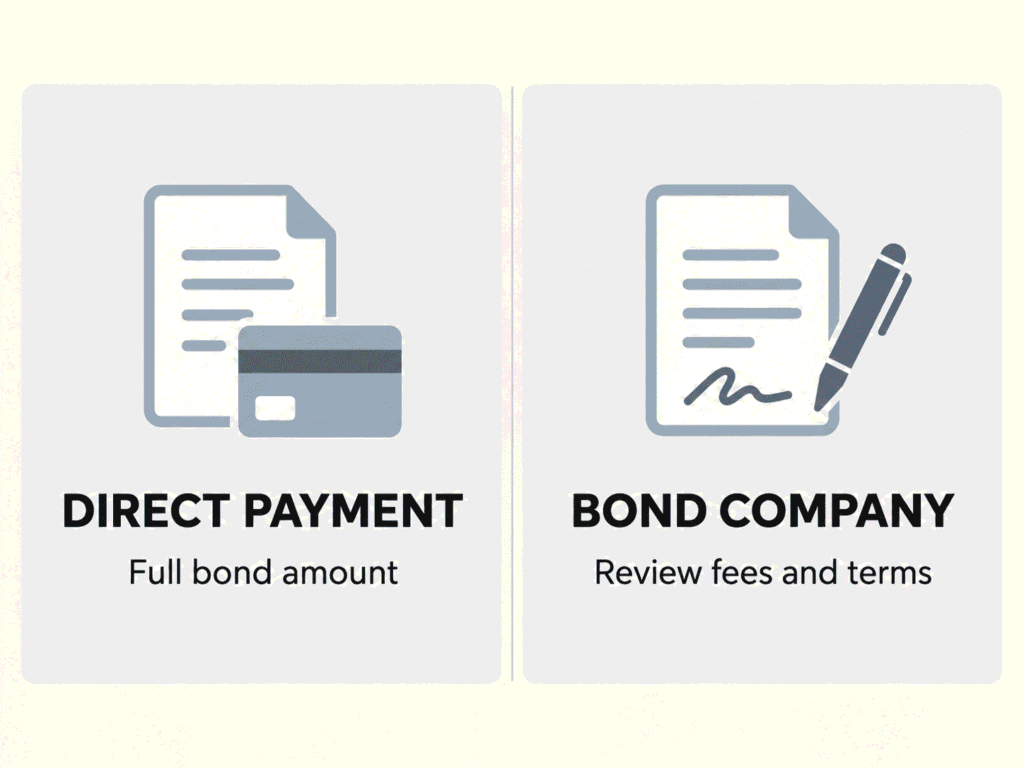
The payment route affects how much your family needs immediately and what may later be returned. 8 C.F.R. § 103.6(b) recognizes a deposit in the bond’s full face amount and bonds backed by acceptable Treasury-certified sureties. A private company’s contract is a separate financial commitment. Read it for the actual arrangement rather than assuming the company simply collects a smaller version of the same payment.
| Question | Direct cash bond | Bond company |
|---|---|---|
| What must we provide? | The full face amount of the bond. | The initial payment and any security required by the contract. |
| What else could be charged? | Confirm any payment-related charges. | Check premiums, recurring fees, financing costs, and collateral obligations. |
| What could come back? | The deposit, subject to cancellation and refund requirements. | Any refundable payment or collateral depends on its purpose and contract terms. |
| What should we keep? | Bond agreement, payment receipt, and notices. | The complete contract, receipts, and collateral records. |
For a direct cash bond, plan around the full amount. As an illustration only, a $10,000 bond means a $10,000 deposit; it does not mean that paying $1,000 directly to ICE satisfies the cash-bond requirement. This is a payment example, not an estimate of a typical bond. A company may offer different terms, but those terms do not change the face amount stated in the bond decision.
ICE operates CeBONDS for electronic cash-bond processing. Confirm the current payer requirements, documentation, accepted payment method, and case eligibility through ICE before transferring funds. Also ask counsel whether any stay or other restriction affects release. Having the money available and having an operative release decision are separate parts of the process.
Before signing with a company, get direct answers to four questions: What is the total charge? Which payments are refundable? What secures the agreement? When is collateral returned? Ask what happens if the immigration case continues longer than expected. If a representative’s explanation differs from the written agreement, resolve that difference before paying; keep a complete copy of what you sign.
Will Your Family Get the Bond Money Back?
A direct cash deposit may be returned when the bond is properly canceled and the refund requirements are met. The end of a habeas case does not automatically cancel a delivery bond. Federal litigation concerns detention, while the underlying immigration proceedings and bond obligations can continue. A family planning to use refunded funds for immediate expenses should therefore avoid assuming a particular return date.
8 C.F.R. § 103.6(c)(3) and (e) distinguish substantial performance of bond conditions from a substantial violation. Confirm the cancellation and refund process with ICE; a final breach determination can put the money at risk. A favorable case outcome and the processing of a bond refund are different events, and the paperwork should establish what has happened to the obligation.
The person responsible under the bond is the obligor. Keep the agreement, receipts, cancellation or breach notices, and any assignment documents together, and confirm who is entitled to receive the refund. The Florence Project’s bond guide, hosted by ICE stresses retaining payment records and following the refund instructions. Keep contact details current so the responsible person can receive and act on notices.
With a company, separate premiums or service fees, collateral, and any cash deposit in your records. They may have different return conditions. Do not assume a refundable deposit means every company charge is refundable, or that bond cancellation by itself resolves every obligation in the private contract. Ask for the relevant provision and a written explanation of the return process.
A Real Case: Release on a $1,500 Bond After Federal Intervention
Our published Honduras case shows why the minimum can be a real outcome without being a reliable prediction. An immigration judge declined bond jurisdiction for an asylum seeker who had entered without inspection. Our firm filed a federal habeas petition challenging the denial of an individualized custody hearing. Following federal intervention, the client was released from detention in Maryland on a $1,500 immigration bond.
The full Honduras habeas and minimum-bond success story describes that result. It does not establish a general rate, an average amount, or what another judge will decide. For your family, the useful comparison is the legal and factual record, including what the federal order requires and what evidence supports the custody request.
Frequently Asked Questions
Is immigration bond included in the habeas attorney fee?
Bond is a separate obligation from attorney fees. Review your engagement agreement and ask whether representation at the bond hearing is included or separately charged. Paying for the habeas petition does not, by itself, pay the bond needed for release.
Does winning habeas guarantee a $1,500 bond?
No. The $1,500 figure is the monetary minimum under § 1226(a), not a promised result. A federal order may require a hearing without guaranteeing release. The immigration judge can deny bond or set a higher amount based on the applicable law and record.
Can a family member pay the bond?
A family member may be able to post the bond, subject to ICE’s current payer and documentation requirements. Confirm those requirements before sending funds. Contributing money to a relative and becoming the person responsible under the bond are different roles.
Can we pay immigration bond in installments?
A direct cash bond requires the full face amount. A company may offer a separate payment arrangement, but the agreement can carry additional charges or security requirements. Compare the complete obligation rather than only the initial payment.
Does a habeas win automatically trigger a bond refund?
No. The habeas case and the bond obligation are separate. Confirm that the bond has been canceled and follow the applicable refund instructions. Any company fees or collateral must also be assessed under the terms of the private agreement.
Build Your Budget Around the Actual Bond Decision
A useful budget starts with three things: the relief ordered, the amount currently required, and the resources your family can actually access. Review the decision with counsel before committing funds. If it is unaffordable, address that problem directly with supporting financial information and a discussion of the available legal options. If a company is involved, review the full agreement before choosing how to pay.
For families still dealing with a refusal to hold a hearing, our denied bond hearing practice page explains how that issue may call for federal review. Our habeas corpus and ICE detention guide provides the broader context. Your family’s next step should follow the decision in your loved one’s file.
Get a Clear Review of Your Loved One’s Bond Situation
Send us the A-Number, detention facility, and any written bond decision or federal court order. Tell us whether a hearing is upcoming or an amount has already been set. We can review the legal issues affecting detention and potential release, including concerns about an amount your family cannot afford.
Phone: (+1) 862-799-2200
Email: info@gozellaw.com
Legal Disclaimer: This article provides general information and is not legal advice. Reading it does not create an attorney-client relationship. Information was reviewed on September 8, 2026. Bond eligibility, amount, review options, payment procedures, and refunds depend on the governing law, court orders, bond terms, and individual facts. No bond amount, fee recovery, or release is guaranteed. Prior results do not guarantee a similar outcome. Consult qualified counsel about your case and confirm current payment instructions with ICE.
Sources
- 8 U.S.C. § 1226 — Apprehension and Detention
- Matter of Guerra, 24 I&N Dec. 37 (BIA 2006)
- 8 C.F.R. § 1003.19 — Custody/Bond
- EOIR Policy Manual — Bond Jurisdiction
- EOIR Policy Manual — Bond Appeals Generally
- 8 C.F.R. § 103.6 — Immigration Bonds
- ICE CeBONDS
- Florence Immigrant & Refugee Rights Project — How to Get a Bond (February 2022; hosted by ICE)
- My Habeas Lawyer — Honduras Minimum-Bond Case
Every day in detention is a day away from your family.
If the immigration system has failed you, federal court may be the only answer. Let us review your case for free.
Get a Free Case Evaluation