Published June 30, 2026 · Last updated September 23, 2026
When someone you love is held in ICE detention, two questions usually come first: how fast can we act, and what will this cost? A habeas corpus case is not a routine immigration filing. It is a federal court action that challenges whether the government has the legal authority to keep your loved one detained.
This guide breaks down habeas corpus cost in real numbers: the $5 federal filing fee, what a habeas petition costs in attorney time, the options that exist when a family cannot pay, and the three-day clock the statute puts on the government. It also shows how quickly real cases from our own docket have moved, and why no attorney should promise a guaranteed release date.
At a glance: habeas corpus cost in 2026
| What | Amount | Basis |
|---|---|---|
| Court filing fee | $5 | 28 U.S.C. § 1914(a) |
| Administrative fee charged in other civil cases | Not charged | Federal district court fee schedule |
| If you cannot pay the filing fee | Can be waived | In forma pauperis, 28 U.S.C. § 1915 |
| Attorney fee for a habeas petition (our firm) | From $5,000, flat | Agreed in writing before work begins |
| Government’s deadline to answer | 3 days, up to 20 for good cause | 28 U.S.C. § 2243 |
| Notice of appeal, only if you appeal | $605 | Waivable for a person who cannot pay |
In This Article
- Why Timeline and Cost Matter So Much in ICE Detention
- What Happens in a Habeas Corpus Case?
- What Does a Habeas Corpus Case Cost?
- If You Cannot Afford the Fee or a Lawyer
- Can the Government Be Made to Pay Your Attorney’s Fees?
- The Stages of a Habeas Case, From Intake to Decision
- What the Law Requires: The § 2243 Clock
- Real Timelines From Our Own Cases
- What Factors Can Speed Up or Slow Down the Case?
- Document Checklist: What Families Should Gather Fast
- Cost vs. the Cost of Waiting in Detention
- Frequently Asked Questions

Why Timeline and Cost Matter So Much in ICE Detention
In an ICE detention case, time is not just a calendar issue. Every day in detention can affect family stability, medical care, work, childcare, legal preparation, and the detained person’s ability to communicate with counsel.
Cost matters too because families are often making decisions under pressure. A transparent review should explain what work is included, what risks may affect the timeline, and what the legal team will need before filing in federal court.
Key point: A habeas case is not priced or timed like a simple form filing. It is federal litigation, often prepared under urgent conditions while someone remains in custody.
What Happens in a Habeas Corpus Case?
A habeas corpus petition asks a federal judge to review whether the government’s detention is lawful. Under 28 U.S.C. § 2241, federal courts have authority to consider habeas petitions in custody cases, including immigration detention challenges.
In plain English, the petition does not usually ask the federal court to decide the entire immigration case. Instead, it challenges the detention itself and asks whether ICE can continue holding the person without release, a bond hearing, or another constitutionally adequate process.
- Habeas can challenge prolonged detention when custody has gone on too long without meaningful review.
- Habeas can challenge denied or unavailable bond hearings when the immigration court process does not provide relief.
- Habeas can challenge detention after a final removal order when removal is not reasonably foreseeable.
- Habeas can challenge unlawful re-detention after years of release or supervision.
If you are trying to understand whether this path fits your loved one’s case, speaking with a habeas lawyer can help clarify whether the issue is detention, bond, transfer risk, removal timing, or a combination of several urgent facts.
What Does a Habeas Corpus Case Cost?
When families ask about habeas corpus cost, there are two separate numbers, and confusing them is the most common mistake: the court’s filing fee, which is fixed by statute, and the attorney’s fee, which is where the real cost lies.
The $5 Habeas Corpus Filing Fee Under 28 U.S.C. § 1914(a)
Federal law sets the fee for filing an application for a writ of habeas corpus at $5. The same statute, 28 U.S.C. § 1914(a), charges $350 to open any other civil case in federal district court, and the Judicial Conference adds a $55 administrative fee on top. Its district court fee schedule states that the administrative fee does not apply to habeas applications. The result is a striking gap:
| Cost to Open the Case | Standard Federal Civil Case | Habeas Corpus Petition |
|---|---|---|
| Filing fee under § 1914(a) | $350 | $5 |
| Administrative fee | $55 | Not charged |
| Total to file | $405 | $5 |
The $5 is paid to the Clerk of the district court where the petition is filed. That figure surprises people, and it should: filing is cheap. The work is not. A person who cannot pay even the $5 can ask the court to waive it, as explained below.
Attorney Fees: Where the Real Cost Is
The attorney fee reflects federal litigation prepared under time pressure while someone remains in custody. Our habeas petitions start at around $5,000, quoted as a flat fee and agreed in writing before any work begins.
| What You Are Paying For | Amount | How It Is Set |
|---|---|---|
| Federal court filing fee | $5 | Fixed by statute. Waivable for a person who cannot pay. |
| Attorney fee — habeas petition | From $5,000 | Flat fee, agreed in writing before work begins. Covers review, drafting, exhibits, filing and the reply to the government’s return. |
| Emergency filing | Quoted case by case | When a transfer or removal is imminent and the petition must be prepared in hours rather than days. |
| Contested litigation | Quoted case by case | Only if the government opposes and additional briefing, motion practice or a hearing follows. |
| Record collection | Discussed at intake | Obtaining ICE, EOIR or medical records where the family cannot get them directly. |
Whatever the number, and whichever firm you speak with, the quote should be in writing before any work begins. It should state exactly what is included: the petition, the exhibits, the filing, the reply to the government’s return, and whether a hearing is covered. If a firm will not put its fee in writing, treat that as a warning sign.
Costs That Are Not the Filing Fee
Three other amounts come up often. None of them is part of the $5 court fee or the petition fee:
- Immigration bond. If the federal judge orders a bond hearing and the immigration judge sets bond, that money is paid to the government, not to the court or the lawyer. A cash bond is generally returned when the case ends if every condition was met. Our guide to immigration bond amounts after a habeas win covers typical amounts and how the money comes back.
- An appeal. Filing a notice of appeal costs $605, paid by the party that appeals and waivable for a person who cannot pay. When the government appeals a habeas grant, the family pays no court fee, but defending the appeal is new attorney work outside the petition fee.
- Records. Where the family cannot obtain ICE, EOIR or medical records directly, collecting them is discussed at intake.
If You Cannot Afford the Fee or a Lawyer
The $5 fee is waivable. A detained person who cannot pay can ask the court for permission to proceed in forma pauperis under 28 U.S.C. § 1915 by filing a short financial application with the petition. The official federal § 2241 petition form instructs petitioners who cannot pay to do exactly that.
A lawyer can sometimes be appointed, too. Under the Criminal Justice Act, 18 U.S.C. § 3006A(a)(2)(B), a federal court may provide counsel to a financially eligible person seeking relief under § 2241 when the interests of justice require it. That is a discretionary power, not a right to a free lawyer.
In 2026 some districts with heavy immigration dockets have started using that power systematically. The District of Utah has provisionally appointed its Federal Public Defender for financially eligible people in immigration custody there who have colorable habeas claims. The District of Arizona, in a general order dated February 19, 2026, provisionally appointed its Federal Public Defender to screen certain pro se immigration habeas petitions.
These programs differ by district and can change quickly. If cost is the obstacle, say so in the first conversation. A useful case review should tell you whether a fee waiver, an appointed lawyer or a nonprofit option exists where your loved one is held.
Can the Government Be Made to Pay Your Attorney’s Fees?
Sometimes, yes, and almost no one discussing habeas corpus cost mentions it.
The Equal Access to Justice Act allows a party who prevails against the federal government in a civil action to recover attorney’s fees, unless the government’s position was substantially justified. Whether an immigration habeas petition counts as a “civil action” for that purpose is now one of the most consequential questions in this area.
The federal appeals courts are split. The Second, Third and Tenth Circuits treat habeas as a civil lawsuit covered by the EAJA; the Fourth and Fifth Circuits hold that it is not. The most recent appellate ruling came from the Third Circuit on February 2, 2026, in Michelin v. Warden, Moshannon Valley Correctional Center, which upheld fee awards of $18,224.58 and $15,841.60 to two people who won release after prolonged detention without bond hearings.
The Supreme Court will now decide the question nationwide. On June 29, 2026 it agreed to hear Montoya Palacios v. Liggins, No. 25-1223, a Maryland case in which the district court granted habeas but denied fees because of Fourth Circuit precedent. The petitioner filed his opening brief on September 16, 2026, and a decision is expected during the Court’s 2026–2027 term.
Where fee recovery is available today
| Circuit | States | EAJA Fees in Immigration Habeas |
|---|---|---|
| Second Circuit | New York, Connecticut, Vermont | Available |
| Third Circuit | New Jersey, Pennsylvania, Delaware | Available |
| Tenth Circuit | Colorado, Kansas, New Mexico, Oklahoma, Utah, Wyoming | Available |
| Fourth Circuit | Maryland, Virginia, West Virginia, North Carolina, South Carolina | Not available |
| Fifth Circuit | Texas, Louisiana, Mississippi | Not available |
In the remaining circuits, ask counsel how the district courts where your loved one is held have ruled. The practical effect of fee awards is already measurable: Courthouse News identified 97 habeas cases in 2026 in which courts ordered the government to pay the legal fees of people it had detained unlawfully, totaling more than $1.1 million.
Three cautions. This is not a contingency arrangement: the fee is agreed at the outset, and any recovery is decided only after the case ends. Recovery is discretionary and requires both winning and a finding that the government’s position was not substantially justified. And the Supreme Court’s ruling could widen or close this option for everyone.
We will not promise fee recovery in any case. We will tell you honestly whether the circuit where your loved one is held is one where the argument is currently available.
The Stages of a Habeas Case, From Intake to Decision
The exact process depends on the facts, but most immigration habeas cases move through several core stages. Families should understand these steps because early document collection and accurate case history can make the first filing stronger. The last column shows what each stage costs under the fee structure above.
| Stage | What Happens | Typical Timing | What It Costs |
|---|---|---|---|
| 1. Intake and urgent review | The legal team reviews detention history, court history, and immediate risks. | Same day to 48 hours | Free case review |
| 2. Document review | ICE paperwork, immigration court records, bond history, and family evidence are reviewed. | 1–5 days; faster when the family already has the A-Number and Notice to Appear | Included in the petition fee |
| 3. Drafting the petition | The legal arguments, facts, exhibits, and requested relief are prepared. | 1–5 days; compressed to hours when a transfer or removal is imminent | Included; emergency filings quoted separately |
| 4. Filing and service | The case is filed in the district where the person is held and served on the government. | Same day the petition is complete | $5 court fee; attorney work included |
| 5. Government response | The court orders the respondent to show cause and sets a return date. | 3–20 days under the statute; often longer by local order | Reply to the return included |
| 6. Resolution | Release, an ordered bond hearing, another custody order, or denial. | Hearing set within 5 days of the return under the statute; varies in practice | Quoted separately only if the case is contested |
Some cases resolve before a full hearing because the government changes position after the federal case is filed. Other cases require motion practice, briefing, or a judge’s decision after reviewing the petition and government response.
Not sure how fast your loved one’s case can move?
A habeas case review should look at how long detention has lasted, whether removal is actually foreseeable, whether a bond hearing was denied, and whether emergency filing is needed.
What the Law Requires: The § 2243 Clock
Most articles about habeas timelines describe what courts usually do. Fewer mention what the statute actually demands, and the difference matters when a family is deciding whether federal court is worth it.
28 U.S.C. § 2243 sets an unusually fast schedule. A judge entertaining a habeas application must “forthwith” either award the writ or order the government to show cause why it should not be granted. That order is directed at whoever has custody of the detained person. It is returnable within three days, and a court may extend that only for good cause, and only up to twenty days. Once the return is filed, the statute directs that a hearing day be set no more than five days later, again absent good cause. The section closes by requiring the court to “summarily hear and determine the facts, and dispose of the matter as law and justice require.”
| What § 2243 Requires | Statutory Timing |
|---|---|
| Court awards the writ or orders the government to show cause | “Forthwith” |
| Government files its return certifying the true cause of detention | 3 days; up to 20 with good cause |
| Hearing day is set after the return | No more than 5 days later, unless the court allows more time for good cause |
| Court decides | “Summarily,” as law and justice require |
Read together, the statute sets a fast default: a return in three days and never more than twenty, then a hearing within five days of the return. Even with the maximum extension for the return, that is under four weeks from the court’s order to a hearing, not the months an immigration court calendar can take. It is a default rather than a hard ceiling, because the hearing date can also be moved for good cause.
In practice, district courts frequently set their own briefing schedules by local rule or standing order, and government responses often land later than three days. Some districts handling large volumes of immigration habeas petitions have adopted expedited screening procedures; others take considerably longer. § 2243 does not guarantee a fast outcome. What it does is give counsel a statutory basis to ask for one, which is why a well-drafted petition requests expedited consideration and states plainly why delay causes harm.
The immigration court can take months to schedule a hearing. Federal habeas is measured in days by statute. That contrast is the whole reason families turn to federal court.
Real Timelines From Our Own Cases
There is no universal habeas timeline because federal judges, districts, government responses, detention facts, and emergency risks all vary. As a working range, urgent filings on strong facts tend to move in days to weeks, and contested litigation in weeks to months. Rather than quote an industry average, here are outcomes from our own published case results. The spread between them is the honest answer.
| Situation | What Happened | Time to Release |
|---|---|---|
| Indian national, New Jersey | Taken into ICE custody facing indefinite detention. Habeas filed within 2–3 days of detention. | 3 days |
| Afghan asylum seeker, ICE check-in | Detained at a routine check-in after years of compliance. | 5 days |
| Honduran asylum seeker | Immigration judge declined bond jurisdiction. Habeas petition filed; released on a $1,500 minimum bond. | Released on minimum bond |
| Tacoma, prolonged detention | Held despite winning withholding of removal, while ICE pressed third-country removal arguments. Required a petition and a full rebuttal brief. | 13 months to release order |
An emergency filing on strong facts can move in days. A contested prolonged-detention case where the government fights every step can take much longer — the Tacoma case study explains why that one ran as long as it did. The range exists because the facts, the district and the assigned judge differ in every case. Prior results do not guarantee a similar outcome. You can read all of these in full on our habeas corpus case results page.
What drives the timeline in each case type
| Case Type | What Usually Drives the Timeline | Where Delay Comes From |
|---|---|---|
| Emergency transfer or removal risk | Filing speed above everything else | Jurisdiction can change within hours of a transfer |
| Prolonged detention over 6 months | The custody record; length of detention carries the argument | Gathering complete ICE and EOIR records |
| Denied bond or no bond hearing | Bond records and which custody statute the government invokes | Obtaining the immigration judge’s ruling or proof none was held |
| Final removal order detention | Travel-document history and whether removal is realistically foreseeable | Waiting on consulate or country-condition evidence |
The Supreme Court’s decision in Zadvydas v. Davis is especially important in some post-removal-order detention cases. It is often discussed when a person remains detained after a final removal order and removal may not be reasonably foreseeable.
The faster a family can provide accurate documents, the faster a legal team can identify whether the case is ready for federal court.
What Factors Can Speed Up or Slow Down the Case?
The habeas petition timeline is shaped by more than the filing date. A strong review considers where the person is detained, why ICE claims detention is lawful, and whether the record supports emergency action.
- Detention location: The proper federal district and respondent can affect filing strategy.
- Transfer risk: A planned ICE transfer can create urgency and jurisdiction concerns.
- Final removal order: The case may require analysis of travel documents and removal feasibility.
- Prior bond history: A denied bond hearing, no bond hearing, or “mandatory detention” label may matter.
- Medical or family hardship: Health and caregiving facts may support urgency.
- Missing documents: Incomplete records can slow review and weaken the first filing.
- An appeal: If either side appeals, the case moves to the circuit court and a new briefing schedule begins.
For families still gathering information, this guide on what to do if your loved one is detained by ICE can help organize the first steps. The goal is to move quickly while avoiding mistakes that could hurt the federal court filing.
Document Checklist: What Families Should Gather Fast
Families do not always need every document before contacting a lawyer, but the right documents can speed up review. The most helpful records usually show who is detained, why they are detained, and what has already happened in immigration court or with ICE.
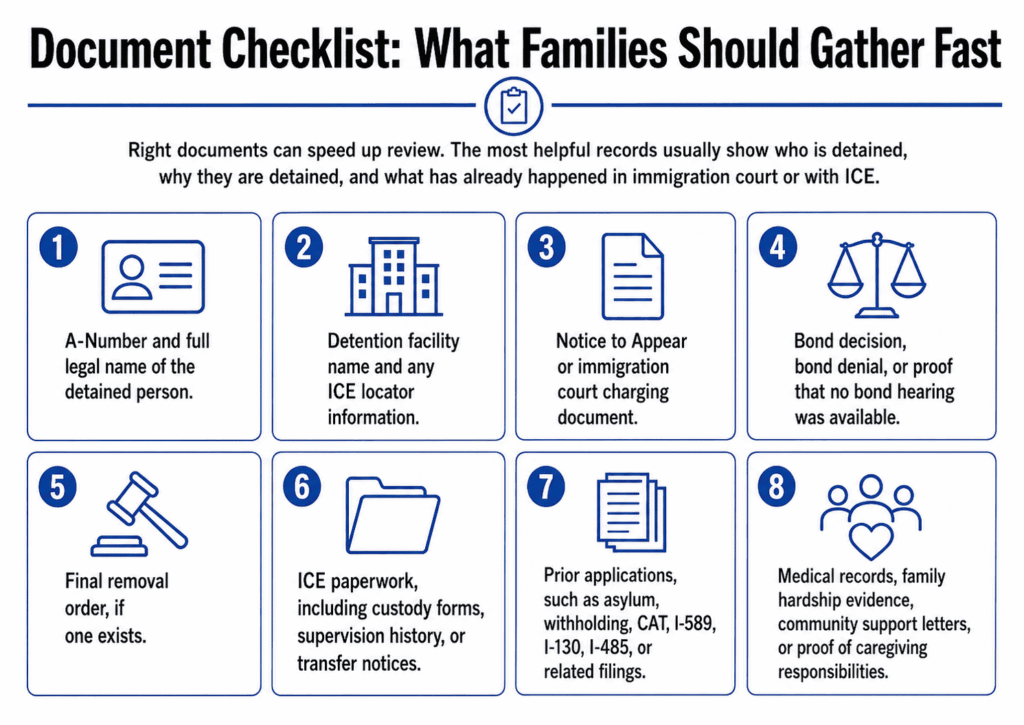
- A-Number and full legal name of the detained person.
- Detention facility name and any ICE locator information.
- Notice to Appear or immigration court charging document.
- Bond decision, bond denial, or proof that no bond hearing was available.
- Final removal order, if one exists.
- ICE paperwork, including custody forms, supervision history, or transfer notices.
- Prior applications, such as asylum, withholding, CAT, I-589, I-130, I-485, or related filings.
- Medical records, family hardship evidence, community support letters, or proof of caregiving responsibilities.
If you are unsure how to organize these materials, this guide on how to file a habeas petition for ICE detention can help you understand which records usually matter. The legal team can then decide whether the case is ready to file or needs more documentation first.
Cost vs. the Cost of Waiting in Detention
For many families, the hardest part is deciding whether to invest in federal litigation while already under financial stress. But the cost of waiting can include lost income, family separation, missed medical care, increased removal risk, and emotional harm that grows with each week in custody.
This does not mean every detained person should file habeas. It means the decision should be based on a focused legal review of detention length, constitutional concerns, custody history, government justification, and realistic possible outcomes.
The real question is not only “How much does habeas corpus cost?” It is also “What is continued detention costing this family?”
Some families may need a habeas petition because immigration court cannot provide a meaningful remedy. Others may need bond strategy, transfer prevention, or another detention-focused solution listed under My Habeas Lawyer’s ICE detention practice areas.
Frequently Asked Questions
How much does it cost to file a habeas corpus petition?
The federal court filing fee is $5 under 28 U.S.C. § 1914(a). The $55 administrative fee charged in other civil cases does not apply to habeas, so $5 is the entire court fee to file. Attorney fees are separate; ours start at around $5,000 as a flat fee agreed in writing.
Is the $5 filing fee really all the court charges?
To file, yes. A court fee arises later only if the case is appealed: a notice of appeal costs $605, paid by the party that appeals and waivable for a person who cannot pay. The real cost of a habeas case is attorney work, not court fees.
Can the habeas filing fee be waived?
Yes. A person who cannot pay can ask to proceed in forma pauperis under 28 U.S.C. § 1915 by filing a financial application with the petition. A federal court may also appoint a lawyer for a financially eligible petitioner when the interests of justice require it, and some districts have started doing so for immigration detainees in 2026.
How much does a habeas corpus lawyer cost?
Our attorney fee for a habeas petition starts at around $5,000, quoted as a flat fee in writing before work begins. Emergency filings and contested litigation are quoted case by case because they require more work in less time. With any firm, ask for a written quote that lists exactly what is included.
Does the attorney fee include the immigration bond?
No. If the court orders a bond hearing and the immigration judge sets bond, that amount is paid to the government and is separate from both the filing fee and the attorney fee. A cash bond is generally returned when the case ends if every condition was met.
How long does the government have to respond?
Under 28 U.S.C. § 2243 the return is due within three days, extendable to twenty for good cause, with a hearing set no more than five days after the return unless the court allows more time. In practice many district courts set longer schedules by local order, so the statutory clock is a starting point to argue from rather than a guarantee.
If we win, can we recover the attorney fee from the government?
Possibly, depending on the circuit. The Second, Third and Tenth Circuits allow fee requests under the Equal Access to Justice Act in immigration habeas cases; the Fourth and Fifth Circuits do not. The Supreme Court agreed on June 29, 2026 to decide the question in Montoya Palacios v. Liggins. Fee awards are discretionary, are decided after the case ends, and no firm can promise them.
How fast can a habeas petition be filed?
In urgent cases, filing may need to happen quickly after a focused review. The speed depends on document availability, legal readiness, detention location, and whether emergency relief is needed. In one of our New Jersey cases the petition was filed within two to three days of the client being taken into ICE custody.
Does filing habeas guarantee release?
No. A habeas petition can be powerful, but it does not guarantee release. Outcomes depend on the legal record, the judge, the government’s response, and the specific basis for detention.
Is habeas different from a bond hearing?
Yes. A bond hearing is usually inside immigration court, while habeas is filed in federal court. A habeas corpus petition challenges the legality of detention through independent federal review.
Do we need every document before filing?
Not always. Families should contact counsel quickly, but missing documents can affect strategy. The most important early items are usually the A-Number, detention location, court history, and ICE custody records.
A Clear Review Can Reduce Uncertainty
When a loved one is detained by ICE, families need more than vague answers. A useful habeas review should explain how fast the case can move, what it may cost, what documents are needed, and what outcomes are realistically possible.
The best next step is to get a focused review before more time passes in detention. That review can determine whether habeas, bond strategy, emergency transfer prevention, or another legal path is the strongest option.
Need a timeline and cost estimate for your loved one’s case?
Is a loved one in ICE detention? Time is critical. A habeas corpus petition can be a powerful tool to challenge unlawful detention. Reach out now for a free case review.
Phone: (+1) 862-799-2200
Email: info@gozellaw.com
Legal Disclaimer
This article is provided for general informational purposes only and does not constitute legal advice. Every immigration case has unique circumstances. For legal guidance specific to your situation, we recommend consulting with an experienced immigration attorney. The information in this article reflects laws and policies as of the publication date; subsequent changes may affect its accuracy.
Prior results do not guarantee a similar outcome. Case results described on this page are specific to the facts of those matters. Fee figures are indicative starting points, not quotes; every engagement is priced individually and confirmed in writing.
Sources
- 28 U.S.C. § 1914 — District Court; Filing and Miscellaneous Fees, Cornell Legal Information Institute.
- District Court Miscellaneous Fee Schedule, Administrative Office of the U.S. Courts, effective December 1, 2023.
- 28 U.S.C. § 1915 — Proceedings in Forma Pauperis, Cornell Legal Information Institute.
- 28 U.S.C. § 2241 — Power to Grant Writ, Cornell Legal Information Institute.
- 28 U.S.C. § 2243 — Issuance of Writ; Return; Hearing; Decision, Cornell Legal Information Institute.
- 18 U.S.C. § 3006A — Adequate Representation of Defendants, Cornell Legal Information Institute.
- 28 U.S.C. § 2412 — Equal Access to Justice Act, Cornell Legal Information Institute.
- Michelin v. Warden, Moshannon Valley Correctional Center, No. 24-2990, U.S. Court of Appeals for the Third Circuit, February 2, 2026.
- Montoya Palacios v. Liggins, No. 25-1223, Question Presented, Supreme Court of the United States, certiorari granted June 29, 2026.
- Attorney’s Fees — A Hidden Cost of Trump’s Mass Immigrant Detention Agenda, Courthouse News Service, August 6, 2026.
Every day in detention is a day away from your family.
If the immigration system has failed you, federal court may be the only answer. Let us review your case for free.
Get a Free Case Evaluation