There is no single document packet that automatically establishes an ICE habeas claim in Texas. The evidence must match the legal authority for detention, the person’s procedural history, the custody review already provided, and the specific relief requested from the federal court. For information about Texas detention facilities, federal districts, transfers, and representation, review our page on Texas ICE detention representation.
A person detained under 8 U.S.C. § 1225(b), discretionary detention under § 1226(a), mandatory detention under § 1226(c), or post-order detention under § 1231 may need different records. Evidence that is central to one type of habeas petition may have limited relevance to another.
This guide explains what families and counsel should collect for a Texas ICE habeas petition, including custody records, immigration court documents, detention timelines, compliance evidence, criminal dispositions, medical records, declarations, removal-related correspondence, and a practical release plan.
In This Article
- Why Evidence Matters in a Texas ICE Habeas Case
- Identify the Legal Authority for Detention
- Texas ICE Habeas Evidence Map
- Build a Verified Detention Timeline
- Collect Custody, Court, and Agency Records
- Preserve Bond and Custody-Review Evidence
- Address Danger, Flight Risk, and Prior Compliance
- Prepare a Detailed Release Plan
- Organize Medical and Mental Health Evidence
- Evidence for Post-Removal-Order Detention
- Confirm the Facility, Custodian, and Transfer History
- Use Declarations to Complete the Record
- Common Evidence Mistakes
- Texas ICE Habeas Evidence Checklist
- Frequently Asked Questions
Why Evidence Matters in a Texas ICE Habeas Case
A habeas lawyer evaluating detention in Texas must connect the facts to a federal constitutional or statutory custody claim. A petition under 28 U.S.C. § 2241 is not simply a request for sympathy or faster immigration processing. It asks a federal court to determine whether the government may lawfully continue holding a particular person under the circumstances presented.
Evidence in an immigration habeas case commonly serves four related purposes:
- Establishing the statute or legal authority under which ICE is holding the person;
- Reconstructing the complete procedural and detention history;
- Showing what custody review occurred and whether it remains meaningful under current circumstances;
- Demonstrating why a bond hearing, new custody review, release under conditions, or another specific remedy may be appropriate.
A habeas petition generally does not ask the district court to grant asylum, cancel a removal order, approve adjustment of status, or replace the immigration judge’s decision on the merits. The evidentiary record should remain focused on custody, the process provided, and the federal violation alleged. For foundational context, review our guide to federal habeas review under 28 U.S.C. § 2241.
The strongest evidence answers a legal question. It identifies why the person is detained, what review has already occurred, why the problem remains unresolved, and what relief the federal court can lawfully provide.
A current Fifth Circuit caution
Texas federal courts fall within the Fifth Circuit. As of July 27, 2026, the consolidated immigration detention cases in Sosnava Rodriguez v. Ortega remain pending for en banc review. A prior panel opinion concerning individualized review after 90 days was vacated when rehearing en banc was granted and does not currently operate as binding precedent.
Families should therefore not assume that detention for a particular number of days automatically creates a bond hearing or release right. The record must support the legal theory available under the person’s actual detention statute, procedural posture, district, and individual circumstances.
Identify the Legal Authority for Detention
The first evidentiary question is not how many support letters the family can collect. It is which statute currently authorizes detention. The answer affects whether ordinary immigration court bond review may be available, whether ICE claims detention is mandatory, whether removal foreseeability matters, and what form of federal relief may be requested.
Potentially relevant detention authorities include:
- 8 U.S.C. § 1225(b): custody involving certain applicants for admission or other individuals treated under the inspection framework;
- 8 U.S.C. § 1226(a): discretionary detention while removal proceedings remain pending;
- 8 U.S.C. § 1226(c): mandatory detention asserted for specified criminal or related categories;
- 8 U.S.C. § 1231: detention after a final or reinstated removal order.
Documents that may help identify the detention authority include the Notice to Appear, Form I-286 or another ICE custody determination, parole documents, criminal records relied upon by DHS, immigration judge bond orders, reinstatement documents, Board of Immigration Appeals decisions, and the final removal order.
The statute in effect at the beginning of detention may not remain controlling throughout the case. A final administrative order, judicial stay, reopened proceeding, reinstatement decision, or other procedural event may alter the government’s asserted custody authority. Counsel should verify the current basis rather than relying solely on an old form or verbal explanation from an officer.
Our resource on mandatory detention habeas petitions explains why classification evidence and prolonged-detention evidence involve related but distinct questions.
Texas ICE Habeas Evidence Map
The following table provides a practical starting point. Not every category belongs in every petition, and the relevance of a document depends on the legal claim it supports.
| Evidence Category | Examples | What the Evidence May Establish |
|---|---|---|
| Custody authority | Notice to Appear, Form I-286, parole records, reinstatement documents, final order, ICE classification notices | Which statute or custody framework ICE relies upon |
| Detention chronology | Booking records, transfer notices, facility records, court notices, appeal receipts, continuance orders | How long custody has lasted and why the case remains unresolved |
| Bond and custody review | Bond request, immigration judge order, hearing notes, BIA appeal, parole request, post-order custody review | What process occurred, which evidence was considered, and whether the findings remain current |
| Danger and flight risk | Certified criminal dispositions, court attendance, ICE reporting history, employment, rehabilitation, family and residence records | Whether continued detention is necessary and whether conditions can address identified risks |
| Medical or humanitarian circumstances | Diagnoses, medication lists, treatment requests, specialist letters, family-caregiving records | Current harm, urgency, changed circumstances, and the feasibility of outside treatment |
| Removal foreseeability | Travel-document requests, embassy communications, failed removal attempts, proof of cooperation | Whether removal is significantly likely in the reasonably foreseeable future |
| Release plan | Verified address, sponsor declaration, transportation, financial support, reporting and medical-care plan | Whether release can be structured through practical and enforceable conditions |
Do you have custody documents but do not know which records matter for federal court?
Our federal litigation team can review the detention authority, court history, prior bond record, transfer history, and proposed release evidence to determine whether a Texas ICE habeas petition fits the current procedural posture.
Build a Verified Detention Timeline
A complete and accurate chronology is often more useful than a large collection of unorganized exhibits. The timeline should allow counsel and the federal court to reconstruct the custody history without guessing when an event occurred or who caused a material delay.
The chronology should identify, where applicable:
- The date, place, and circumstances of the ICE arrest or re-detention;
- The first facility where the person was booked;
- Every transfer between facilities, counties, districts, or states;
- Requests for bond, parole, release, or custody review;
- Bond hearing dates and decisions;
- Master calendar and individual hearing dates;
- Immigration judge, BIA, or federal appellate decisions;
- Continuances, remands, stays, motions, and appeals;
- Post-order custody reviews and travel-document efforts;
- The current procedural stage and next scheduled event.
A useful chronology separates elapsed time from responsibility for delay
Do not list every month of detention as legally identical. A period spent awaiting a scheduled merits hearing may present a different issue from a period caused by an agency error, an unexplained failure to issue a decision, repeated remands, unavailable travel documents, or a government-requested continuance.
Likewise, a detained person’s good-faith use of an appeal or application for relief should not automatically be described as improper delay. The timeline should state what happened, which party took the action, why the step was legally available, and how it affected continued custody.
| Date | Agency or Court | Event | Supporting Record | Source of Delay | Effect on Custody |
|---|---|---|---|---|---|
| March 4, 2026 | ICE | Taken into custody at a scheduled check-in | ICE paperwork and family declaration | Not applicable | Continuous detention began |
| March 18, 2026 | Immigration Court | Bond hearing requested | Written request and filing confirmation | No hearing date issued | No individualized review completed |
| April 9, 2026 | ICE | Transferred to a Texas facility | Locator record and facility confirmation | Government transfer | Counsel and medical access disrupted |
For cases centered on length and procedural history, review our overview of challenging prolonged ICE detention.
Collect Custody, Court, and Agency Records
Official records provide the framework around which declarations and family evidence can be organized. The family may not possess every document, but it should identify what exists, where it came from, and which records remain missing.
ICE and DHS records
- Form I-286 or another custody determination;
- ICE arrest, processing, or booking paperwork;
- Detainer or transfer documentation;
- Parole applications and written decisions;
- Order of Supervision documents;
- Post-Order Custody Review notices and decisions;
- Travel-document questionnaires and requests;
- Correspondence with the assigned deportation officer or ERO office.
Immigration court and BIA records
- Notice to Appear and charging amendments;
- Hearing notices and scheduling orders;
- Written or oral immigration judge decisions;
- Bond orders and bond appeal records;
- BIA briefing schedules, receipts, remand orders, and decisions;
- Applications for asylum, withholding, CAT protection, cancellation, or other relief;
- Motions to reopen or reconsider and any stay decisions.
USCIS and federal court records
- USCIS receipt, approval, denial, or interview notices relevant to the detention posture;
- Federal petition-for-review filings and stay orders;
- Prior habeas filings, orders, or settlement documents;
- Any federal decision changing the procedural posture of the removal case.
The goal is not to attach every immigration filing ever submitted. Each exhibit should help establish custody authority, procedural history, prior review, changed circumstances, present risk, removal feasibility, or the remedy requested.
Preserve Bond and Custody-Review Evidence
A federal habeas petition should accurately describe what custody review has already occurred. The record must distinguish between an initial ICE custody decision, an immigration judge bond hearing, a BIA bond appeal, parole review, a Joseph-type classification challenge, and post-order administrative review.
The Department of Justice explains that bond proceedings are separate from the underlying removal proceedings. Evidence filed in the merits case is not automatically part of the bond record, and evidence submitted in bond proceedings may need to be filed again in the removal case. EOIR also states that bond hearings are generally not recorded.
Because the record may be limited, families and counsel should preserve:
- The written bond request and all exhibits;
- The date, court, judge, and method of appearance;
- Detailed attorney notes from the hearing;
- The government’s stated basis for detention or requested bond amount;
- Any oral findings made by the immigration judge;
- The written bond order or custody memorandum;
- The notice of appeal, briefing, and BIA decision;
- Evidence of any material change after the prior custody decision.
A prior bond denial does not automatically establish that continued detention is lawful forever. At the same time, a district court ordinarily does not function as a routine appellate bond court that simply reweighs the same evidence. The habeas petition must identify a federal legal or constitutional defect, outdated review, classification problem, prolonged-detention issue, or other basis for independent federal relief.
Our comparison of habeas corpus and immigration court bond hearings explains why the two proceedings involve different courts, powers, and legal questions.
Address Danger, Flight Risk, and Prior Compliance
Even when the habeas claim concerns prolonged detention or the absence of meaningful review, the government may argue that continued custody remains necessary because of danger, flight risk, national security, or noncompliance. A strong record addresses those concerns directly rather than ignoring unfavorable facts.
Evidence of prior compliance
- ICE check-in records;
- Compliance with an Order of Supervision;
- Attendance at immigration court hearings;
- Timely address-change filings;
- Compliance with electronic monitoring or reporting requirements;
- Prior compliance with parole or bond conditions;
- Passport surrender or cooperation with document requests;
- Attendance at criminal court, probation, or treatment appointments.
For a person who lived in the community for years before being re-detained, a documented history of appearing for proceedings and reporting to ICE may be more persuasive than a general promise that the person will comply in the future.
Criminal-history evidence
Do not rely only on an FBI summary, an arrest entry, or the person’s memory. Obtain certified dispositions where possible and distinguish carefully among an arrest, charge, dismissal, deferred adjudication, conviction, sentence, probation completion, and expungement or other later relief.
- Certified judgment and disposition records;
- Charging documents and plea records where relevant;
- Proof that probation, treatment, or community service was completed;
- Rehabilitation and counseling records;
- Evidence explaining the age and circumstances of the conduct;
- Employment, education, licensing, or service completed afterward.
Unfavorable facts should be addressed accurately. Concealing or minimizing a criminal record can damage credibility and prevent counsel from explaining why an old event does not establish current danger.
Community and family ties
- Marriage and birth certificates;
- Evidence of U.S. citizen or lawful permanent resident relatives;
- Lease, mortgage, or long-term residence records;
- Tax returns and employment history;
- Professional licenses, school enrollment, or community involvement;
- Evidence that the person supports children, parents, or another dependent;
- A pending immigration application or other reason to continue appearing.
Family ties are important, but they should not substitute for a release plan. Ties explain why a person is connected to the community. A release plan explains how compliance will work after release.
Prepare a Detailed Release Plan
A release plan converts general assurances into concrete arrangements. It should show the proposed residence, financial support, transportation, reporting structure, treatment plan, and responsible people available to assist the detainee.
A complete plan should answer:
- Where will the person live immediately after release?
- Who owns or rents the residence?
- Who else lives there?
- How will food, clothing, medication, and other expenses be paid?
- How will the person travel to ICE check-ins and court hearings?
- Who will monitor upcoming deadlines and appointments?
- What medical or mental health care has been arranged?
- How will the person comply with GPS, telephone reporting, curfew, or other conditions?
- Is a responsible third-party custodian available if requested?
Documents supporting the proposed residence
- Lease, deed, or mortgage statement;
- Recent utility bill;
- Government identification showing the host’s address;
- Signed declaration from the host;
- Explanation of the sleeping arrangement and length of stay;
- Confirmation that the residence permits the proposed occupant.
What a sponsor declaration should explain
- The sponsor’s relationship to the detained person;
- How long the sponsor has known the person;
- The sponsor’s address and lawful ability to provide housing;
- The financial and transportation support offered;
- How the sponsor will help ensure reporting and court attendance;
- Whether the sponsor understands the proposed conditions of release;
- The source of the sponsor’s personal knowledge.
A habeas release sponsor is not necessarily serving the same legal function as a financial sponsor under Form I-864. The declaration should focus on housing, supervision, financial stability, transportation, and compliance rather than using unrelated immigration-benefit terminology.
“He can stay with family” is not a complete release plan. Identify the address, host, financial support, transportation, reporting arrangements, treatment providers, and conditions the person can follow.
Organize Medical and Mental Health Evidence
Medical evidence may support urgency, changed circumstances, current harm, the inadequacy of prior custody review, or the feasibility of treatment outside detention. However, a detention challenge and a lawsuit focused only on conditions of confinement are not automatically the same legal claim.
Useful records may include:
- Medical diagnoses and treatment history;
- Current medication list and prescription records;
- Specialist reports and recommended follow-up care;
- Hospital discharge instructions;
- Facility medical-request forms or tablet requests;
- Grievances concerning missed medication or delayed treatment;
- Mental health evaluations and treatment records;
- Evidence of physical or psychological deterioration during custody;
- Letters from treating physicians or other qualified providers;
- A confirmed outside treatment and payment plan.
Connect the diagnosis to the detention question
A medical record is most useful when the petition explains its legal relevance. For example, the evidence may show that circumstances materially changed after the last custody review, that continued detention is causing documented deterioration, that the person cannot meaningfully participate in proceedings, or that release conditions can address health needs more effectively.
Whenever possible, pair evidence of inadequate continuity of care with a specific outside plan identifying a doctor, clinic, appointment, medication source, insurance coverage, family caregiver, or method of payment.
Evidence for Post-Removal-Order Detention
A different evidentiary record is required when the person has a final or reinstated removal order and detention is governed by 8 U.S.C. § 1231. The central issue may become whether there is a significant likelihood of removal in the reasonably foreseeable future.
The Supreme Court’s decision in Zadvydas v. Davis does not create automatic release on day 181. After the presumptively reasonable period discussed in that decision, the detained person must provide good reason to believe that removal is not significantly likely in the reasonably foreseeable future. The government then has an opportunity to respond.
Potential evidence includes:
- The immigration judge and BIA decisions establishing when the order became final;
- Any judicial or administrative stay of removal;
- ICE travel-document requests;
- Embassy or consular correspondence;
- Passport applications or identity-document submissions;
- Evidence that the receiving country refused, delayed, or failed to issue documents;
- Prior failed removal attempts;
- ICE statements describing a practical barrier or projected removal date;
- Post-Order Custody Review notices and decisions;
- Proof that the detained person cooperated with identification and removal efforts.
Document cooperation carefully
The government may argue that the removal period was extended or that release is inappropriate because the person failed or refused to cooperate. Preserve copies of forms signed, identity information provided, interviews attended, photographs or fingerprints submitted, consular appointments completed, and written requests for clarification.
If the person could not provide a requested item, explain why. Distinguish an inability to obtain a document from an intentional refusal to assist. Our guide to habeas after a final removal order addresses the Zadvydas framework in greater detail.
Confirm the Facility, Custodian, and Transfer History
Before filing, verify where the person is physically confined. The immigration court location, family residence, attorney’s office, and place of arrest do not necessarily identify the proper federal district for a physical-custody habeas petition.
Collect and confirm:
- The current facility’s full name and address;
- The date the person arrived there;
- The ICE Online Detainee Locator result;
- Facility booking or identification information;
- The name or official title of the person in charge of the facility;
- The responsible ICE field office;
- Every prior facility and transfer date;
- Any evidence of an imminent additional transfer.
A transfer between two Texas facilities may move the person into a different federal judicial district. A transfer outside Texas may also change the circuit law relevant to the case. The jurisdictional consequences are fact-specific, especially when a transfer occurs shortly before or after filing.
Preserve screenshots of the locator, facility confirmations, telephone records, written notices, transportation records, and declarations describing when the family or counsel learned about the move. Our ICE transfer checklist for families explains how to document a transfer before critical information is lost.
Use Declarations to Complete the Record
Official records rarely explain every fact. A declaration can establish events that were not recorded, describe the source of family support, document compliance, explain a medical or caregiving need, and authenticate a proposed release arrangement.
Potential declarants include:
- The detained person;
- A spouse, parent, adult child, sibling, or other relative;
- The proposed housing or financial sponsor;
- An employer or prospective employer;
- A medical or mental health provider;
- A religious or community leader;
- A person who transported the detainee to prior hearings or ICE appointments;
- Prior counsel with personal knowledge of a hearing, delay, or agency communication.
Characteristics of a useful declaration
- Identifies the declarant and relationship to the detained person;
- Explains how the declarant knows each material fact;
- Uses dates, locations, and specific events;
- Separates personal knowledge from information learned from someone else;
- Avoids exaggerated legal conclusions;
- Does not contradict official records without an explanation;
- States the concrete support or responsibility the declarant accepts;
- Is signed under penalty of perjury in a legally appropriate form.
A generic letter saying that the person is honest, kind, or a good parent carries less evidentiary value than a declaration describing years of ICE compliance, a verified residence, transportation to future hearings, financial support, caregiving responsibilities, or specific rehabilitation.
Common Evidence Mistakes
Even a large collection of documents can fail to create a useful habeas record if the exhibits are incomplete, inconsistent, or disconnected from the claim.
| Common Mistake | Why It Creates a Problem | Better Approach |
|---|---|---|
| Submitting only family photographs | Photographs may show relationships but do not establish custody authority, prior review, or the source of delay. | Pair family evidence with official records, declarations, and a verified release plan. |
| Using an unverified detention start date | A legal claim based on duration requires an accurate continuous-custody date. | Confirm the date through booking, ICE, facility, court, or transfer records. |
| Ignoring transfers | A transfer may affect jurisdiction, the respondent, access to counsel, and the applicable precedent. | Record every facility, transfer date, and method of confirmation. |
| Hiding criminal history | Incomplete disclosure damages credibility and prevents a meaningful current-risk analysis. | Obtain certified dispositions and explain rehabilitation and changed circumstances. |
| Using generic support letters | Conclusions without facts provide little help in evaluating risk or release conditions. | Use detailed declarations based on personal knowledge. |
| Providing no verified release address | The court cannot evaluate whether release can be structured safely and practically. | Submit housing records, identification, and a host declaration. |
| Assuming six months or 90 days guarantees relief | Different statutes and procedural postures require different legal showings. | Connect duration to the governing law, review provided, and case-specific facts. |
| Attaching documents without explaining relevance | A large exhibit file can obscure rather than prove the claim. | Organize documents by category and state what each exhibit establishes. |
| Using old facility information | The detainee may have moved to another district before filing. | Confirm current custody immediately before the petition is filed. |
| Treating habeas as an appeal of the removal order | District court habeas review generally focuses on custody, not the merits of the final removal decision. | Identify the specific detention violation and custody remedy requested. |
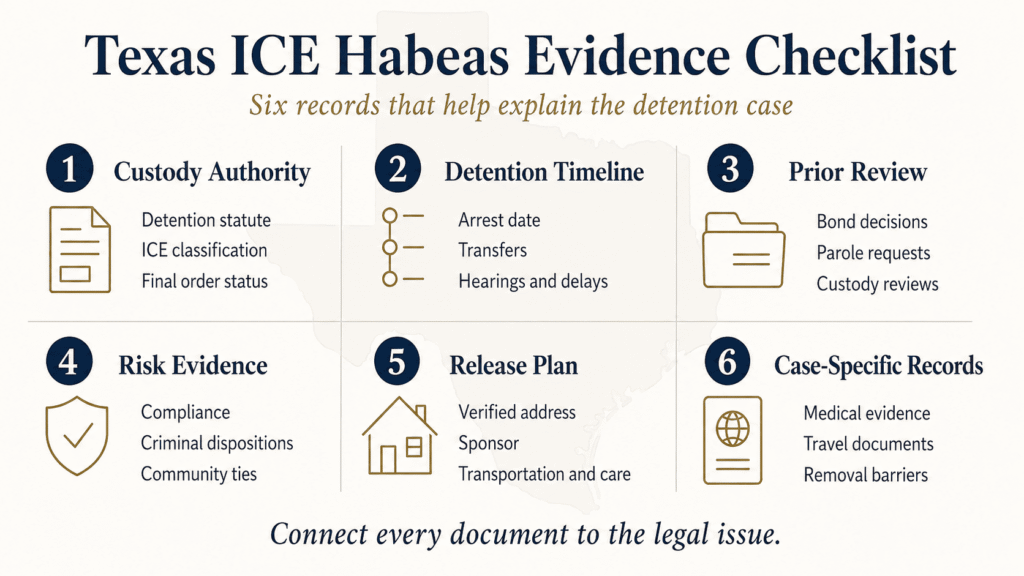
Texas ICE Habeas Evidence Checklist
Before a Texas detention petition is prepared, counsel should be able to answer the following questions and identify the documents supporting each answer.
- Where is the person physically detained today? Confirm the current facility and whether another transfer is expected.
- Which statute currently authorizes detention? Determine whether ICE relies on § 1225, § 1226(a), § 1226(c), § 1231, or another provision.
- When did continuous ICE custody begin? Support the date with official or otherwise reliable records.
- Has the detention authority changed? Review final orders, reinstatement decisions, stays, reopening, and other procedural developments.
- What custody review has occurred? Obtain ICE decisions, bond records, BIA appeals, parole decisions, and post-order reviews.
- Why does the immigration case remain unresolved? Identify each material period of delay and the party or event responsible.
- What has changed since the last review? Document new medical facts, rehabilitation, family circumstances, legal developments, or removal barriers.
- What evidence addresses danger? Obtain certified criminal dispositions, rehabilitation, employment, treatment, and current-risk evidence.
- What evidence addresses flight risk? Document hearing attendance, ICE reporting, residence, family ties, pending relief, and past compliance.
- Is there a complete release plan? Confirm housing, sponsorship, transportation, financial support, reporting, and medical care.
- If there is a final order, is removal foreseeable? Collect travel-document records, consular correspondence, custody reviews, failed attempts, and cooperation evidence.
- What exact relief is requested? Match the evidence to release, a bond hearing, a new custody review, corrected classification, or another legally available remedy.
A Texas ICE habeas petition should read as a documented custody challenge, not a collection of hardship records. Every exhibit should help establish the legal authority, detention history, prior process, current risk analysis, removal feasibility, or requested remedy.
Frequently Asked Questions
What are the most important documents for a Texas ICE habeas petition?
There is rarely one controlling document. A useful starting packet includes the custody determination, Notice to Appear, immigration court and BIA decisions, bond or custody-review records, a verified detention timeline, current facility information, risk-related evidence, and a practical release plan.
Can family members collect evidence for the habeas case?
Yes. Family members can collect housing records, relationship documents, tax and employment records, medical history, prior ICE reporting evidence, transportation arrangements, sponsor declarations, and communications concerning transfers or removal efforts. Counsel should review the materials for relevance and consistency before filing.
Are family support letters enough to obtain release?
No. Detailed declarations may help establish residence, support, compliance, rehabilitation, and release conditions, but they do not replace official custody records, procedural documents, criminal dispositions, or case-specific legal evidence.
Does detention for six months automatically prove a habeas claim in Texas?
No. Six months has particular significance in the post-order framework discussed in Zadvydas, but it is not a universal release deadline. The detention statute, procedural posture, prior custody review, source of delay, and requested remedy all affect the analysis.
Does Texas currently have an automatic bond hearing after 90 days?
No binding Fifth Circuit rule currently guarantees a bond hearing solely because 90 days have passed. The July 2, 2026 panel opinion addressing certain § 1225(b)(2)(A) detainees was vacated when the Fifth Circuit granted rehearing en banc. The individual record remains critical while that litigation continues.
Can medical records support a habeas petition?
Potentially. Medical evidence may demonstrate urgency, changed circumstances, harm from continued detention, or the inadequacy of an earlier custody review. Its value is stronger when accompanied by a specific outside treatment plan and an explanation connecting the medical facts to the detention claim.
Does a criminal record prevent federal habeas review?
Not automatically. The effect of a criminal record depends on the detention statute, the nature and disposition of the conduct, the passage of time, rehabilitation, current circumstances, and the legal theory presented. Certified records and accurate disclosure are essential.
What if ICE transfers the detainee while evidence is being collected?
Confirm the new location immediately. A transfer may change the appropriate federal district, immediate custodian, facility records, access to counsel, and applicable circuit law. Preserve evidence of when the transfer occurred and when the family or attorney learned about it.
Are original documents required?
Readable copies are commonly used for initial review and many filings, but the source and authenticity of the documents must be identifiable. Certified copies may be especially important for criminal dispositions, court judgments, and disputed official records.
Can habeas challenge the underlying deportation order?
A federal district court habeas petition usually challenges the legality of custody rather than asking the court to cancel the removal order. A separate petition for review, motion to reopen, stay request, or other immigration procedure may be required to challenge removal itself.
What Makes a Texas ICE Habeas Evidence Packet Effective?
An effective evidence packet does not begin with the number of months detained or the number of support letters available. It begins with the legal authority for custody, the verified detention start date, the complete procedural history, the review already provided, and the specific defect that remains unresolved.
The supporting record should then address the issues relevant to that theory: current danger and flight risk, compliance history, medical changes, release conditions, responsibility for delay, transfer-related prejudice, or the practical likelihood of removal. Every document should help the federal court understand why continued detention is unlawful now and what relief follows from that violation.
Is a loved one being held by ICE in Texas without a meaningful path to release?
Send us the custody documents, detention timeline, immigration court history, prior bond or custody-review records, transfer information, and proposed release evidence. Our team can identify which detention framework applies and evaluate whether federal habeas review may be available.
Phone: (+1) 862-799-2200
Email: info@gozellaw.com
Legal Disclaimer: This article is provided for general informational purposes only and does not constitute legal advice. Immigration detention analysis is highly fact-specific and depends on the governing statute, procedural posture, detention location, available custody review, requested remedy, and current case law. The information reflects laws and publicly available developments as of July 27, 2026; pending Fifth Circuit en banc proceedings and later decisions may affect its accuracy. Prior results do not guarantee a similar outcome.
Sources
- 28 U.S.C. § 2241: Power to Grant Writ
- 8 U.S.C. § 1225: Inspection and Detention of Applicants for Admission
- 8 U.S.C. § 1226: Apprehension and Detention of Aliens
- 8 U.S.C. § 1231: Detention and Removal of Aliens Ordered Removed
- EOIR Policy Manual, Chapter 8.3: Bond Proceedings
- Rumsfeld v. Padilla, 542 U.S. 426 (2004)
- Zadvydas v. Davis, 533 U.S. 678 (2001)
- Jennings v. Rodriguez, 583 U.S. 281 (2018)
- Johnson v. Arteaga-Martinez, 596 U.S. 573 (2022)
- 8 C.F.R. Part 241: Apprehension and Detention of Aliens Ordered Removed
- Fifth Circuit Court Calendar: Sosnava Rodriguez v. Ortega, No. 26-50183
- Buenrostro-Mendez v. Blanche, Supreme Court Docket No. 26-43
Every day in detention is a day away from your family.
If the immigration system has failed you, federal court may be the only answer. Let us review your case for free.
Get a Free Case Evaluation