An ICE transfer does not necessarily eliminate the habeas option. It may, however, change the federal court where the petition should be filed, the official who should be named as respondent, and the steps counsel must take before requesting emergency relief.
The timing of the transfer is critical. If ICE moves the person before a habeas petition is filed, counsel may need to begin the jurisdiction analysis from the new detention facility. If the transfer occurs after a properly filed petition, the original court may retain jurisdiction under a different line of authority.
This guide explains how pre-filing and post-filing transfers can affect the district of confinement, the immediate custodian rule, an existing federal case, and the practical steps families should take after learning that ICE moved their loved one.
In This Article
- Why the Timing of an ICE Transfer Matters
- Where to File After a Pre-Filing Transfer
- The Immediate Custodian Rule
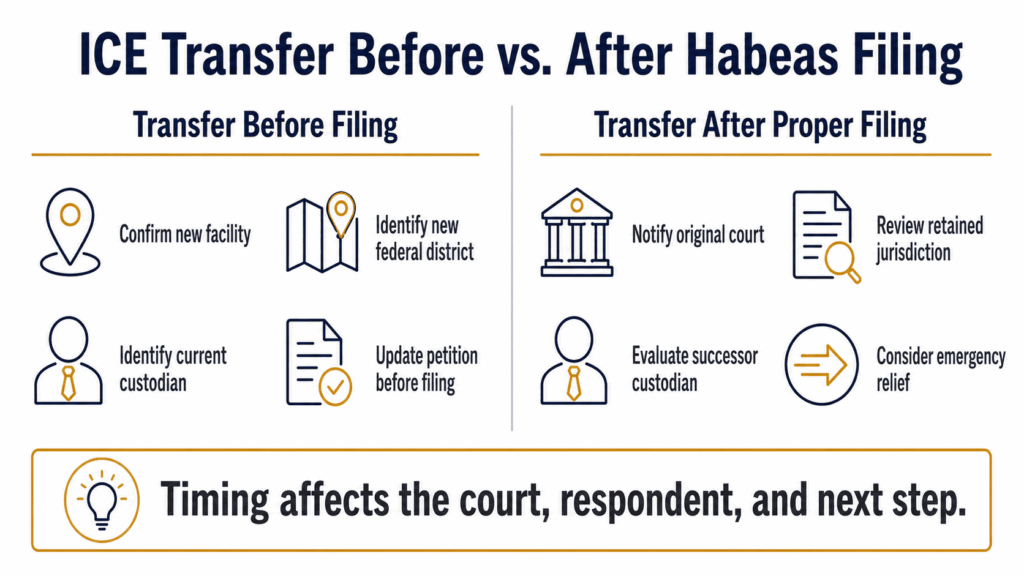
- ICE Transfer Before vs. After Habeas Filing
- What Happens When ICE Transfers the Person After Filing?
- Three Transfer Scenarios
- What to Verify Before Filing
- Common Filing Mistakes After a Transfer
- Can a Habeas Court Prevent Another Transfer?
- Frequently Asked Questions

Why the Timing of an ICE Transfer Matters
A habeas corpus petition challenging present physical detention is generally filed under 28 U.S.C. § 2241. The petition asks a federal district court to review whether the government is holding the person in violation of the Constitution, federal statutes, or other federal law.
Transfer timing matters because federal habeas jurisdiction is ordinarily evaluated when the petition is filed. Counsel must therefore establish where the person was confined at the relevant time, who exercised immediate custody, and whether the selected court had authority over the appropriate respondent.
Transfer Before the Petition Is Filed
When a person is moved before filing, the former detention location may no longer provide the correct jurisdictional starting point. The Supreme Court’s decision in Rumsfeld v. Padilla involved a petitioner who had been moved from New York to South Carolina before his attorney filed. The Court concluded that the former district never acquired jurisdiction over the petition.
Transfer After a Proper Filing
A transfer completed after a petition was properly filed presents a different question. Under the limited principle discussed in Padilla and Ex parte Endo, a post-filing transfer may not automatically deprive the original court of jurisdiction if the petition properly named the immediate custodian and an appropriate respondent remains within the court’s reach.
The central distinction is not simply “old facility versus new facility.” It is whether the transfer occurred before or after the federal court properly acquired jurisdiction.
Where to File After a Pre-Filing Transfer
When ICE completes a transfer before the petition is filed, counsel should ordinarily confirm the person’s current physical location and identify the federal judicial district containing that facility. The official AO 242 instructions direct § 2241 petitioners to the district and division in which they are confined.
The state alone is not enough. A single state may contain multiple federal judicial districts and divisions. Counsel should use the facility’s complete street address—not the ICE field office, immigration court, family residence, or place of arrest—to identify the potentially appropriate district.
Families should first verify the new facility through the ICE Online Detainee Locator System, attorney notifications, facility calls, and information received directly from the detained person. The locator may not update immediately, so conflicting records should be preserved rather than resolved through assumption.
Our ICE transfer checklist for families explains how to organize locator screenshots, facility information, transfer dates, legal documents, and urgent medical or attorney-access concerns.
The Immediate Custodian Rule in Immigration Habeas Cases
Sections 2242 and 2243 focus on the person who has custody of the detainee. For a core challenge to present physical confinement, Padilla describes the default respondent as the official with immediate control—commonly the warden or facility administrator—rather than a remote supervisory official.
In immigration detention, however, the analysis can be more complicated. Facilities may be operated by ICE, a county, or a private contractor, and the relevant custodian’s title can vary. A petition may also name additional DHS or ICE officials when supported by the applicable circuit’s precedent, the requested relief, and the structure of custody.
The Supreme Court expressly noted in Padilla that lower courts had divided over whether the Attorney General could be an appropriate respondent in habeas cases filed by noncitizens detained pending removal, and the Court declined to resolve that issue. Counsel must therefore examine current circuit and district precedent instead of treating one nationwide respondent list as universally correct.
For an overview of the federal statutory foundation, review our guide to 28 U.S.C. § 2241 in ICE detention cases.
ICE Transfer Before vs. After Habeas Filing
| Question | Transfer Before Filing | Transfer After Proper Filing |
|---|---|---|
| Detention location | New facility generally becomes the starting point | Original filing location and new facility must both be reviewed |
| Federal court | District containing the current facility may be required | Original court may retain jurisdiction under the limited Endo principle |
| Respondent | Current immediate custodian must be identified | Original respondent, successor custodian, and officials within the court’s reach may require review |
| Immediate action | Update the petition before filing | Notify the court and evaluate amendment, substitution, or emergency relief |
| Main risk | Filing in a district that never acquired jurisdiction | Assuming jurisdiction automatically continues in every case |
The table provides a general framework, not a universal result. The legal effect of a transfer may depend on the facility, timing, respondent, circuit precedent, service status, relief requested, and whether the original petition was jurisdictionally proper.
What Happens When ICE Transfers the Person After Filing?
In Ex parte Endo, the petitioner properly filed in the Northern District of California and was later moved to Utah. The Supreme Court held that the transfer did not eliminate the original court’s jurisdiction where an official responsible for her custody remained within the district and could comply with the court’s order.
Padilla later described Endo as an important but limited rule: when the government transfers a petitioner after a properly filed petition naming the immediate custodian, the original court may retain jurisdiction and direct relief to a respondent within its jurisdiction who has legal authority to effectuate release.
That principle does not mean every post-filing transfer is legally irrelevant. Counsel may still need to:
- File a notice informing the court of the transfer and new facility
- Determine whether the original custodian remains an appropriate respondent
- Evaluate substitution of the successor custodian under the applicable procedural rules
- Identify an official within the original district who can implement the requested relief
- Update allegations involving attorney access, medical care, removal risk, or detention conditions
- Request temporary protection if another transfer or removal appears imminent
If the initial court concludes that jurisdiction is missing, transfer to another federal court may be considered under provisions such as 28 U.S.C. § 1631 when its requirements and the interest-of-justice standard are satisfied. Transfer is not automatic, and dismissal remains a possible outcome.
Was your loved one transferred before or after a habeas petition was filed?
Our federal litigation team can review the transfer timeline, current facility, potential federal district, named respondents, existing docket, and urgency of any additional transfer or removal risk.
Three Transfer Scenarios and Their Filing Consequences
Scenario 1: Transfer Completed Before Filing
A family prepares to file in Texas, but ICE moves the person to a Louisiana facility the night before filing. Counsel should not rely on the former Texas location merely because the documents were already drafted. The new facility, its federal district, the current custodian, and controlling circuit law must be confirmed before submission.
Scenario 2: Transfer Discovered During Final Preparation
The locator changes while counsel is finalizing the petition, but the family does not know when the person physically arrived. The filing should generally pause long enough to establish the transfer timeline through locator screenshots, facility calls, attorney notices, transportation records, or direct communication with the detained person.
Scenario 3: Transfer Occurs After a Proper Filing
The petition is filed in the district of confinement against the appropriate custodian, and ICE later moves the person to another state. Counsel should promptly inform the original court and analyze whether jurisdiction continues under Endo, whether a successor respondent should be substituted, and whether additional emergency relief is necessary.
What to Verify Before Filing After an ICE Transfer
A reliable filing analysis requires more than the name of the new state. Families and counsel should assemble a precise custody record before selecting the court and respondents.
- Confirm the person’s identity. Record the full legal name, date of birth, country of birth, and A-Number.
- Identify the current facility. Obtain the complete facility name, physical address, telephone number, and ICE facility page.
- Preserve the transfer timeline. Save the last confirmation at the former facility, the first confirmation at the new facility, locator screenshots, and attorney notices.
- Map the federal district. Determine which judicial district and division contain the facility’s physical address.
- Identify the immediate custodian. Verify the warden, facility administrator, or other official with day-to-day control.
- Review circuit precedent. Determine whether additional ICE or DHS officials may or should be named.
- Check the docket. If a petition was already submitted, preserve the filing receipt, case number, assigned judge, and service records.
- Document the emergency. Record medical needs, interrupted attorney access, scheduled hearings, threatened removal, or evidence of another planned transfer.
Families starting from incomplete information can also use our guide on what to do when a loved one is detained by ICE. For a broader filing overview, see how a habeas petition for ICE detention is prepared and filed.
Common Filing Mistakes After an ICE Transfer
| Common Mistake | Why It Creates a Problem |
|---|---|
| Filing in the former district after a completed transfer | The former court may never acquire jurisdiction over the current custodian |
| Using only the state name | The state may contain multiple federal districts and divisions |
| Naming only high-level officials | The petition may omit the immediate custodian required by applicable precedent |
| Naming only the warden without checking local law | Some immigration habeas strategies may require or support additional respondents |
| Relying on one locator search | Transfer information may be delayed, incomplete, or inconsistent |
| Assuming any filing prevents transfer | A habeas petition does not automatically prohibit another transfer or removal |
| Failing to notify the court | The docket may contain an outdated address, custodian, and factual record |
A jurisdictional mistake can consume time while the person remains detained or is moved again. Although a court may consider transfer rather than dismissal in an appropriate case, families should not assume that an incorrectly filed petition will automatically be preserved.
Can a Habeas Court Prevent Another ICE Transfer?
Possibly, but a request to prevent a future transfer presents additional questions. Filing a habeas petition alone does not create an automatic stay of transfer. Counsel may need to request a temporary restraining order, preliminary injunction, or other protective relief and satisfy the governing legal standard.
The supporting evidence may address threatened transfer, disruption of attorney access, urgent medical needs, interference with judicial review, or the risk that another move will defeat effective relief. The court will also examine its authority to issue the requested order and whether the named respondents can comply.
For cases in which transfer has not yet occurred, review our separate guide to emergency options for trying to stop an ICE transfer to another state. That article focuses on transfer prevention; this guide focuses on rebuilding the filing analysis after a transfer has already happened.
Frequently Asked Questions
Can we file habeas in the state where the person was previously detained?
Not necessarily. If ICE completed the transfer before filing, the former district may not have jurisdiction over the current custodian. Counsel should identify the new facility, district of confinement, appropriate respondent, and controlling precedent before filing.
Who should be named as respondent after an ICE transfer?
The immediate custodian—often the current warden or facility administrator—is generally the starting point for a challenge to present physical confinement. Immigration habeas practice may also involve additional ICE or DHS officials depending on circuit law, local precedent, custody structure, and requested relief.
Does a transfer after filing automatically end the habeas case?
No. A properly filed petition may remain within the original court’s jurisdiction under the limited principle recognized in Endo and discussed in Padilla. The result depends on whether the initial filing was proper and whether an appropriate respondent remains within the court’s reach.
What if ICE transfers the person while the petition is being prepared?
Preparation is not the same as filing. If the transfer occurred before the petition was filed, counsel should update the facility, district, respondent, and transfer allegations before submitting the case.
Can the federal court transfer an incorrectly filed case?
Potentially. A court may consider transfer under § 1631 or another applicable provision when the statutory requirements are met and transfer serves the interest of justice. The court may also dismiss the case, so transfer should not be treated as guaranteed.
How quickly should an attorney review the new detention location?
As soon as possible. A second transfer, removal attempt, medical emergency, or interruption in attorney access can change the available strategy. Counsel should receive the A-Number, facility information, transfer timeline, custody documents, and any existing federal docket information immediately.
Does habeas challenge the removal order itself?
A detention habeas petition generally challenges custody rather than directly asking the district court to vacate a final removal order. Challenges to removal orders and challenges to detention follow different jurisdictional rules and must be analyzed separately.
The Transfer Changed the Filing Analysis, Not Necessarily the Habeas Option
An ICE transfer can disrupt family contact and legal preparation, but it does not necessarily eliminate federal habeas review. The critical task is to reconstruct the custody timeline and determine where the person was confined when the petition was—or will be—filed.
A careful review should identify the current facility, federal district, immediate custodian, relevant circuit precedent, existing docket, and risk of another transfer or removal. A qualified habeas lawyer can then evaluate whether to file in the new district, preserve an existing case, amend the respondents, request transfer of the action, or seek emergency protective relief.
Did ICE transfer your loved one before or after a habeas filing?
Send us the A-Number, former and current facility information, transfer notices, locator screenshots, existing petition, filing receipt, and any information about another planned transfer or removal. Our team can evaluate the appropriate court, respondent, and next filing step.
Phone: (+1) 862-799-2200
Email: info@gozellaw.com
Legal Disclaimer: This article is provided for general informational purposes only and does not constitute legal advice. Habeas jurisdiction, venue, respondent selection, transfer consequences, and available emergency relief depend on the facts and controlling law in each case. Consult an experienced attorney for advice regarding a specific detention. The information reflects laws, judicial decisions, and publicly available guidance as of August 5, 2026. Subsequent developments may affect its accuracy. Prior results do not guarantee a similar outcome.
Sources
- 28 U.S.C. § 2241 — Power to Grant Writs of Habeas Corpus
- 28 U.S.C. § 2242 — Application for a Writ of Habeas Corpus
- 28 U.S.C. § 2243 — Issuance of Writ; Return; Hearing; Decision
- 28 U.S.C. § 1631 — Transfer to Cure Want of Jurisdiction
- Rumsfeld v. Padilla, 542 U.S. 426 (2004)
- Ex parte Endo, 323 U.S. 283 (1944)
- U.S. Courts — AO 242 Petition Under 28 U.S.C. § 2241
- ICE Online Detainee Locator System
- ICE — Locating Individuals in Detention
- ICE Detention Management and Detention Standards
- National Immigration Litigation Alliance — Habeas Corpus Petitions Practice Advisory
Every day in detention is a day away from your family.
If the immigration system has failed you, federal court may be the only answer. Let us review your case for free.
Get a Free Case Evaluation