The immigration judge refused to hold a bond hearing. You have found a lawyer, gathered the custody paperwork, and decided that federal court is the next step. Then comes a question most families have never had to consider: what should the petition actually ask the judge to do?
A habeas corpus petition under 28 U.S.C. § 2241 does not come with one fixed remedy. It can ask a federal judge to order release. It can also ask for something narrower, an order requiring that a bond hearing be held under 8 U.S.C. § 1226(a). Two different requests, two different legal theories, and very different odds.
The narrower request is frequently the one courts grant. This guide explains why, what each request requires the petition to establish, and the detail that decides what a court-ordered hearing is actually worth: who carries the burden once it begins.
The Two Things a Habeas Petition Can Ask For
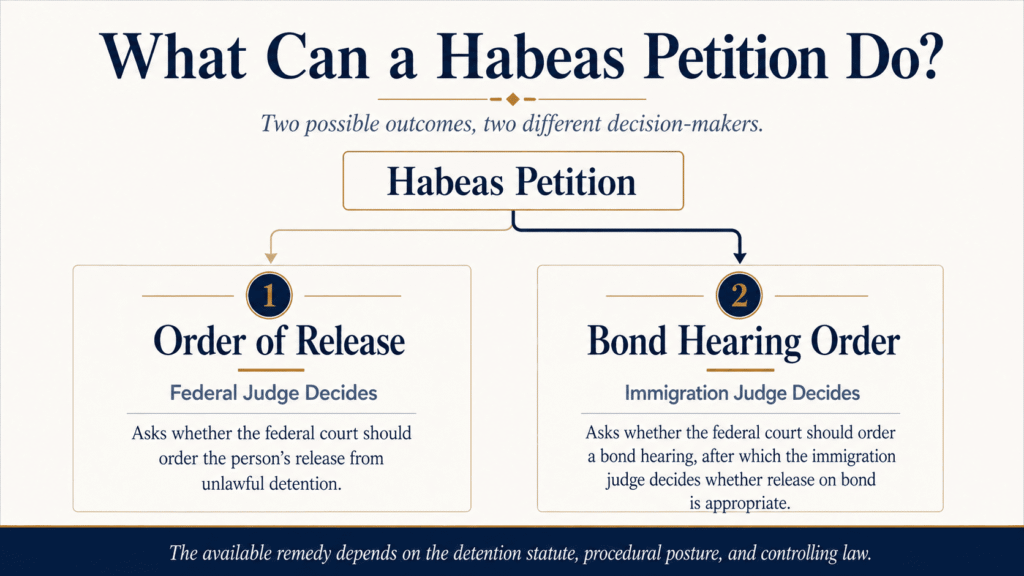
Under 28 U.S.C. § 2241, a federal district court can examine whether the government is holding someone lawfully. What the court does next depends on what the petition asked for and which legal defect it proved.
An order of release asks the court to find that no lawful basis supports continued custody, or that no lesser remedy will cure the constitutional problem. An order requiring a bond hearing asks for less: a finding that the government invoked the wrong framework, and an instruction returning the custody question to an immigration judge.
| Order of release | Order requiring a bond hearing | |
|---|---|---|
| What the court must find | No lawful authority supports continued custody | The wrong statute was applied, or the process was inadequate |
| Who decides release | The federal judge | The immigration judge, at the hearing that follows |
| What the family receives | Release, subject to any conditions the court sets | Access to a hearing that was previously refused |
| Typical footing | Constitutional, often after very prolonged custody | Statutory, constitutional, or both |
The two are not mutually exclusive, and petitions routinely plead alternative relief. The mechanics of preparing and filing are covered in our step-by-step guide to filing a habeas petition.
Why Asking for a Bond Hearing Is Often the Stronger Request
The narrower request asks the court to do something it is more comfortable doing. Federal habeas courts review the lawfulness of custody. They are far more reluctant to substitute their own judgment for the discretionary release decision Congress assigned to the immigration system.
That matters because § 1226(a) already contains a release mechanism. It authorizes detention pending a removal decision while permitting release on bond of at least $1,500 or conditional parole. If the petition establishes that § 1226(a) governs, the remedy is not something the court must invent. It is access to machinery Congress already built.
There is a doctrinal reason for caution with the broader ask. In Jennings v. Rodriguez (2018), the Supreme Court rejected the argument that the detention statutes imply a right to periodic bond hearings, deciding on statutory grounds and returning the constitutional questions to the lower courts. A petition resting only on a demand for release runs into that history.
The practical framing: a release request asks the federal judge to end the detention. A bond hearing request asks the federal judge to fix the process and let the immigration judge decide. Courts grant the second more readily.
What the Petition Must Establish
A request for a court-ordered bond hearing generally rests on one of two arguments. Experienced counsel plead both.
The statutory argument: which section governs custody
Since July 2025 the government has argued that anyone who entered without inspection remains an “applicant for admission” under 8 U.S.C. § 1225, and so falls under mandatory detention with no immigration court bond authority. The Board of Immigration Appeals made that reading precedent in Matter of Yajure Hurtado.
The statutory answer is that someone who has lived here for years and was arrested in the interior is not seeking admission in any ordinary sense, so § 1226(a) governs and the immigration judge does have authority. As of August 2026, seven federal appellate courts have rejected the government’s reading and two have accepted it. Our post on what § 1225(b)(2) means for your family sets out that dispute.
The due process argument when detention is already prolonged
The constitutional argument stands independently. Whichever statute applies, holding someone for months with no individualized custody review may violate the Fifth Amendment. This route survives where controlling precedent has closed the statutory one.
Its present shape is unsettled. On July 2, 2026 a Fifth Circuit panel held that detention under § 1225(b)(2)(A) is presumptively reasonable for 90 days and that due process requires a hearing beyond that point. Eight days later the full court vacated that opinion and granted rehearing en banc, with argument set for September 24, 2026. Our post on the Fifth Circuit changes in July 2026 traces that sequence.
Not sure which request fits your family member’s case?
The right relief depends on the detention statute, how long custody has lasted, and the circuit holding your loved one. Send us those three facts and we will tell you what a petition could realistically seek.
Who Carries the Burden at the Hearing You Win
This is the part families are rarely told, and it separates a hearing worth a great deal from one worth much less. Winning on the statutory theory delivers a hearing, not a release. What that hearing is worth depends on who must prove what once it starts.
At an ordinary custody redetermination under § 1226(a), the burden sits with the detained person. Under 8 C.F.R. § 1236.1(c)(8) and Matter of Guerra, that person must show that release would not endanger persons or property, that they are not a threat to national security, and that they are likely to appear. ICE carries no burden of proof.
A prolonged-detention hearing ordered on constitutional grounds can look very different. Many federal courts have held that once custody becomes unreasonably prolonged, due process requires the government to justify it by clear and convincing evidence. The same order on paper, the opposite starting position in the room.
The Supreme Court is deciding this now. In Genalo v. Black, No. 25-886, review was granted on June 15, 2026 to decide whether § 1226(c) detention can become unreasonably prolonged such that due process requires a bond hearing, and if so, whether the government must justify continued custody by clear and convincing evidence.
Genalo concerns § 1226(c), a different provision, so it will not settle the § 1225 dispute. But a ruling on who bears the burden would reach across detention categories. Until then, the theory a petition pleads shapes not only whether a hearing is ordered but what happens inside it.
What Can Still Go Wrong After the Order
A court-ordered hearing removes one obstacle, not all of them. Four situations come up often enough to know about in advance.
- Bond can be denied on the merits. The order guarantees process, not an outcome. A judge previously blocked on jurisdiction may hear the evidence and still find flight risk or dangerousness. Our denied bond hearings page covers that situation.
- DHS can freeze a release order. Under 8 C.F.R. § 1003.19(i)(2), where DHS determined the person should not be released or set bond at $10,000 or more, a release order is automatically stayed if DHS files a notice of intent to appeal within one business day. That stay lapses if no appeal follows within ten business days, and 90 days after the notice if the Board has not ruled.
- A transfer can change the governing law. Habeas jurisdiction generally follows the district of confinement, so moving someone into a circuit that accepted the government’s reading changes which precedent controls. Jurisdiction ordinarily attaches at filing, which is why filing promptly can matter more than filing perfectly.
- The ground can shift mid-case. With an en banc rehearing pending and certiorari petitions before the Supreme Court, the rule governing a petition filed today may not govern it in three months.
None of this argues against filing. It argues for a petition that pleads more than one theory.
Frequently Asked Questions
Can a habeas petition force ICE to release my family member?
Sometimes, but release is the harder of the two remedies to obtain. A federal court orders release when it finds that no lawful authority supports continued custody, or that no lesser remedy cures a constitutional violation. More commonly, a successful petition produces an order requiring that a bond hearing be held.
What is the difference between asking for release and asking for a bond hearing?
An order of release ends the detention. An order requiring a bond hearing returns the custody question to an immigration judge who must apply the correct legal standard. The first asks the federal judge to decide release; the second asks the federal judge to fix the process. Petitions frequently request both in the alternative.
Does a court-ordered bond hearing mean my family member will get bond?
No. The order secures access to a hearing that was refused. The immigration judge then decides bond on the evidence and can still deny it based on flight risk or dangerousness. No lawyer can guarantee that outcome.
Who has to prove what at the bond hearing?
At an ordinary custody redetermination under 8 U.S.C. § 1226(a), the detained person carries the burden of showing they are not a danger and are likely to appear, under 8 C.F.R. § 1236.1(c)(8) and Matter of Guerra. At a hearing ordered on prolonged-detention due process grounds, many federal courts have required the government to justify continued custody by clear and convincing evidence. The Supreme Court is reviewing that question in Genalo v. Black.
Can we ask for both release and a bond hearing in the same petition?
Yes. Pleading alternative relief is standard practice, and pleading both the statutory and the due process theory is generally advisable, particularly where the statutory route is closed or unsettled.
Does it matter which federal circuit holds my family member?
Considerably. Federal appellate courts are divided on whether people who entered without inspection and were arrested in the interior fall under 8 U.S.C. § 1225 or § 1226(a). The circuit covering the detention facility supplies the controlling precedent, and an ICE transfer can change it.
The Remedy You Ask For Shapes the Hearing You Get
Families arriving at federal court want one thing, which is to bring their relative home. The petition that gets closest is often not the one that asks most directly. Asking the court to restore a § 1226(a) bond hearing requires a smaller finding and fits a remedy Congress already wrote.
What makes that hearing valuable is the theory underneath it, and that choice is made when the petition is drafted rather than after the order arrives. Our account of a 13-month detention that ended through habeas shows one way it can go.
Could a habeas petition restore your loved one’s right to a bond hearing?
Send us the bond order, the detention facility, and the date custody began. We will review the statute ICE is relying on and the precedent controlling that district, then tell you what relief a petition under 28 U.S.C. § 2241 could realistically request.
Phone: (+1) 862-799-2200
Email: info@gozellaw.com
Legal Disclaimer: This article is provided for general informational purposes only and does not constitute legal advice. Reading it does not create an attorney-client relationship. Immigration detention law is changing rapidly, and the authorities discussed here reflect the legal landscape reviewed as of August 26, 2026. The relief available in a particular case may depend on the detention location, procedural history, immigration history, and controlling federal precedent. Prior results do not guarantee a similar outcome. Consult qualified counsel for advice regarding a specific case.
Sources
- 28 U.S.C. § 2241, Cornell Legal Information Institute.
- 8 U.S.C. § 1225, Cornell Legal Information Institute.
- 8 U.S.C. § 1226, Cornell Legal Information Institute.
- 8 C.F.R. § 1236.1, Cornell Legal Information Institute.
- 8 C.F.R. § 1003.19 and 8 C.F.R. § 1003.6, Cornell Legal Information Institute.
- Matter of Guerra, 24 I&N Dec. 37 (BIA 2006), Board of Immigration Appeals.
- Matter of Yajure Hurtado, 29 I&N Dec. 216 (BIA 2025), U.S. Department of Justice, Executive Office for Immigration Review, September 5, 2025.
- Genalo v. Black, No. 25-886, Questions Presented, Supreme Court of the United States, certiorari granted June 15, 2026.
- Rodriguez Vazquez v. Bostock, No. 25-6842, U.S. Court of Appeals for the Ninth Circuit, July 30, 2026.
- A Circuit Split Ripe for Review: Mandatory Detention Under INA § 235(b)(2)(A), Catholic Legal Immigration Network, updated August 19, 2026.
- Challenging EOIR Bond Denials in Federal Court, Immigrant Legal Resource Center, practice advisory, March 2026.
Every day in detention is a day away from your family.
If the immigration system has failed you, federal court may be the only answer. Let us review your case for free.
Get a Free Case Evaluation