Your brother was arrested in Atlanta. Two days later, the ICE locator shows him in Jena, Louisiana, and you are still in Georgia, trying to work out which court can hear his case. The answer is almost always the same one: roughly 90 percent of Louisiana’s immigration habeas petitions are filed in the U.S. District Court for the Western District of Louisiana, according to the Louisiana Illuminator.
Western District of Louisiana immigration habeas practice changed three times in 2026. The court took over service of petitions, opened a public defender route for some detainees and, on September 17, set an equal split of these cases among judges from every division. Above it, the Fifth Circuit is deciding whether people held without bond must get a hearing, and on October 1 the Supreme Court agreed to review the no-bond policy itself. This guide explains which facilities fall in the district, who decides the case, whom the petition must name and what is still possible in Louisiana now.
This page is about the federal court. For help with a specific case in the state, see our Louisiana ICE detention lawyer page; for timing, see how long habeas corpus takes.
In This Article · Western District of Louisiana
- Why Almost Every Louisiana ICE Case Goes to One Federal Court
- ICE Facilities in the Western District of Louisiana
- Five Divisions, One District-Wide Draw
- The Court’s Two Immigration Habeas Standing Orders
- Who Must Be Named as Respondent
- Where the Fifth Circuit Stands in October 2026
- Filed in the Wrong Court, or Moved After Filing
- What Your Family Can Do This Week
- Frequently Asked Questions

Why Almost Every Louisiana ICE Case Goes to One Federal Court
A habeas petition is filed in the federal district where the person is physically held. Where the family lives, where the immigration case is docketed and where the lawyer works do not decide it. Our habeas corpus and ICE detention guide explains the rule and the statute behind it.
The Western District of Louisiana covers 42 of the state’s 64 parishes, according to the court’s clerk’s office. Nearly every ICE detention site in Louisiana sits inside those parishes. The exception is the detention unit at the state penitentiary in Angola, which falls in the Middle District of Louisiana, as the Illuminator has reported.
That concentration makes the Western District one of the busiest immigration habeas courts in the country; our review of what the 2026 habeas data shows has the numbers. For a family in New Jersey, Georgia or Texas, the practical answer is usually the same: the case belongs in this court, even if no one in the family has ever been to Louisiana.
ICE Facilities in the Western District of Louisiana
ICE’s online facility list, checked on October 2, 2026, shows eight detention facilities in Louisiana, and each one is in a Western District parish. The table adds the Alexandria Staging Facility, a short-term site ICE uses to hold people before deportation, release or transfer. Counts differ by source and month: the Illuminator counted ten ICE detention centers statewide in June 2026, all but one in this district.
| Facility | City | Parish | W.D. La. division |
|---|---|---|---|
| Allen Parish Public Safety Complex | Oberlin | Allen | Lake Charles |
| Central Louisiana ICE Processing Center | Jena | LaSalle | Alexandria |
| Jackson Parish Correctional Center | Jonesboro | Jackson | Monroe |
| Pine Prairie ICE Processing Center | Pine Prairie | Evangeline | Lafayette |
| Richwood Correctional Center | Monroe | Ouachita | Monroe |
| River Correctional Center | Ferriday | Concordia | Alexandria |
| South Louisiana ICE Processing Center | Basile | Evangeline | Lafayette |
| Winn Correctional Center | Winnfield | Winn | Alexandria |
| Alexandria Staging Facility (short-term) | Alexandria | Rapides | Alexandria |
If you are not sure where your relative is right now, start with our guide to finding someone in ICE detention. Facilities with their own guide are linked in the table above; new guides are added as they are published.
Five Divisions, One District-Wide Draw
The court has five administrative divisions: Alexandria, Lafayette, Lake Charles, Monroe and Shreveport. Local Rule 77.3 assigns each parish to one of them, and for most civil cases the division still decides which judges are in the pool.
How Judges Are Assigned Since September 17, 2026
Immigration habeas petitions now work differently. Standing Order 1.74 directs the court to assign them to judges in all divisions, and the amended Standing Order 1.61, effective September 17, 2026, splits them equally among seven district judges. Where your relative is held no longer decides who hears the case.
Each case is also referred to a magistrate judge, who often reviews the petition and writes a report and recommendation that the district judge then accepts or rejects, as in this 2025 Alexandria case. That extra step can add time compared with courts where a magistrate judge decides directly.
What the Division Still Affects
The division still shows in the case number: the first digit reflects it, such as 1 for Alexandria, 3 for Monroe and 6 for Lafayette. It also decides which Federal Public Defender office handles a request under the order described below. For families, the division is mostly a label. The district is what has to be right.
The Court’s Two Immigration Habeas Standing Orders
Two standing orders issued in 2026, both posted on the court’s district-wide orders page, set the ground rules for immigration habeas in this court.
Standing Order 1.74: Service and Scheduling
Until July 2026, the clerk issued formal summonses, as in a January 2026 case from Jena. Under Standing Order 1.74, the court now screens each petition and issues an order setting deadlines for the government’s response and the petitioner’s reply. The clerk then serves the federal respondents by email at the address the U.S. Attorney designates and mails a copy to the warden of the facility. People who file on paper without a lawyer receive a paper copy of the order.
The order reserves motions for a temporary restraining order for imminent, irreparable harm, and it names imminent removal from the United States as the example. The response deadlines themselves still vary by judge.
Standing Order 1.73: When the Federal Public Defender Can Step In
Standing Order 1.73, last updated April 10, 2026, provisionally appoints the Federal Public Defender for people who meet all of these conditions:
- They are detained in the Western District of Louisiana.
- They are held, or there is a good-faith argument that they are held, under a final order of removal.
- They appear financially eligible and have contacted the office for help.
- They have at least one colorable claim under 28 U.S.C. § 2241.
For those petitions, the filing fee is provisionally waived. The provisional appointment does not reach people whose removal cases are still pending, which includes everyone held under the government’s no-bond reading of § 1225(b)(2)(A), although the court can appoint the office in other cases when the interests of justice require it. Requests go to the Lafayette office for the Alexandria, Lake Charles and Lafayette divisions, and to the Shreveport office for the Monroe and Shreveport divisions; the order lists both phone numbers.
Not sure which of these rules apply to your relative?
Send us the facility name and A-Number. We will check where the petition belongs, whether the public defender order could apply and what should be filed first, at no cost.
Who Must Be Named as Respondent
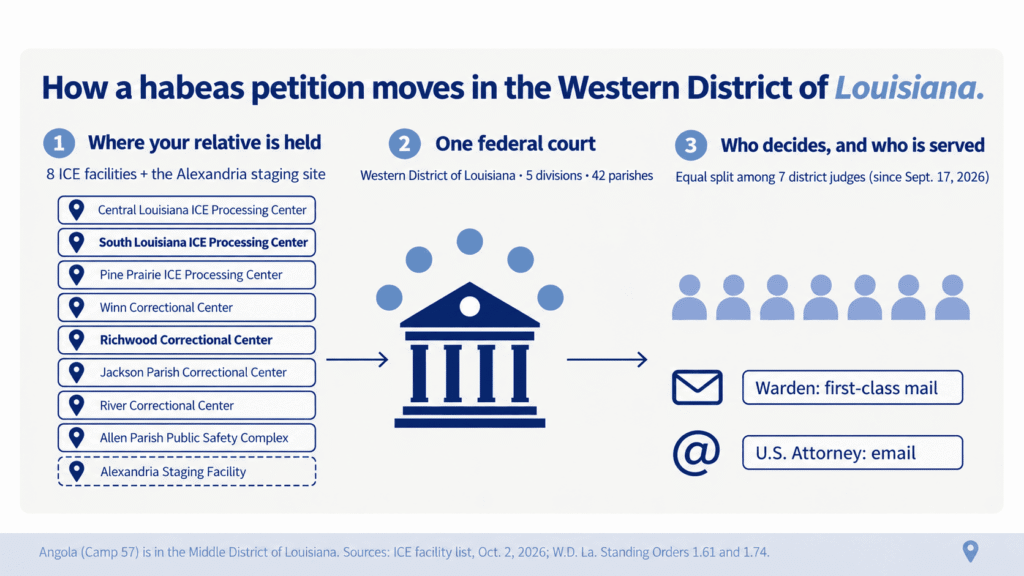
A habeas petition is a lawsuit against the official who holds the person. Under the immediate custodian rule from Rumsfeld v. Padilla, that is usually the warden of the facility where your relative is physically held. Our page on where to file habeas after an ICE transfer explains how the rule works when ICE moves someone.
The Warden of a Privately Run Facility
Most Louisiana ICE facilities are run by private companies; the Illuminator found that Allen Parish is the only one run by local authorities. The warden still has day-to-day custody, and Standing Order 1.74 names the warden as the person to be served by mail. Petitions prepared by lawyers commonly add federal officials as well, such as the director of ICE’s New Orleans Field Office, as this petition from Winn Correctional Center shows.
Petitions filed without a lawyer often name only “Immigration & Customs Enforcement” or the facility itself, as many Western District dockets show. Getting the names right at the start avoids an order to amend later.
Federal Respondents and How They Are Served
Because the clerk now serves the U.S. Attorney’s Office by email, families do not have to arrange service on the federal side. What the petition must still do is name the right officials, explain why the detention is unlawful and ask for specific relief. Our explainer on 28 U.S.C. § 2241 covers what the statute allows a federal judge to order.
Where the Fifth Circuit Stands in October 2026
The Western District sits under the Fifth Circuit. In February 2026, in Buenrostro-Mendez v. Bondi, that court held that people who entered without inspection are subject to mandatory detention under § 1225(b)(2)(A), with no statutory right to a bond hearing. That ruling still binds Louisiana judges.
A panel later held that the Constitution requires a bond hearing after 90 days for long-time residents. The full court vacated that decision on July 10, stayed the related release orders on July 21 and heard argument on September 24. A decision is pending.
Separately, on October 1, the Supreme Court agreed to hear Rhoney v. Barbosa da Cunha, a case testing the no-bond policy, in the term that opens October 5. Until those courts rule, statutory bond arguments are difficult in Louisiana, but individual petitions raising due process and prolonged detention claims are still being filed and decided. Our Fifth Circuit bond hearing update tracks each step.
Filed in the Wrong Court, or Moved After Filing
Filed in New Orleans or Baton Rouge
Petitions are sometimes filed in New Orleans, where many families and lawyers are. The usual result is a transfer, not a dismissal: in March 2026, the Eastern District sent one such petition to the Western District’s Alexandria Division “in the interest of justice,” and the Southern District of New York did the same with a Louisiana detainee’s petition in 2025. The case survives, but the new court starts its own screening, and the days in between are lost.
Moved to Angola
If ICE moves someone to Angola before a petition is filed, the petition belongs in the Middle District of Louisiana. That court treats pro se filings differently: under its General Order 2026-11, the Federal Public Defender is provisionally appointed for petitioners who file without a lawyer, pending a check of financial need. In the Western District, the automatic appointment is limited to final-order cases.
Moved Into Louisiana From Another State
Louisiana receives transfers from across the country; the man the Illuminator profiled in June was arrested in Atlanta and was being held in Allen Parish. If the move happened before filing, the petition goes to the Western District under Fifth Circuit law, even if it was drafted for another court. If it happened after filing, the original court may keep the case. When a move is only threatened, our page on stopping an ICE transfer to another state explains the emergency options.
What Your Family Can Do This Week
A lawyer can move quickly once five facts are clear. Gather them now:
- Confirm the facility. Search the ICE Online Detainee Locator and call the facility; the locator can lag behind a real move.
- Find the A-Number. It appears on most ICE papers; our guide to what an A-Number is shows where to look.
- Ask whether there is a final order of removal. That one fact decides whether the Standing Order 1.73 route is open.
- Collect the custody papers. Keep the Notice to Appear, any bond or custody decision and the date of every move; our page on understanding detention paperwork explains each one.
- Watch for a move. A transfer to the Alexandria staging site or to Angola changes the plan, so tell counsel the same day.
In this district, three questions shape every case: is the facility in the Western District, are the right officials named, and which Fifth Circuit rules apply to your relative’s custody. If you are comparing lawyers from another state, our questions to ask before you hire explain what to check.
Frequently Asked Questions
Does the division where my relative is held decide the judge?
Not for immigration habeas. Since September 17, 2026, these petitions are split equally among seven district judges across all five divisions. The division still shows in the case number and decides which public defender office handles a request.
Can the Federal Public Defender take my relative’s case?
Possibly, if your relative is held in the Western District under a final order of removal, cannot afford a lawyer and has a colorable claim. The provisional appointment under Standing Order 1.73 does not cover people whose removal cases are still pending, although the court can appoint counsel in other cases when justice requires.
Does a petition have to be on the court’s own form?
If the detained person files without a lawyer, yes. The court’s local rules require pro se habeas petitions and fee waiver motions on court-approved forms, and filings that are not get a deficiency notice with a deadline to fix them. Our page on problems with pro se habeas petitions explains the other risks.
Is the Angola facility part of the Western District?
No. The ICE detention unit at the Louisiana State Penitentiary in Angola is in West Feliciana Parish, which belongs to the Middle District of Louisiana. That court has its own procedures and its own public defender order.
My relative was moved to the Alexandria Staging Facility. What does that mean?
ICE uses it as a short-term holding site before deportation flights, releases and transfers, so a move there can mean removal is close. Tell counsel the same day; Standing Order 1.74 reserves emergency motions for this kind of imminent harm.
Who receives the petition on the government’s side?
Under Standing Order 1.74, the clerk serves the federal respondents by email through the U.S. Attorney’s Office and mails a copy to the facility’s warden. Families do not have to arrange service themselves.
Is a loved one in ICE detention in Louisiana?
Time is critical. A habeas corpus petition can be a powerful tool to challenge unlawful detention. Reach out to us now.
Phone: +1 (862) 799-2200
Legal Disclaimer: This article is provided for general informational purposes only and does not constitute legal advice. Every immigration case has unique circumstances. For legal guidance specific to your situation, we recommend consulting with an experienced immigration attorney. The information in this article reflects laws and policies as of the publication date; subsequent changes may affect its accuracy. Sources were reviewed as of October 2, 2026.
Sources
- Standing Order 1.74, Service and Scheduling of Immigration Habeas Cases, U.S. District Court for the Western District of Louisiana, July 2026; accessed October 2, 2026.
- Standing Order 1.61, Assignment of Cases to District and Magistrate Judges (amended), U.S. District Court for the Western District of Louisiana, effective September 17, 2026; accessed October 2, 2026.
- Standing Order 1.73, Appointment of the Federal Public Defender in Immigration Habeas Cases, U.S. District Court for the Western District of Louisiana, April 10, 2026; accessed October 2, 2026.
- Clerk’s Office: The Western District of Louisiana and Its Divisions, U.S. District Court for the Western District of Louisiana; accessed October 2, 2026.
- Order Amending the Local Civil and Criminal Rules, U.S. District Court for the Western District of Louisiana, May 2024; accessed October 2, 2026.
- Detention Facilities: Louisiana, U.S. Immigration and Customs Enforcement; accessed October 2, 2026.
- Fifth Circuit Hears Major Case Over Right to Challenge Immigration Detention, American Immigration Council, September 24, 2026; accessed October 2, 2026.
- Supreme Court to hear dispute over Trump’s mandatory detention policy, CBS News, October 1, 2026; accessed October 2, 2026.
- “Stuck in purgatory”: ICE detention times in Louisiana stretch on for years, Louisiana Illuminator, June 25, 2026; accessed October 2, 2026.
- Court cases alleging unlawful immigration detention skyrocket in Louisiana, Louisiana Illuminator, March 10, 2026; accessed October 2, 2026.
Every day in detention is a day away from your family.
If the immigration system has failed you, federal court may be the only answer. Let us review your case for free.
Get a Free Case Evaluation