For eight days in July 2026, a Fifth Circuit decision appeared to create a 90-day hearing requirement for certain people held in ICE detention. Then, on July 10, the full Fifth Circuit vacated that panel opinion and agreed to rehear the dispute en banc.
The result is a legal landscape that is both more restrictive and more uncertain for families with loved ones detained in Texas, Louisiana, or Mississippi. The July 2 opinion is no longer binding precedent, but the constitutional question surrounding prolonged detention remains unresolved.
This article explains what the Fifth Circuit decided on July 2, what the July 10 order actually changed, and why habeas corpus may remain available despite the vacatur of the favorable panel opinion.
In This Article
- The Legal Baseline Before July 2026
- What the Fifth Circuit Panel Decided on July 2
- What Happened on July 10?
- What Is the Current Rule in Texas and Louisiana?
- Why a Transfer to the Fifth Circuit Can Matter
- Can Habeas Corpus Still Help During En Banc Review?
- What Families Should Do Now
- Frequently Asked Questions

The Legal Baseline Before July 2026
To understand July’s developments, families first need to understand Buenrostro-Mendez v. Bondi. In its February 6, 2026 decision, the Fifth Circuit addressed which federal detention statute governs certain people who entered the United States without inspection and were arrested years later inside the country.
The petitioners had lived in the United States for many years but had never been formally inspected and admitted or paroled. The Fifth Circuit concluded that they could be detained under 8 U.S.C. § 1225(b)(2)(A), rather than the more bond-friendly framework found in § 1226(a).
Section 1226(a) generally allows the government to detain a person or release that person on bond or conditional parole. By contrast, the Fifth Circuit read § 1225(b)(2)(A) as requiring detention during the covered removal proceedings and as providing no statutory right to an immigration-court bond hearing.
The official Buenrostro-Mendez opinion therefore became the Fifth Circuit’s key published precedent on statutory bond eligibility. The Fifth Circuit’s decisions govern federal courts in Texas, Louisiana, and Mississippi.
Key distinction: Buenrostro-Mendez answered which detention statute applies. It did not necessarily answer every constitutional question about how long detention may continue without individualized review.
Statutory Bond Eligibility and Due Process Are Different Questions
This distinction matters because a statute may authorize detention while the Constitution may still impose limits on how that authority is exercised in an individual case. A person may lack a statutory right to bond before an immigration judge and still argue that continued detention without meaningful review violates the Fifth Amendment.
That constitutional issue became the focus of the cases later consolidated under Sosnava Rodriguez v. Ortega. The petitioners did not merely argue that immigration judges had misread the statute. They argued that detention without individualized justification deprived them of liberty without due process.
What the Fifth Circuit Panel Decided on July 2
On July 2, 2026, a divided three-judge Fifth Circuit panel issued an opinion affirming three federal district court orders granting habeas relief. The petitioners had each lived in the United States for more than a decade, had no reported criminal history, and had not yet received final removal orders.
The panel accepted Buenrostro-Mendez as the governing interpretation of § 1225(b)(2)(A), but separately examined whether detention under that provision had constitutional limits. The majority concluded that the government could not hold people situated like the three petitioners for more than 90 days without an individualized hearing.
Under the now-vacated July 2 panel opinion, the government would have been required to provide a hearing within 90 days of the start of detention. At that hearing, the government would have needed to articulate an individualized justification for continued detention, such as dangerousness or flight risk.
The panel did not prescribe a single mandatory hearing procedure or adopt a particular evidentiary standard such as clear and convincing evidence. It left the government to determine the mechanics, provided that a timely hearing and an individualized explanation were given.
The Decision Was Not a Universal 90-Day Release Rule
Although the opinion was significant, it did not cover every person held by ICE. The panel limited its ruling to people situated like the three petitioners and stated that it did not automatically apply to detention under § 1226(c) or other independently applicable detention statutes.
The opinion also did not guarantee release after 90 days. A hearing could still result in continued detention if the government presented an adequate individualized reason. The relief was therefore an opportunity for review, not automatic release on day 91.
| What the July 2 Panel Said | What It Did Not Say |
|---|---|
| Certain § 1225(b)(2)(A) detainees must receive a hearing within 90 days. | Every ICE detainee must be released after 90 days. |
| The government must give an individualized justification for continued detention. | The government must satisfy a specifically defined clear-and-convincing-evidence standard. |
| Dangerousness and flight risk may justify continued detention. | Every person receiving a hearing will obtain bond. |
| The rule applied to people situated like the three petitioners. | The decision automatically governed § 1226(c), post-order detention, or every custody category. |
What Happened on July 10?
On July 10, only eight days after the panel opinion was filed, a majority of the Fifth Circuit’s active and eligible judges voted to rehear the consolidated cases en banc. An en banc rehearing places the case before the full appellate court rather than the original three-judge panel.
The Fifth Circuit’s July 10 en banc order stated that oral argument would occur on a date to be set later and that the clerk would establish supplemental briefing. The order also provided that the July 2 panel opinion was vacated under Fifth Circuit Rule 41.3. The full court later heard argument on September 24, 2026.
Vacatur means the panel opinion no longer functions as binding Fifth Circuit precedent. Since July 10, families cannot rely on the 90-day framework as the controlling circuit rule, and district courts are not required to apply it as binding precedent.
Important clarification: The Fifth Circuit did not issue a new merits decision on July 10 holding that indefinite detention without a hearing is constitutional. It agreed to reconsider the dispute and removed the July 2 opinion’s precedential effect.
What the En Banc Order Did Not Decide
The July 10 order was procedural rather than a final merits opinion. It did not explain how the full court will ultimately resolve the due-process question, and it did not adopt a new constitutional rule affirmatively authorizing unlimited detention.
The full court could later affirm, modify, or reject the panel’s reasoning. Until then, the statutory holding in Buenrostro-Mendez remains the principal published Fifth Circuit authority, while the constitutional duration-and-hearing question remains unsettled.
Was your loved one told there is “no bond” after being detained or transferred into the Fifth Circuit?
The July decisions do not eliminate every federal-court option. A case-specific review can determine whether the custody statute and detention history, the transfer record and due-process concerns, support an emergency or standard habeas corpus petition.
What Is the Current Rule in Texas and Louisiana?
As of October 21, 2026, there is still no binding Fifth Circuit rule guaranteeing a bond hearing after 90 days, and no final en banc ruling on the due process question. Two courts now have the issue before them: the full Fifth Circuit, which heard argument on September 24, and the Supreme Court, which agreed on October 1 to decide the statutory question.
| Legal Issue | Status as of October 21, 2026 |
|---|---|
| Statutory bond eligibility under § 1226(a) | Buenrostro-Mendez still binds federal courts in Texas, Louisiana and Mississippi. People who entered without inspection are treated as detained under § 1225(b)(2)(A), with no statutory right to a bond hearing. |
| July 2 ninety-day hearing framework | Vacated on July 10 and not binding precedent. On July 21, the court stayed the district court judgments in the consolidated appeals pending en banc review. |
| Constitutional due process claim | Argued before the full Fifth Circuit on September 24, 2026. No en banc decision had been published when we checked on October 21. |
| Habeas corpus under 28 U.S.C. § 2241 | Still available. District judges decide due process claims one petition at a time, and some have continued to grant habeas relief after the July 21 stay. |
| Supreme Court review of the statutory question | Granted on October 1, 2026 in Rhoney v. Barbosa da Cunha, No. 26-104, a Second Circuit case. No argument date has been set. |
| Supreme Court petition in Buenrostro-Mendez | No. 26-43 remains pending. The docket lists no ruling on it. |
The Supreme Court case to watch is no longer Buenrostro-Mendez alone. The question presented in Barbosa da Cunha is limited to the statute: whether § 1225(b)(2)(A) mandates the detention of people present in the United States without having been admitted. The Buenrostro-Mendez petition, No. 26-43, is still on the Supreme Court docket with no ruling entered.
A grant of review does not change the rule today. Until the Supreme Court decides Barbosa da Cunha, Buenrostro-Mendez continues to bind district courts in the Fifth Circuit, and a petition filed now is decided under current law. A Supreme Court ruling would settle the statutory question nationwide. The due process question pending before the full Fifth Circuit is a separate issue and is not part of the question the Court agreed to decide.
To compare the Fifth Circuit with the other regional circuits, see our federal circuit bond map. For filing details in the court that hears most Louisiana detention cases, see our guide to habeas in the Western District of Louisiana.
Two decisions are now pending: the full Fifth Circuit on due process, and the Supreme Court on the statute. Until either court rules, Buenrostro-Mendez controls, and every petition rests on its own facts.
Why a Transfer to the Fifth Circuit Can Matter
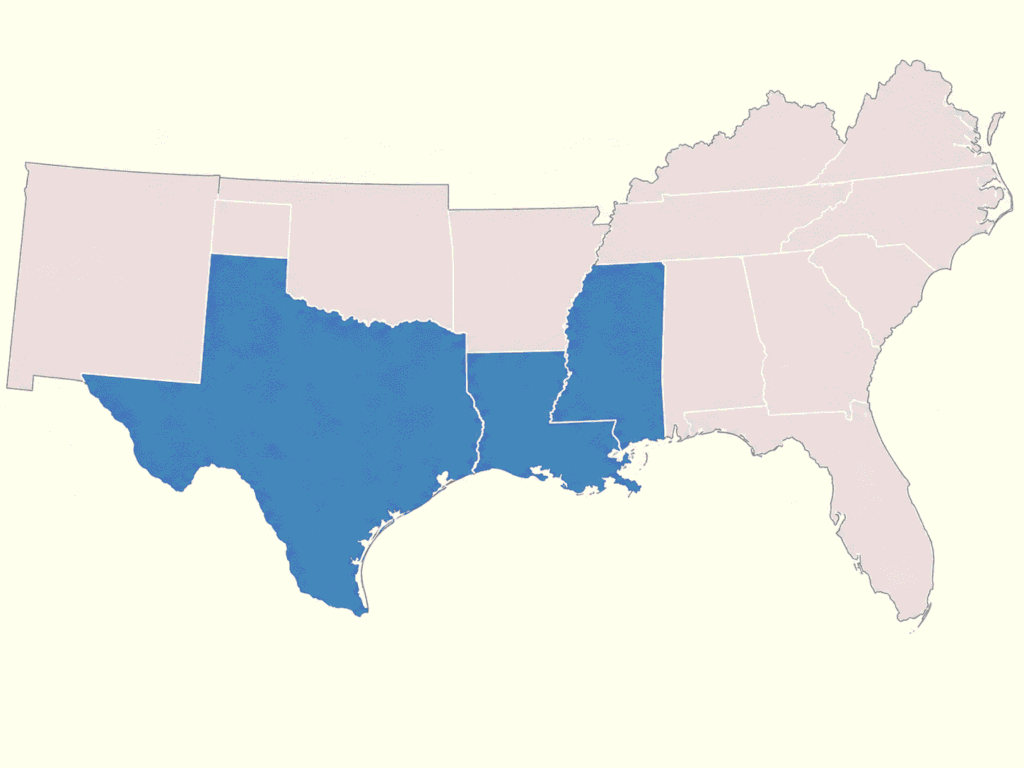
ICE transfers detained individuals between facilities for operational, capacity, security, medical, transportation, or case-management reasons. Regardless of the reason for a particular transfer, a move can have major legal consequences because physical custody may affect where a federal habeas petition should be filed and which appellate precedent governs.
In physical-custody habeas cases, the general rule identified by the Supreme Court in Rumsfeld v. Padilla focuses on the person’s immediate custodian and the federal district encompassing the place of confinement. Exceptions and post-filing transfer rules can apply, so the correct filing location requires individual analysis.
A transfer from New York, New Jersey, California, or another circuit into Texas or Louisiana may therefore change the precedent a federal district court must follow. It can also separate the detained person from family members, existing counsel, medical providers, witnesses, and documentary evidence.
Families facing a possible transfer should review our guide on how to try to stop an ICE transfer to another state. Families who discover the move only after it occurs should preserve the complete custody timeline and all transfer, medical, and legal-access records.
ICE’s official Detainee Transfers Directive states that, when a person has an attorney of record, ICE should notify counsel as soon as practicable on the day of transfer and no later than 24 hours afterward. That directive creates a notification policy, but it does not create an automatic right to prevent every transfer.
Can Habeas Corpus Still Help During En Banc Review?
Yes, depending on the individual facts. Vacating the July 2 opinion did not repeal 28 U.S.C. § 2241, eliminate federal habeas jurisdiction, or prevent every detained person from presenting a statutory or constitutional challenge to continued custody.
Section 2241 allows federal courts to consider a habeas petition from a person who alleges that custody violates the Constitution, federal law, or a federal treaty. In an ICE detention case, the petition generally focuses on the legality of custody rather than the ultimate merits of the removal case.
Readers can review our explanation of 28 U.S.C. § 2241 in immigration detention cases and our guide on how a habeas petition can win back a bond hearing. A habeas case and a bond hearing are different legal proceedings before different courts with different forms of authority.
Potential Habeas Arguments After July 10
A habeas petition cannot simply assume that the vacated July 2 opinion still controls. Counsel must evaluate the applicable detention statute and controlling precedent, together with the individual facts supporting a statutory or constitutional claim.
- Incorrect detention classification: Whether ICE is relying on the correct statutory provision.
- Length of custody: How long the person has been detained and why proceedings remain unresolved.
- Lack of individualized review: Whether any decisionmaker has considered danger, flight risk, or alternatives to detention.
- Government-caused delay: Whether agency inactivity or repeated government requests have extended custody.
- Medical or humanitarian concerns: Whether continued detention is causing serious, documented harm.
- Transfer-related prejudice: Whether a transfer interfered with counsel, evidence, medical care, or access to proceedings.
- Post-order detention: Whether a final removal order exists and whether removal is reasonably foreseeable.
The requested relief also varies. A federal court may be asked to order an individualized bond hearing or meaningful custody review. In an appropriate case, the petition may request release or another remedy tailored to the alleged constitutional violation.
Habeas corpus does not guarantee that a detained person will be released or receive bond. It provides a mechanism for independent federal judicial review, and the outcome depends on the statute, custody history, venue, record, and governing precedent.
What Families Should Do Now
When a loved one is detained or transferred, accurate information is more valuable than assumptions about the July decisions. Families should build a complete custody record so that a habeas lawyer can evaluate the correct court, respondent, legal theory, and requested relief.
- Confirm the current facility. Use the official ICE Online Detainee Locator System and call the facility if the database has not updated.
- Record every custody date. Note the arrest date, facility changes, transfer dates, bond requests, and court hearings.
- Collect immigration documents. Preserve the Notice to Appear, custody determination, bond orders, BIA decisions, removal orders, and ICE paperwork.
- Identify the claimed detention statute. Determine whether ICE cites § 1225, § 1226(a), § 1226(c), § 1231, or another authority.
- Preserve evidence of community ties. Gather family records, employment history, housing, tax filings, medical records, and proof of prior court attendance.
- Document access problems. Save records of missed legal calls, delayed medication, interrupted representation, or unavailable evidence after transfer.
- Do not rely on the vacated 90-day rule. The July 2 panel opinion is not currently binding precedent.
- Request a location-specific legal assessment. The correct strategy may change depending on the facility and federal district.
Families should also avoid waiting solely for the en banc Fifth Circuit or Supreme Court proceedings to end. Those cases may affect the law, but an individual detention claim depends on the person’s present circumstances, and urgent problems may require action under the law that exists today.
Frequently Asked Questions
Is the Fifth Circuit’s 90-day bond-hearing rule currently in effect?
No, the July 2 panel opinion was vacated on July 10 when the Fifth Circuit agreed to rehear the cases en banc. The 90-day framework therefore does not currently operate as binding Fifth Circuit precedent.
Did the Fifth Circuit rule that ICE may constitutionally detain someone forever?
No final en banc decision has made that holding. The July 10 order granted rehearing and vacated the prior opinion, but it did not resolve the constitutional limits of indefinite or prolonged detention.
Can an immigration judge still grant bond after Buenrostro-Mendez?
It depends on which detention statute applies to the person. Buenrostro-Mendez restricts statutory bond access for certain people held under § 1225(b)(2)(A), but other custody categories may have different bond rules.
Can someone file habeas after being transferred to Texas or Louisiana?
A transfer does not automatically eliminate habeas corpus. It may change the proper filing district, respondent, and governing precedent, so the new facility location should be reviewed immediately.
Does filing habeas automatically stop another transfer?
Filing a petition alone may not automatically stop ICE from transferring the person. Counsel may need to request separate emergency relief, such as a temporary restraining order or transfer-related injunction, depending on the circumstances.
Has the Supreme Court agreed to hear Buenrostro-Mendez?
Not yet. The Buenrostro-Mendez petition, No. 26-43, is still pending. On October 1, 2026, however, the Court agreed to decide the statutory question at the center of that case in Rhoney v. Barbosa da Cunha, No. 26-104. No argument date has been set, and the due process question before the full Fifth Circuit is not part of that case.
Should a family wait for the en banc decision before seeking help?
Not necessarily. Detention length, statutory classification, medical needs, transfer risk, and lack of review may require immediate analysis, and waiting for appellate litigation could allow individual harm to continue.
What July’s Fifth Circuit Developments Mean for Families
July 2026 did not produce a final answer on bond hearings in the Fifth Circuit. It produced a significant but short-lived panel ruling, followed by an en banc order that removed the ruling’s precedential force and reopened the constitutional dispute.
For now, Buenrostro-Mendez remains the statutory starting point for certain § 1225(b)(2)(A) cases, while the constitutional limit on detention without individualized review remains contested. Families should not assume either that release is guaranteed after 90 days or that all habeas options disappeared on July 10.
Is a loved one in ICE detention in Texas, Louisiana, or Mississippi?
Time and filing location can materially affect a detention challenge. Our team can review the facility, custody statute, bond history, transfer record, and detention timeline to determine whether a federal habeas corpus strategy may be available.
Phone: (+1) 862-799-2200
Email: info@gozellaw.com
Legal Disclaimer
This article is provided for general informational purposes only and does not constitute legal advice. Every immigration detention case has unique circumstances. Prior results do not guarantee a similar outcome. For legal guidance specific to your situation, we recommend consulting with an experienced immigration attorney. The information in this article reflects laws and policies as of the publication date; subsequent changes may affect its accuracy.
Sources
- Buenrostro-Mendez v. Bondi, U.S. Court of Appeals for the Fifth Circuit, February 6, 2026.
- Sosnava Rodriguez v. Ortega, Fifth Circuit panel opinion, July 2, 2026.
- Order Granting Rehearing En Banc, U.S. Court of Appeals for the Fifth Circuit, July 10, 2026.
- Buenrostro-Mendez, Supreme Court Docket No. 26-43.
- 28 U.S.C. § 2241 — Power to Grant Writ, U.S. House Office of the Law Revision Counsel.
- ICE Directive 11022.1 — Detainee Transfers, U.S. Immigration and Customs Enforcement.
- Rumsfeld v. Padilla, 542 U.S. 426 (2004), Cornell Legal Information Institute.
- Rhoney v. Barbosa da Cunha, Supreme Court Docket No. 26-104, certiorari granted October 1, 2026.
- Defending the Constitutional Right of Longtime Residents to Challenge Their Detention, American Immigration Council (July 21, 2026 stay order and district court practice).
- Sosnava Rodriguez v. Ortega, Constitutional Accountability Center (en banc oral argument, September 24, 2026).
Every day in detention is a day away from your family.
If the immigration system has failed you, federal court may be the only answer. Let us review your case for free.
Get a Free Case Evaluation