ICE has no legal authority to hold a U.S. citizen for immigration purposes, yet ProPublica counted 519 Americans detained by immigration agents between January 2025 and October 21, 2026, more than a hundred of them after agents questioned whether they were citizens. When a U.S. citizen is detained by ICE, what usually ends it is proof of citizenship in the right hands within a day, and a federal habeas petition if ICE keeps holding them anyway.
This guide covers one situation: someone in ICE custody who is, or may be, a U.S. citizen. For detention in general, start with what to do if your loved one is detained by ICE. Below: what the law and ICE’s policy require, the documents that settle these cases, and how habeas corpus for ICE detention works when they do not.
Last updated: November 11, 2026. Detention figures from ProPublica’s October 29, 2026 update; policy and court decisions as listed under Sources.
In This Article · U.S. Citizens Held by ICE
- Can ICE Detain a U.S. Citizen?
- Why Citizens End Up in ICE Custody
- What to Do in the First 24 Hours
- Documents That Prove U.S. Citizenship
- When ICE Won’t Let Go: Habeas Corpus for a Citizen
- After Release: Records, Damages and Next Steps
- Frequently Asked Questions
- What to Do Next If ICE Is Holding a U.S. Citizen

Can ICE Detain a U.S. Citizen?
Not under its immigration powers. ICE’s own directive states that, as a matter of law, the agency cannot use its civil immigration authority to arrest or detain a U.S. citizen. Agents can briefly stop someone they reasonably suspect is in the country unlawfully, and they can arrest anyone, citizen or not, they accuse of assaulting or obstructing officers.
Two Kinds of Citizen Detentions
ProPublica’s count falls into two groups. More than a hundred people were held because agents doubted they were citizens. Roughly 300 were accused of assaulting or obstructing officers, often at protests or while filming; only 137 were charged with federal crimes, and nearly half of those charges were dropped.
A criminal accusation goes to criminal court and a criminal lawyer. This guide is about the first group.
What ICE’s Own Policy Requires
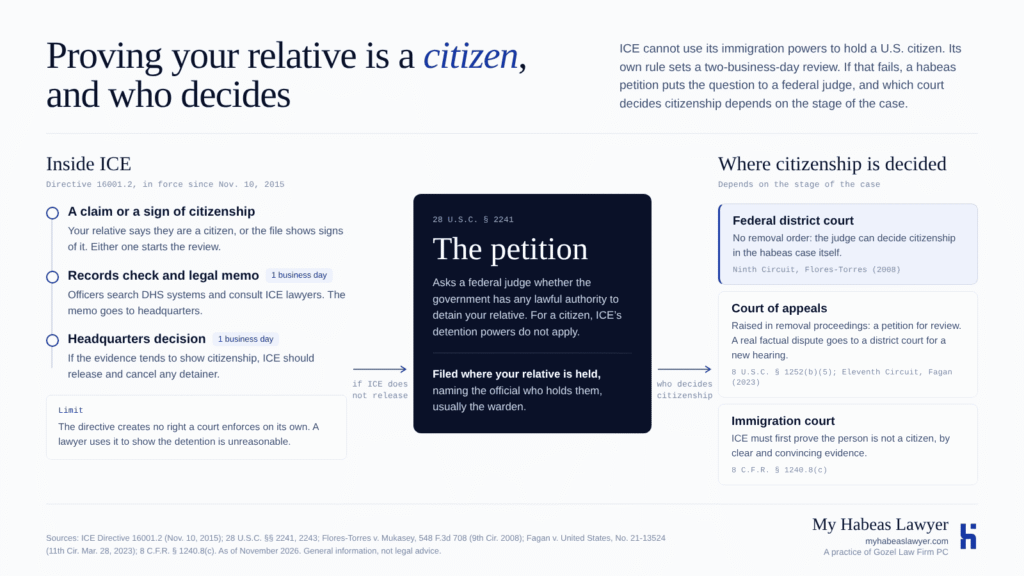
ICE Directive 16001.2, in force since November 10, 2015, applies when someone claims to be a citizen or when the file shows signs of citizenship, even without a claim. It sets a short clock:
- Officers must check every available DHS data system and consult the local ICE Office of the Chief Counsel.
- For someone in custody or under a detainer, a memo on the claim goes to ICE headquarters within one business day, and headquarters answers within one business day.
- If the evidence tends to show citizenship, even without proving it is more likely than not, ICE should release the person and cancel any detainer. When it is unclear whether the evidence is that strong, the directive says ICE should not detain.
The directive says it creates no rights enforceable in court, so it does not open the door by itself. It is still ICE’s own standard, and a lawyer can cite it to the field office and to a federal judge to show why continued detention is unreasonable.
Why Citizens End Up in ICE Custody
Most of these detentions start with a records problem or a snap judgment. The common patterns:
- Mistaken identity. A similar name, a shared address or a car registered to someone else.
- Old records. A green card entry never updated after naturalization. The Government Accountability Office found that ICE policy did not require officers to update the citizenship field even after finding evidence a person may be a citizen.
- No papers on hand. No federal law requires citizens to carry proof of citizenship, and few do.
- Appearance and accent. Nearly all of the Americans ProPublica found held over citizenship doubts were people of color.
Citizens Who Don’t Know They Are Citizens
Some people in ICE custody became citizens automatically and never knew. Under INA 320, a child who held a green card, was under 18 and lived in the legal and physical custody of a U.S. citizen parent became a citizen the moment the last of those conditions was met. The rule covers anyone under 18 on February 27, 2001; older cases follow earlier versions of the law. Others were born abroad to a U.S. citizen parent and were citizens from birth.
Neither group had to apply; a Certificate of Citizenship only documents that status. A parent’s naturalization date, the child’s green card and a birth certificate can establish what ICE’s records miss.
ICE Detainers on Citizens in County Jails
A citizen booked into a county jail on an unrelated charge may face an ICE request to hold them up to 48 hours past release. GAO found that from fiscal year 2015 through March 2020, ICE issued detainers for at least 895 potential U.S. citizens and later cancelled about 74 percent of them. The directive covers detainers too, so send citizenship documents to the jail and the ICE office named on the detainer the same day.
When a Person’s Own Words Are Used Against Them
The arrest report, Form I-213, records what the person told the officer, and in March 2026 the Board of Immigration Appeals held that the form is presumed reliable. A frightened “yes,” an answer lost to a poor interpreter or a statement made during a mental health crisis can become the government’s main evidence. Ask the lawyer to get the I-213 early.
What to Do in the First 24 Hours
ICE’s review runs on business days and transfers happen fast. In order:
- Locate your relative. Use the ICE Online Detainee Locator, then call the facility or field office to confirm. Our guide to finding someone in ICE detention covers empty searches.
- Get the A-Number if one exists. ICE may have assigned one even to a citizen; it appears on ICE paperwork. Here is what an A-Number is.
- Gather the proof. Keep originals; send clear copies. The next section ranks the documents.
- Write down what happened. Time, place, agency and what was said about citizenship.
- Call a federal habeas lawyer the same day. If ICE does not release, a petition may need to be filed before a transfer moves your relative.
Finding Someone the ICE Locator Won’t Show
The locator searches by A-Number or by name, and both need a country of birth. ICE will have recorded a foreign country for anyone it is holding as a noncitizen, so search under the country ICE likely entered, not the United States. If nothing comes up, call the ICE field office for the area and the local jail; a short hold before booking may not appear online.
What Not to Sign
Your relative should say clearly that they are a U.S. citizen, ask for a lawyer and sign nothing they cannot read and understand. Papers offered in custody can include a stipulated removal order or voluntary departure, either of which can end with leaving the country without a full hearing. One caution runs the other way: a false claim to U.S. citizenship is a federal crime, so this advice is only for people who are, or believe they are, citizens.
Getting the Proof to the Right ICE Office
Send copies to the deportation officer on the case, if you can learn the name, and to the ICE field office that covers the facility, with a short cover letter stating that your relative is a U.S. citizen and asking for review under Directive 16001.2. Keep proof of when you sent it; that record matters if the case goes to federal court.
Is ICE holding a relative who is a U.S. citizen?
Send us the facility name and whatever citizenship documents you have. We will check what can be filed in federal court now, free of charge.
How ICE must review a citizenship claim, and which court decides it if ICE does not release.Documents That Prove U.S. Citizenship
The State Department’s list of primary citizenship evidence is the clearest guide to what ICE should accept, because it is the same list used to issue passports.
| Document | Who has it | What it shows ICE |
|---|---|---|
| U.S. passport or passport card, even expired if undamaged | Anyone ever issued one | Identity and citizenship in one document; the strongest single proof |
| Certified U.S. birth certificate | People born in the United States | Birth on U.S. soil; a hospital souvenir certificate is not enough |
| Certificate of Naturalization | People who naturalized | Citizenship from the oath date, which old green card records miss |
| Certificate of Citizenship | People who became citizens through a parent | Issued by USCIS after Form N-600; confirms derived or acquired citizenship |
| Consular Report of Birth Abroad (FS-240) | Children born abroad to U.S. citizen parents | Citizenship from birth outside the United States |
| Foreign birth certificate, a parent’s naturalization certificate and the child’s green card | Derived citizens with no certificate yet | Together, the facts that made the person a citizen under INA 320 |
When the Documents Are Missing or Disputed
If the papers are lost, the State Department can search its own records for anyone previously issued a passport or a Consular Report of Birth Abroad. Secondary evidence, such as hospital birth records, early school and baptismal records, and census entries, also helps, though it carries less weight. When ICE calls a document fraudulent, that dispute belongs before a federal judge, not an officer.
When ICE Won’t Let Go: Habeas Corpus for a Citizen
If ICE keeps holding your relative after receiving proof, the main tool is a petition for a writ of habeas corpus under 28 U.S.C. § 2241. It asks a federal district judge one question: does the government have lawful authority to hold this person right now? For a citizen the answer should be no, because ICE’s detention powers reach only noncitizens.
The petition is filed in the district where your relative is held, naming the official with day-to-day custody, usually the warden. Our page on where to file after an ICE transfer explains that rule.
Which Court Decides the Citizenship Question
Whether a district judge can decide citizenship inside a habeas case depends on where the question arose:
- No removal order. In Flores-Torres v. Mukasey (2008), the Ninth Circuit held that the limits in 8 U.S.C. § 1252(b) apply only to review of a removal order, so a district court can decide citizenship in a habeas case challenging detention.
- Citizenship raised in removal proceedings. In Fagan (2023), the Eleventh Circuit held that the claim must go through a petition for review in the court of appeals, which sends a genuine factual dispute to a district court for a new hearing under § 1252(b)(5). The Fourth Circuit reached a similar result in 2011.
- Immigration court. When ICE charges someone with being present without admission, the government must first prove the person is not a citizen, by clear and convincing evidence.
A lawyer will often work more than one route at once. If your relative already has a removal order, see habeas after a final deportation order.
A Case to Watch: Ten Months in Indiana
According to an Associated Press review, a man arrested after an immigration court hearing on January 5, 2026 has been held since then at an Indiana state prison that houses ICE detainees. ICE relied on his own claim of Jamaican birth, which his doctors attribute to paranoid schizophrenia; a Florida birth certificate and a passport he held for 15 years point the other way.
His lawyers filed a habeas petition on August 19, and the government argued that the citizenship question belongs in immigration court, not before a federal judge. As of late October, the judge had not ruled. Habeas puts the question before a judge, but a fight over jurisdiction can add months.
How Fast It Can Move
Under 28 U.S.C. § 2243, the government must answer an order to show cause within three days, or up to 20 days for good cause, though courts often set longer schedules. A lawyer can ask for emergency relief the day the petition is filed. Our day-by-day habeas timeline and our guide to what happens after a habeas petition is filed explain each step.
After Release: Records, Damages and Next Steps
If ICE’s records still list your relative as a noncitizen, the same mistake can happen at the next stop. Three steps help:
- Correct the record. Ask the lawyer to send ICE written confirmation of citizenship and to request the arrest report and file. Our guide to ICE detention records explains what to ask for.
- Get a document that travels. A passport card fits in a wallet. A derived citizen can file Form N-600 for a Certificate of Citizenship, which Gozel Law Firm’s citizenship practice handles.
- Consider damages separately. A Federal Tort Claims Act claim generally starts with a written administrative claim to the agency within two years. Suits against individual agents face steep limits; H.R. 10826, introduced in October 2026, would ease them but is not law. A civil rights lawyer handles this track.
Frequently Asked Questions
Can ICE hold a U.S. citizen overnight?
Not lawfully under its immigration powers, but it happens. ProPublica found 36 Americans held for at least a day without reaching a lawyer or family. ICE’s directive calls for a decision within about two business days and release when evidence points to citizenship.
Do U.S. citizens have to carry proof of citizenship?
No federal law requires it. A passport card in a wallet or a photo of the passport can shorten a stop. Green card holders are different: adults must carry their card.
Can a U.S. citizen be deported?
Not lawfully, but it has happened. GAO found ICE removed 70 potential U.S. citizens from fiscal year 2015 through March 2020, and ProPublica found roughly a dozen deported since January 2025, mostly children.
Can ICE detain a U.S. citizen for obstruction?
Agents can arrest anyone they accuse of assaulting or interfering with federal officers. That is a criminal arrest, not an immigration hold. ProPublica found fewer than half of the roughly 300 Americans accused this way were charged.
Can I sue ICE for detaining me as a U.S. citizen?
Possibly, through a Federal Tort Claims Act claim, which generally begins with an administrative claim within two years. Claims against individual agents are much harder, and habeas seeks release, not money.
My relative told ICE they were born abroad. Is it too late?
No. A statement is evidence, not proof, and a U.S. birth certificate or a parent’s naturalization record can outweigh it. Tell the lawyer what was said and why, including any language barrier or mental health condition.
What to Do Next If ICE Is Holding a U.S. Citizen
A citizen held by ICE is in custody without legal authority, and your family’s documents usually end it. Today, confirm where your relative is, gather the passport, birth certificate or citizenship certificate, and send copies to the ICE office with a request for review under Directive 16001.2. If ICE does not release, or a transfer looks likely, ask a federal habeas lawyer to file in the district where your relative is held. Our guide to how federal habeas works in ICE detention explains the full process, and you can see who files these petitions, and where.
Is a loved one in ICE detention?
Time is critical. A habeas corpus petition can be a powerful tool to challenge unlawful detention. Reach out to us now.
Phone: +1 (862) 799-2200
Legal Disclaimer: This article is provided for general informational purposes only and does not constitute legal advice. Every immigration case has unique circumstances. For legal guidance specific to your situation, we recommend consulting with an experienced immigration attorney. The information in this article reflects laws and policies as of the publication date; subsequent changes may affect its accuracy. Prior results do not guarantee a similar outcome. Sources were reviewed as of November 2026.
Update Log
- November 11, 2026: First published. Detention figures from ProPublica’s October 29, 2026 update; the Indiana case current through the Associated Press report of October 27, 2026.
Sources
- More Than 500 U.S. Citizens Have Been Detained, Including Handcuffed or Held at Gunpoint, in Trump’s Immigration Crackdown, ProPublica; published October 6, 2026, updated October 29, 2026.
- AP investigation: Documents support claim ICE has detained a mentally ill US citizen since January, Associated Press; October 27, 2026.
- Directive 16001.2: Investigating the Potential U.S. Citizenship of Individuals Encountered by ICE, U.S. Immigration and Customs Enforcement; November 10, 2015.
- Immigration Enforcement: Actions Needed to Better Track Cases Involving U.S. Citizenship Investigations (GAO-21-487), U.S. Government Accountability Office; July 20, 2021.
- Flores-Torres v. Mukasey, 548 F.3d 708, U.S. Court of Appeals for the Ninth Circuit; November 10, 2008.
- Fagan v. United States, No. 21-13524, U.S. Court of Appeals for the Eleventh Circuit; March 28, 2023.
- Matter of Mercado-Martinez, 29 I&N Dec. 529, Board of Immigration Appeals; March 26, 2026.
- Citizenship Evidence, U.S. Department of State; accessed November 2026.
- Policy Manual, Volume 12, Part H: Children of U.S. Citizens, U.S. Citizenship and Immigration Services; accessed November 2026.
- H.R. 10826, Justice for Citizens Wrongfully Detained by ICE Act, 119th Congress; introduced October 2026.
Every day in detention is a day away from your family.
If the immigration system has failed you, federal court may be the only answer. Let us review your case for free.
Get a Free Case Evaluation