Your loved one has been in ICE detention for months, but can you show exactly what happened during that time? The number of days in custody matters, but a federal habeas review usually requires more than a calendar calculation. The detention history may need to show when custody began, what legal authority ICE relied on, what hearings or custody reviews occurred, whether the person was transferred, and what the government has done while detention continued.
For families asking what records do I need for an ICE habeas case, the most useful approach is often to reconstruct the custody history in date order. A clear record can help counsel identify changes in detention authority, unanswered custody requests, periods of inactivity, removal efforts, and other facts that may affect the federal court analysis.
This guide is not a universal evidence checklist. Instead, it explains how to document months in ICE detention so that each important event can be connected to a reliable record and evaluated in the correct legal context.
In This Article
- Why Months in Detention Matter, but the Number Alone Is Not the Case
- Start With Records That Show When ICE Custody Began
- Track What Happened While the Person Was Detained
- Records That Explain Why Detention Is Still Continuing
- Look for What Changed During Those Months
- Put the Records in Date Order Before Legal Review
- What If Your Family Does Not Have Every Document?
- Which Records Should You Bring to a Habeas Case Review?
- Frequently Asked Questions
Why Months in Detention Matter, but the Number Alone Is Not the Case
The length of ICE detention can be legally significant, but there is no universal rule that automatically requires release after a specific number of months. The applicable analysis depends on the statute authorizing custody, the stage of the immigration proceedings, the reviews already provided, the reason detention continues, and the controlling law in the federal court where a habeas petition may be filed.
For example, detention while removal proceedings remain pending may involve statutes such as 8 U.S.C. § 1226. Detention after a final removal order may instead fall under 8 U.S.C. § 1231. Those situations raise different legal and factual questions.
The Supreme Court’s decision in Zadvydas v. Davis established an important framework for certain post-removal-order detention cases. But even there, six months does not create automatic release on day 181. The question can turn on whether removal is significantly likely in the reasonably foreseeable future and what the record shows about the government’s removal efforts.
For a deeper discussion of the six-month issue, see our guide to prolonged ICE detention after six months. Here, the focus is different: how do you document what actually happened during those months?
A strong custody history does more than count days. It connects dates to decisions, transfers, reviews, government actions, and changes in circumstances that may explain why continued detention deserves closer legal review.
Start With Records That Show When ICE Custody Began
The first question sounds simple: when did ICE detention begin? In practice, families sometimes have several dates. A person may have been arrested by another agency first, transferred into immigration custody later, moved between facilities, or released from criminal custody directly to ICE.
Start with records that can establish the custody starting point. Depending on the case, these may include booking or intake records, ICE custody paperwork such as Form I-286, a Notice to Appear, release records from another institution, facility records, transfer notices, or correspondence confirming when ICE assumed custody.
Also record the person’s full legal name, A-Number, current detention facility, and prior facilities. ICE’s official Online Detainee Locator System can help confirm current custody information. Save screenshots with the date and time of the search because locator information can change after a transfer.
Do not rely on memory when a date can be verified. If the exact starting date remains uncertain, identify the earliest date you can prove and separately note which dates still need confirmation.
Track What Happened While the Person Was Detained
Once the starting point is established, reconstruct the major events that occurred while custody continued. The goal is not to collect every piece of paper. The goal is to identify events that may explain the legal and procedural history of the detention.
| Event | Records to Look For | Question the Record May Help Answer |
|---|---|---|
| Transfer to another facility | Transfer notice, locator screenshot, facility admission record | Where was the person held, and when did the location change? |
| Bond or custody review | Bond request, ICE custody decision, immigration judge order, BIA records | Was there a meaningful opportunity to challenge detention? |
| Immigration court hearing | Hearing notice, written order, appeal receipt | What happened in the underlying immigration proceeding? |
| ICE communication | Letters, emails, custody-review notices, request forms | What explanation has the government provided for continued custody? |
| Removal-related activity | Travel-document requests, embassy communications, removal notices | Is removal actually moving forward? |
The EOIR Automated Case Information System may provide basic information about certain immigration court and Board of Immigration Appeals cases. However, EOIR itself cautions that not every case or every piece of case information appears there. Orders and notices issued by the immigration court or BIA remain the official determinations.
If ICE moved the person during the detention period, our ICE transfer checklist for families explains how to preserve facility information, locator screenshots, transfer dates, attorney-access issues, and other time-sensitive records.
Records That Explain Why Detention Is Still Continuing
After reconstructing what happened, ask a second question: what record explains why the person is still detained today? That answer may be different from the explanation ICE gave when custody first began.
In some cases, ICE may rely on a particular detention statute or a mandatory-detention classification. Relevant records can include the Notice to Appear, Form I-286, criminal dispositions, immigration judge orders, or other custody notices. If the issue involves a disputed “mandatory” classification, see our separate guide to mandatory detention and habeas petitions.
In a post-order case, the record may need to answer different questions. When did the removal order become final? Has ICE requested travel documents? Has a consulate responded? Has the receiving country refused or delayed documentation? Were removal attempts scheduled and then cancelled? Has the detained person cooperated with document requests?
Those records can matter because post-order detention is not evaluated in the same way as detention during ongoing removal proceedings. Our guide to habeas after a final removal order addresses the Zadvydas framework and removal foreseeability in greater detail.
Has your loved one already spent months in ICE detention?
Our federal litigation team can review the custody start date, detention history, transfers, bond or custody decisions, immigration court records, ICE communications, and other developments that may affect a habeas evaluation.
Look for What Changed During Those Months
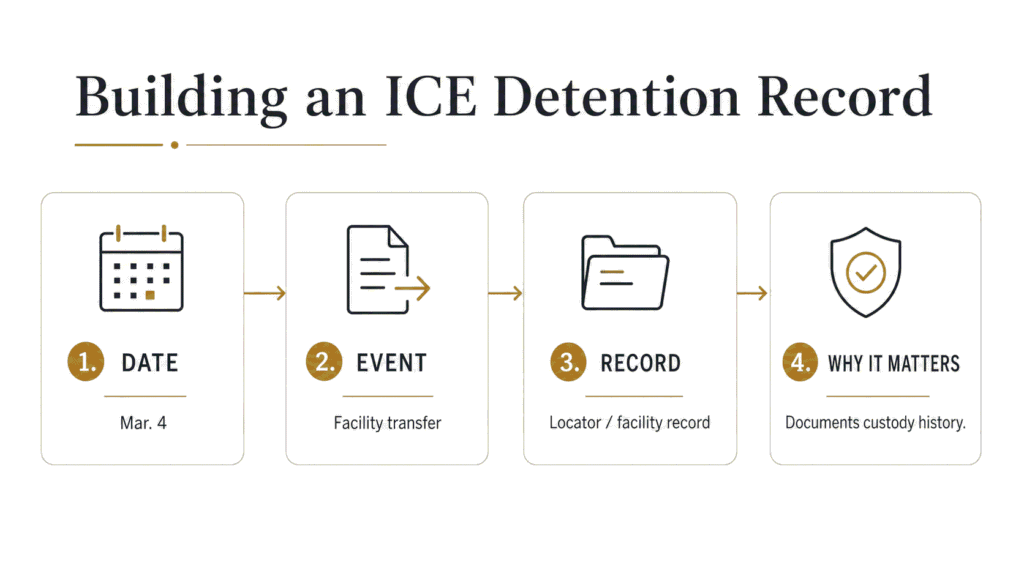
A detention record should not stop with the original custody decision. Months of detention can produce new facts. Those changes may affect what counsel needs to investigate and which legal arguments deserve attention.
Examples can include a new immigration court or BIA decision, a final order becoming effective, a stay being entered or lifted, a change in the government’s ability to obtain travel documents, a new medical diagnosis, an interruption in necessary treatment, or new evidence concerning family and community support.
Changes may also relate to prior government concerns. If custody was justified in part by alleged flight risk or danger, later records concerning court appearances, compliance, rehabilitation, housing, employment history, treatment, or a structured release plan may provide updated information. Whether those facts are legally relevant depends on the detention authority and the claim being considered.
The key is to document when the change occurred and what reliable record supports it. A recent medical report, court order, custody decision, or government communication is generally more useful than an undated recollection that cannot be connected to the sequence of events.
Put the Records in Date Order Before Legal Review
One of the most useful things a family can do before a habeas consultation is surprisingly simple: put the important events in date order. This does not require writing a legal brief. A basic four-column record can make a complicated detention history much easier to understand.
| Date | What Happened | Record You Have | Why It May Matter |
|---|---|---|---|
| January 8 | ICE custody began | Custody paperwork / facility record | Helps establish the beginning of ICE detention |
| February 12 | Bond request addressed | Immigration judge order | Shows what custody review was available |
| March 4 | Transferred to another facility | Locator screenshot / facility record | Documents the custody location and transfer history |
| May 20 | ICE requested travel documentation | ICE correspondence | May help evaluate government removal activity in a post-order case |
If a date is uncertain, label it as approximate rather than presenting a guess as fact. Keep the underlying document beside the entry when possible. If two records conflict, preserve both and flag the inconsistency for counsel.
This approach is also consistent with the broader preparation discussed in our guide on how a habeas petition for ICE detention is prepared and filed. A federal petition needs a clear factual history, but the relevant evidence and legal theory remain case-specific.
What If Your Family Does Not Have Every Document?
Families rarely receive every document generated during months of ICE custody. Missing records do not mean you should invent dates or delay documenting what you already know. Start with the materials available and clearly separate verified facts from information that still needs confirmation.
- Save ICE locator screenshots with the date and time.
- Keep immigration court notices, BIA receipts, bond orders, and ICE custody decisions.
- Preserve emails, letters, facility messages, and attorney communications.
- Write down transfer dates, hearing dates, and important phone calls while they are still fresh.
- Mark dates as approximate when they have not yet been verified.
- Keep conflicting records rather than discarding the one that appears incorrect.
A lawyer may later obtain or request additional records where appropriate. The family’s immediate job is to preserve the factual trail instead of trying to decide which legal argument every document proves.
Which Records Should You Bring to a Habeas Case Review?
For an initial review, organize the documents by the question they help answer rather than trying to create a massive packet. Useful categories often include:
- Custody-start records: documents showing when ICE custody began and where the person was first held.
- Court and custody-review records: hearing notices, bond decisions, immigration judge orders, BIA records, parole decisions, or ICE reviews.
- Transfer records: prior facilities, dates of transfer, locator screenshots, and facility admission information.
- Current detention records: documents showing the legal or factual basis ICE gives for continuing custody.
- Post-order records, if applicable: final orders, travel-document requests, consular communications, and evidence of removal efforts.
- Records of important changes: new court decisions, medical developments, changed family circumstances, compliance evidence, or other material developments during custody.
This is intentionally not a universal exhibit checklist. Different detention theories require different proof. For a more detailed evidence-by-legal-issue analysis, see our Texas ICE habeas evidence guide, which explains how custody authority, detention chronology, bond history, medical evidence, removal feasibility, and release planning can serve different functions in a habeas record.
Frequently Asked Questions
Does six months in ICE detention automatically make someone eligible for habeas?
No. Six months can be an important benchmark in some detention contexts, particularly certain post-removal-order cases under Zadvydas, but it does not create automatic release. The legal authority for custody, procedural history, removal prospects, prior review, jurisdiction, and other facts still matter.
What if we do not know the exact date ICE detention began?
Use the earliest reliable record you have and identify the date as unconfirmed if necessary. Booking documents, release records from another institution, ICE paperwork, facility records, court notices, and attorney records may help establish the actual transition into ICE custody.
Do ICE facility transfers matter in a habeas review?
They can. Transfers help establish where the person was confined at different points in time and may affect attorney access, evidence collection, and the federal jurisdiction analysis. Preserve the prior facility, new facility, transfer date, and supporting records.
Should we save ICE emails and phone records?
Yes, when they concern custody, transfers, reviews, removal efforts, legal access, medical issues, or other important events. For phone calls, record the date, number called, name or title of the person contacted if available, and a factual summary of what was said.
Do we need every immigration court document before speaking with a habeas lawyer?
No. Bring what you have and identify what appears to be missing. The A-Number, current facility, approximate custody starting date, court notices, custody decisions, and any final order or appeal records can provide a useful starting point for an initial review.
Can medical or family records matter after months in detention?
Potentially. Their relevance depends on the legal theory and requested relief. Medical developments, treatment needs, housing, family support, compliance history, and other changed circumstances can sometimes help counsel evaluate current custody conditions or possible release arrangements.
Months of Detention Should Leave a Record You Can Reconstruct
The number of months matters, but the history behind those months matters too. A useful habeas record can show when ICE custody began, where the person was held, what reviews occurred, what decisions were issued, why the government says custody continues, and what changed as the detention grew longer.
Families do not need to decide the federal legal theory themselves. A practical first step is to preserve reliable records and arrange the important events in date order. That allows a habeas lawyer to evaluate the detention authority, procedural history, jurisdiction, government activity, and potential federal claims without reconstructing months of custody from memory alone.
Has your loved one been in ICE detention for months?
Send us the A-Number, current detention facility, approximate custody start date, court and custody records, transfer history, and any ICE communications you have. Our team can review the detention history and evaluate whether federal habeas relief may be available.
Phone: (+1) 862-799-2200
Email: info@gozellaw.com
Legal Disclaimer: This article is provided for general informational purposes only and does not constitute legal advice. Every immigration case has unique circumstances. For legal guidance specific to your situation, we recommend consulting with an experienced immigration attorney. The information in this article reflects laws and policies as of the publication date; subsequent changes may affect its accuracy. Prior results do not guarantee a similar outcome.
Sources
- 28 U.S.C. § 2241 — Power to Grant Writ
- 8 U.S.C. § 1226 — Apprehension and Detention of Aliens
- 8 U.S.C. § 1231 — Detention and Removal of Aliens Ordered Removed
- Zadvydas v. Davis, 533 U.S. 678 (2001)
- ICE Online Detainee Locator System
- EOIR Automated Case Information System
Every day in detention is a day away from your family.
If the immigration system has failed you, federal court may be the only answer. Let us review your case for free.
Get a Free Case Evaluation