A routine ICE check-in can change without warning. A person may arrive expecting to confirm an address, discuss supervision requirements, or complete a scheduled reporting appointment and then be taken into custody before the family understands what happened.
When someone is detained at an ICE check-in, the first legal question is not simply, “How do we get bond?” The more important starting question is: What authority is ICE using to hold this person? That answer may determine whether release must be requested from ICE, an immigration judge, or a federal district court.
This guide explains the differences between an immigration bond request, an ICE custody or parole request, and a federal habeas corpus petition. It also identifies the records families should collect during the first 24 hours and explains why no single release mechanism applies to every ICE check-in detention.
In This Article
- Why an ICE Check-In Can End in Detention
- What Law Is ICE Using to Detain the Person?
- Bond, ICE Release, and Habeas at a Glance
- When an Immigration Bond Request May Be Available
- When an ICE Parole or Custody Request May Be Relevant
- When Federal Habeas Corpus May Be Necessary
- Can Bond, Parole, and Habeas Be Pursued Together?
- What Families Should Do During the First 24 Hours
- Mistakes That Can Delay an Emergency Review
- Frequently Asked Questions
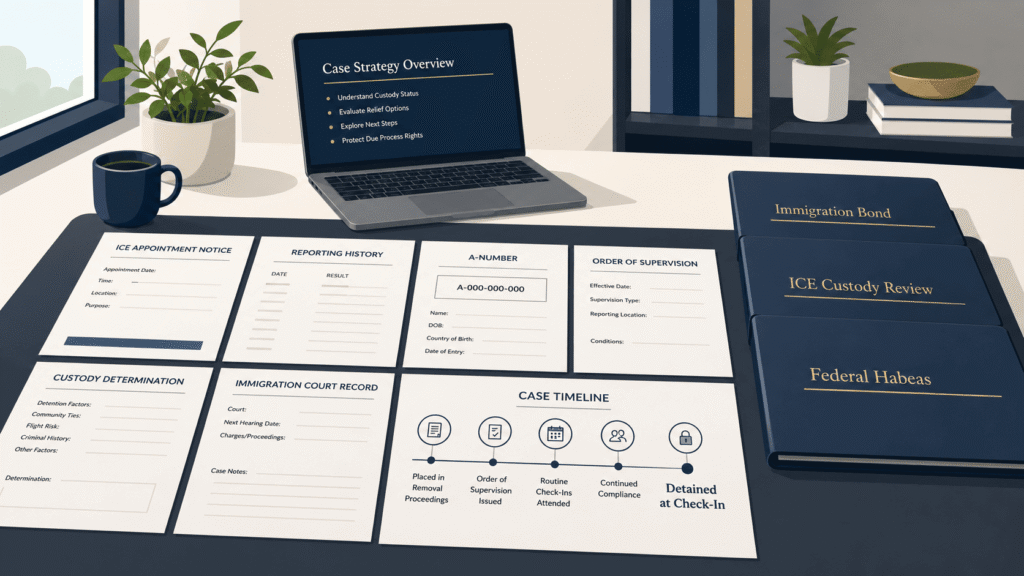
Why an ICE Check-In Can End in Detention
ICE check-ins are generally used to monitor people who are not currently detained. Depending on the person’s history, the appointment may involve confirming an address, reviewing compliance with an order of supervision, checking travel-document efforts, or discussing the status of removal proceedings.
A check-in does not guarantee that the person will leave the office that day. ICE may claim that detention is authorized because of a final removal order, an alleged violation of release conditions, a new criminal or immigration development, an asserted transfer or removal plan, or a change in how the government classifies the person under the detention statutes.
In some cases, the person was previously released on bond, parole, recognizance, or an order of supervision and complied with reporting requirements for years. A sudden re-detention in that setting may require close review of the prior release order, the stated reason for revocation, and whether circumstances materially changed. Our page on challenging unlawful re-detention after release explains that issue in greater detail.
An arrest at an ICE check-in does not automatically prove that detention is lawful. It also does not automatically create a right to bond. The custody authority must be identified first.
What Law Is ICE Using to Detain the Person?
Immigration detention is governed by several different statutes. They do not provide the same access to bond, parole, custody review, or federal court relief. Two people detained at similar check-ins may therefore have very different legal options.
| Possible Authority | General Context | Why It Matters |
|---|---|---|
| 8 U.S.C. § 1226(a) | Detention while removal proceedings remain pending | May permit release on bond or conditional parole, subject to eligibility and jurisdiction |
| 8 U.S.C. § 1226(c) | Mandatory detention for certain covered categories | ICE may argue that an immigration judge cannot grant ordinary bond |
| 8 U.S.C. § 1225(b) | Detention of certain applicants for admission | Bond jurisdiction may be unavailable or disputed; DHS parole may become more important |
| 8 U.S.C. § 1231 | Detention after a final removal order | Post-order custody rules, removal feasibility, and prior supervision history become central |
Section 1226 generally concerns custody while a decision on removal remains pending. Section 1231 addresses detention and removal after a final order. Section 1225 may apply to certain people treated as applicants for admission.
The classification shown on an ICE document is not necessarily the end of the analysis. Counsel may need to compare the statutory label with the person’s entry history, parole history, removal proceedings, prior custody decisions, criminal record, and controlling circuit law.
Bond, ICE Release, and Habeas at a Glance
Bond, parole, and habeas are not three names for the same request. They involve different decision-makers, legal standards, procedures, and possible remedies.
| Legal Path | Decision-Maker | Central Question | Possible Result |
|---|---|---|---|
| Immigration bond | Immigration judge | Does the judge have jurisdiction, and is release on bond legally available? | Bond, continued detention, or no bond jurisdiction |
| ICE custody release or parole | ICE or DHS | Will the agency exercise available statutory or discretionary release authority? | Release under conditions or continued custody |
| Federal habeas corpus | Federal district court | Does the detention violate the Constitution or federal law? | Release, a custody hearing, a new review, limited relief, or denial |
For a broader comparison of the two court systems, review our guide to habeas corpus versus an immigration bond hearing.
When an Immigration Bond Request May Be Available
An immigration bond proceeding asks an immigration judge to review a DHS custody decision. The EOIR Policy Manual explains that bond proceedings are separate from the underlying removal case and that immigration judges generally have bond jurisdiction only when the statutes and regulations permit it.
Where jurisdiction exists, the judge may examine issues such as danger, flight risk, community ties, prior compliance, criminal history, available relief, and the proposed release plan. The person may submit evidence such as sponsor declarations, proof of residence, employment records, family documents, medical records, and certified criminal dispositions.
However, some detained people are classified under provisions that ICE considers mandatory or outside ordinary immigration-court bond jurisdiction. The immigration judge may then refuse to conduct a bond hearing or determine that the court lacks authority to order release.
A no-jurisdiction finding should be reviewed carefully. It may depend on the detention statute, entry classification, final-order status, and controlling precedent. Our article on what happens when an immigration judge denies or refuses a bond hearing discusses possible federal-court issues.
When an ICE Parole or Custody Request May Be Relevant
In some cases, release must first be requested from ICE rather than an immigration judge. This may be described as a custody request, conditional parole request, humanitarian parole request, post-order custody review, or another form of agency release depending on the person’s legal classification.
The word parole has several meanings in immigration law. A custody-related release does not necessarily grant lawful admission, terminate removal proceedings, cancel a removal order, or create permanent immigration status. The request must identify the exact authority under which ICE can release the person.
A strong agency release package may address:
- The person’s history of attending ICE and immigration-court appointments
- A verified residential address and responsible sponsor
- Employment, family, and community ties
- Medical or humanitarian circumstances
- Criminal history and certified case dispositions
- Travel-document and removal-related developments
- A practical reporting, transportation, and treatment plan
For someone previously released under an order of supervision, counsel may also examine the revocation procedures in 8 C.F.R. § 241.4 and the rules addressing removal foreseeability in 8 C.F.R. § 241.13.
Was your loved one taken into custody during a routine ICE appointment?
Our federal litigation team can review the detention statute, prior release history, final-order status, bond jurisdiction, current facility, and transfer risk to determine which legal path may be available.
When Federal Habeas Corpus May Be Necessary
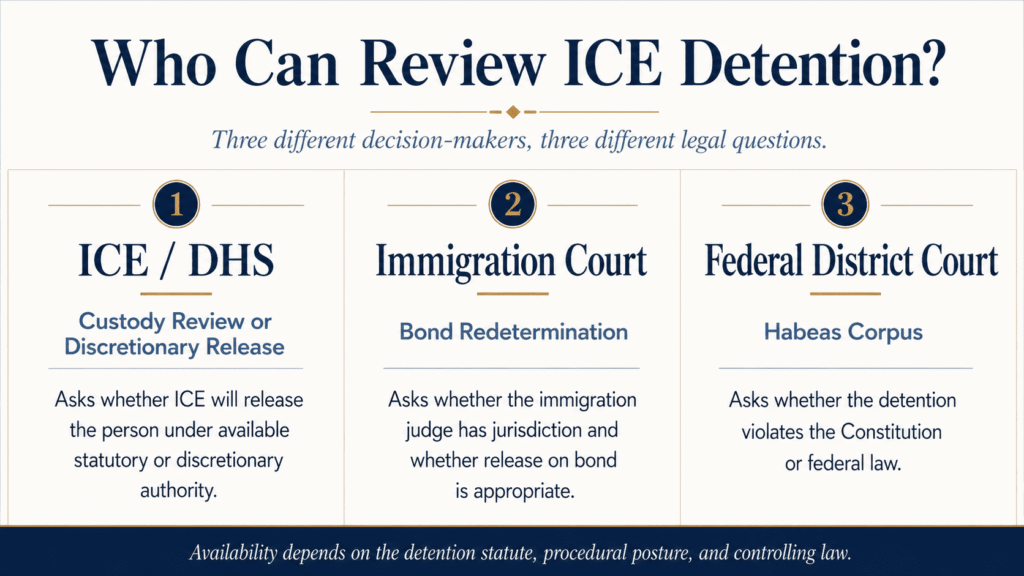
A federal habeas corpus petition asks an independent federal judge to review whether custody violates the Constitution, federal statutes, or other federal law. Most immigration detention petitions are brought under 28 U.S.C. § 2241.
A habeas petition generally does not ask the district court to grant asylum, approve adjustment of status, cancel removal, or replace the immigration judge. Its focus is narrower: May the government lawfully continue holding this person under the existing custody process?
Potential habeas issues after an ICE check-in arrest may include:
- An immigration judge states that no bond jurisdiction exists
- ICE allegedly applies the wrong detention statute
- A person is re-detained without an adequate change in circumstances
- Prior release is revoked without legally sufficient process
- Detention becomes prolonged without meaningful custody review
- Post-order detention continues when removal is not reasonably foreseeable
- A transfer threatens access to counsel or creates a jurisdictional emergency
The possible remedy depends on the claim and controlling law. A federal judge may order release, require a bond hearing, direct a new custody review, issue limited protective relief, deny the petition, or permit additional proceedings. A habeas lawyer must identify the correct respondent, federal district, custody statute, constitutional theory, and requested remedy before filing.
Our guide to 28 U.S.C. § 2241 in immigration detention cases provides additional information about the federal statutory foundation.
Can Bond, Parole, and Habeas Be Pursued Together?
These legal paths are not always mutually exclusive. A person may request agency release while counsel investigates bond jurisdiction or prepares a habeas petition. In another case, the person may first seek bond and later challenge the absence or inadequacy of that process in federal court.
The correct sequence depends on several questions:
- Does the immigration judge have jurisdiction?
- Has ICE issued a written custody decision?
- Is a final removal order in effect?
- Was the person previously released?
- Has an available custody process been requested or completed?
- Is transfer or removal imminent?
- Could delay undermine the federal court’s practical ability to act?
The government may argue that a person should complete an available administrative process before requesting federal relief. In other cases, waiting may be impractical or unnecessary because the claimed injury is the absence of a lawful process, the lack of jurisdiction, or an imminent custody-related action. This analysis is case-specific.
What Families Should Do During the First 24 Hours
The first day should be used to establish a reliable factual record. Families should avoid assuming that ICE, the detention facility, and the immigration court will immediately provide the same information.
- Record the check-in details. Save the office address, appointment notice, date, time, officer information, and last communication.
- Find the A-Number. Check prior ICE notices, work permits, immigration-court documents, and USCIS records.
- Search the ICE locator. Use the exact A-Number or exact biographical details in the Online Detainee Locator System.
- Identify the facility and ERO office. A new detention may not appear immediately in every system.
- Collect prior custody documents. Look for bond orders, parole documents, Forms I-220A or I-220B, supervision orders, Form I-286, and custody-review decisions.
- Confirm the immigration posture. Determine whether proceedings are pending, a final order exists, an appeal is active, or a stay has been granted.
- Preserve proof of compliance. Gather check-in records, address updates, appointment confirmations, and reporting history.
- Collect release-plan evidence. Include a verified address, sponsor, transportation plan, medical information, and family-support records.
- Ask about transfer or removal. Preserve any officer statement, itinerary, locator change, or written notice.
- Request a legal assessment. Counsel should evaluate bond, ICE release, federal habeas, and emergency-transfer issues together.
ICE states that the locator can be used to search for people currently in ICE custody and certain people who have remained in CBP custody for more than 48 hours. If a recently detained person does not appear, families can also contact the appropriate ERO field office rather than treating the absence as proof of release.
Mistakes That Can Delay an Emergency Review
Families often receive incomplete or conflicting information immediately after detention. A few avoidable mistakes can make an urgent legal review more difficult.
| Common Mistake | Why It Creates a Problem |
|---|---|
| Waiting several days for the locator to update | ICE may transfer the person or take other action while the family waits |
| Assuming everyone qualifies for bond | Bond jurisdiction depends on the detention statute and case posture |
| Using “parole” without identifying the legal authority | Different release mechanisms have different standards and consequences |
| Sending only hardship letters | Counsel also needs custody, court, statutory, and procedural records |
| Confusing detention litigation with removal defense | Habeas usually challenges custody rather than deciding the underlying removal claim |
| Ignoring transfer risk | A transfer may affect attorney access, the proper respondent, venue, and circuit law |
Filing a habeas petition also does not automatically stop a transfer or removal. When ICE action appears imminent, counsel may need to evaluate a temporary restraining order, stay request, or other emergency relief. See our guide to emergency habeas options when ICE plans an out-of-state transfer.
Frequently Asked Questions
Can an immigration judge release someone detained at an ICE check-in?
Sometimes. The immigration judge must first have bond jurisdiction. Eligibility depends on the detention statute, the person’s immigration history, and applicable regulations and precedent. Some classifications provide ordinary bond review, while others may place release authority with DHS or create a dispute requiring federal review.
Is an ICE parole request the same as an immigration bond request?
No. A bond request asks an immigration judge to review custody. A parole or custody-release request asks ICE or DHS to exercise agency authority. The evidence may overlap, but the decision-maker, authority, and legal standard are different.
Can a federal judge set an immigration bond?
The available habeas remedy varies. A federal judge may order release in an appropriate case, require a constitutionally sufficient bond hearing, direct a new custody review, or deny relief. In some cases, the actual bond amount is later determined by an immigration judge under the process ordered by the federal court.
Does six months of detention automatically create a right to a bond hearing?
No single nationwide statutory rule guarantees a bond hearing on day 180. In Johnson v. Arteaga-Martinez, the Supreme Court held that § 1231(a)(6) itself does not impose the specific six-month bond-hearing procedure adopted by the lower court. Separate constitutional arguments and circuit-specific precedent may still require case-specific analysis.
What if the person has a final removal order?
A final order may shift the custody analysis to § 1231. Counsel will examine the removal period, any stay, withholding-only proceedings, travel-document efforts, prior release, supervision conditions, and whether removal is reasonably foreseeable. Review our article on habeas corpus after a final deportation order.
What happens if ICE transfers the person to another state?
The family should immediately confirm the new facility and preserve locator screenshots. Transfer can affect counsel access, the current custodian, the appropriate federal district, applicable circuit law, and the practical timing of emergency relief.
Does filing habeas automatically stop removal?
No. A detention habeas petition does not automatically stay removal or prohibit transfer. Any emergency protection generally must be specifically requested and supported with evidence showing the applicable legal standard.
Can a person be released after the immigration judge refuses bond jurisdiction?
Possibly. Depending on the case, counsel may examine an ICE release request, a challenge to the statutory classification, a bond appeal, or federal habeas relief. One anonymized case on our site involved an ICE check-in arrest followed by federal habeas litigation and a later bond hearing. Prior results do not guarantee the outcome of another case.
Choosing the Correct Path After an ICE Check-In Arrest
Bond, ICE parole, and federal habeas answer different questions. The correct strategy depends on the person’s entry history, detention statute, prior release, final-order status, bond jurisdiction, custody documents, current facility, and transfer or removal risk.
Families should avoid assuming that a particular form or hearing is automatically available. The strongest first step is to build an accurate custody record and determine who has legal authority to review the detention now. That analysis may reveal an immigration-court remedy, an ICE release request, a federal habeas claim, or a coordinated strategy involving more than one path.
Was your loved one detained during an ICE check-in?
Time may be critical, especially when the detention facility, bond jurisdiction, or transfer plans remain unclear. Send us the ICE appointment notice, A-Number, custody documents, immigration-court history, prior release records, and current facility information for an urgent evaluation.
Phone: (+1) 862-799-2200
Email: info@gozellaw.com
Legal Disclaimer: This article is provided for general informational purposes only and does not constitute legal advice. Every immigration detention case has unique circumstances. For legal guidance specific to your situation, consult an experienced immigration attorney. The information reflects laws, policies, and publicly available guidance as of July 31, 2026; subsequent changes may affect its accuracy. Prior results do not guarantee a similar outcome.
Sources
- 8 U.S.C. § 1225 — Inspection and Detention of Applicants for Admission
- 8 U.S.C. § 1226 — Apprehension and Detention Pending a Removal Decision
- 8 U.S.C. § 1231 — Detention and Removal After a Final Order
- 28 U.S.C. § 2241 — Power to Grant Writs of Habeas Corpus
- EOIR Policy Manual, Chapter 8.3 — Bond Proceedings
- ICE Online Detainee Locator System
- ICE — Locating Individuals in Detention
- 8 C.F.R. § 241.4 — Continued Detention, Release, and Revocation Procedures
- 8 C.F.R. § 241.13 — Removal Not Reasonably Foreseeable
- Johnson v. Arteaga-Martinez, 596 U.S. 573 (2022)
Every day in detention is a day away from your family.
If the immigration system has failed you, federal court may be the only answer. Let us review your case for free.
Get a Free Case Evaluation