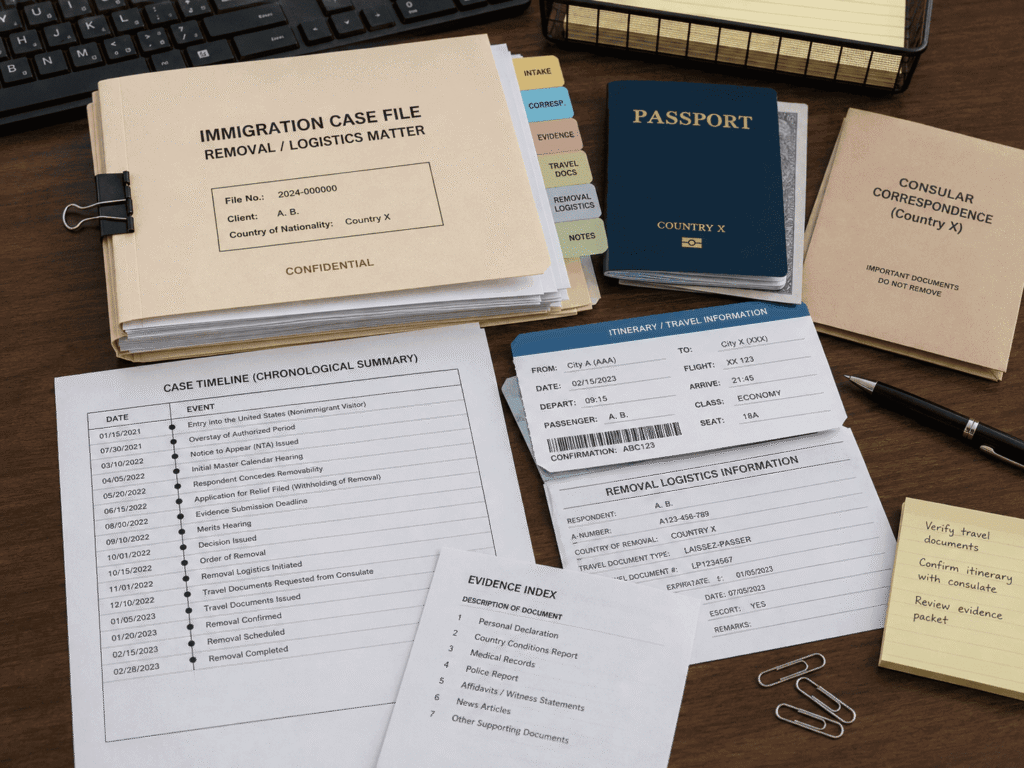
A final removal order does not answer the most important detention question: can ICE actually carry out the removal? Months may pass while a person remains in ICE custody, yet no travel document is issued, no receiving country confirms acceptance, and no concrete departure plan appears.
In post-order detention cases, the legal analysis eventually becomes more specific than simply counting days. Under Zadvydas v. Davis, the question can turn on whether there is a significant likelihood of removal in the reasonably foreseeable future. After the presumptively reasonable six-month period, evidence becomes especially important because the detained person must first provide good reason to believe that removal is no longer realistically approaching.
That means families should not focus only on how long detention has lasted. They should also preserve the record of travel-document efforts, consular communications, ICE custody decisions, failed removal arrangements, and the detained person’s cooperation. Those records may help show whether removal is actually progressing or remains only a theoretical possibility.
In This Article
- What Does “Reasonably Foreseeable” Actually Test?
- What Evidence May Show Removal Is Not Moving Forward?
- What Can ICE’s Own Records Reveal?
- Why Does Cooperation Matter?
- What Should Families Document Over Time?
- What Is Weak Evidence vs. a Stronger Record?
- When May the Evidence Support Federal Habeas Review?
- Frequently Asked Questions
What Does “Reasonably Foreseeable” Actually Test?
The governing question is not whether removal could theoretically happen someday. It is whether the government has a significant likelihood of carrying out removal within a reasonably foreseeable period.
Federal law generally provides a 90-day removal period after a removal order becomes final, although the precise start and duration of that period can depend on the procedural posture of the case. The current text of 8 U.S.C. § 1231 governs that post-order framework.
The Supreme Court addressed longer detention in Zadvydas v. Davis. The Court recognized six months as a presumptively reasonable period. After that point, if the detained person provides good reason to believe there is no significant likelihood of removal in the reasonably foreseeable future, the government must respond with evidence sufficient to rebut that showing.
Six months therefore does not create automatic release. It changes the importance of the evidence.
For a broader explanation of the final-order detention framework, the 90-day period, and the Zadvydas rule, see our separate guide to habeas corpus after a final removal order. This article focuses on the narrower question of how the evidentiary record can show whether removal is actually approaching.
The Supreme Court has also clarified in Johnson v. Arteaga-Martinez that 8 U.S.C. § 1231(a)(6) itself does not create an automatic statutory right to an immigration-court bond hearing after six months.
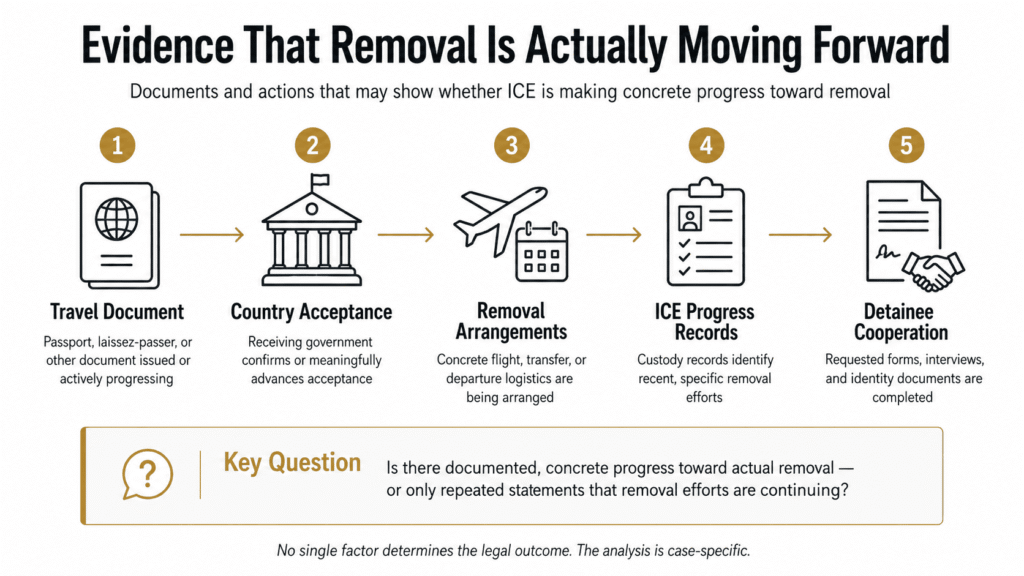
The calendar matters, but the evidence often matters more. A strong post-order record asks what ICE has actually accomplished toward removal, not simply how many days have passed.
What Evidence May Show Removal Is Not Moving Forward?
No single document automatically proves that removal is not reasonably foreseeable. The stronger analysis usually comes from multiple records pointing in the same direction.
Current regulations at 8 C.F.R. § 241.13 expressly allow an eligible detained person to submit documentation supporting the claim that removal is not significantly likely in the reasonably foreseeable future.
Several types of evidence may become relevant.
No Travel Document Has Been Issued
Many removals cannot occur without a valid passport, laissez-passer, or other travel document acceptable to the receiving country. If ICE has repeatedly sought a document but months pass without issuance, the correspondence surrounding those efforts may be more useful than a bare statement that “ICE does not have a passport.”
Important records can include:
- Requests to apply for or renew a passport;
- Copies of travel-document applications;
- Consular interview notices;
- Receipts showing documents were submitted;
- Written responses from an embassy or consulate; and
- ICE notices referring to unresolved travel-document issues.
The critical distinction is between a temporary processing step and a documented pattern showing that the government still lacks what it needs to complete removal.
The Receiving Country Has Not Confirmed Acceptance
Country cooperation can be a practical barrier. ICE itself recognizes that some governments may deny or delay accepting nationals who are subject to final removal orders. Its official visa sanctions information discusses circumstances in which foreign governments delay or refuse the acceptance of their nationals.
That does not mean every delayed response establishes a Zadvydas claim. But a documented history of unsuccessful attempts to obtain acceptance can become important, especially where ICE cannot identify another country willing to receive the person.
Removal Arrangements Have Failed or Been Cancelled
A prior attempt to carry out removal can be highly relevant to the factual record.
Examples may include:
- A scheduled departure that did not occur;
- A flight cancelled because required documents were unavailable;
- A receiving government declining or delaying acceptance;
- A transfer for removal followed by return to detention; or
- Repeated logistical attempts that did not produce an actual departure.
The important question is why the attempt failed and whether the same obstacle remains unresolved.
ICE Still Cannot Identify Concrete Progress
Statements such as “travel documents are pending” or “removal efforts continue” may describe an open process without showing how close that process is to completion.
A more useful record identifies dates and events: when the last travel-document request was made, whether the foreign government responded, whether a passport interview occurred, whether acceptance was confirmed, and whether ICE has identified an expected next step.
What Can ICE’s Own Records Reveal?
Families often possess only part of the story. ICE’s custody documents can provide important clues about what the agency believes is preventing or advancing removal.
Post-Order Custody Review records may identify the basis for continued detention, travel-document activity, flight-risk concerns, danger findings, or the government’s view of the removal timeline. The separate custody procedures in 8 C.F.R. § 241.4 should not be confused with the specific reasonably-foreseeable-removal determination under § 241.13.
For purposes of this evidence-focused review, families should preserve:
- Every written custody decision;
- Notices of file or custody review;
- Travel-document instructions;
- Notices alleging failure to cooperate;
- Written explanations for continued detention;
- Consular appointment records; and
- Any document describing efforts to obtain acceptance by another country.
A custody decision can be useful even when it denies release. The explanation may identify exactly what ICE says is still happening and allow counsel to compare that explanation with the passage of time and later events.
Why Does Cooperation Matter?
A removal-foreseeability argument must address what the detained person has done to cooperate with lawful removal efforts.
Under 8 U.S.C. § 1231(a)(1)(C), the removal period may be extended if a person fails or refuses to make a timely, good-faith application for necessary travel documents or acts to prevent removal. Section 241.13 likewise requires information showing compliance and cooperation with efforts to obtain travel documents.
That makes cooperation evidence a central part of the record.
- Signed travel-document applications;
- Proof of participation in consular interviews;
- Copies of identity documents provided to ICE;
- Passport application receipts;
- Records of attempts to obtain birth certificates or national identity documents; and
- Written responses to ICE requests for information.
If ICE alleges noncooperation, the issue should not be ignored. Counsel should determine what ICE requested, when it requested it, what response was provided, and whether the government has documented an actual refusal or obstruction.
A case in which the detained person has repeatedly complied but removal still cannot be accomplished presents a different record from one in which the government attributes the delay to the person’s own conduct.
What Should Families Document Over Time?
The clearest way to organize the evidence is often a dated timeline. Instead of producing a pile of notices, create a record showing how removal efforts developed and where they stopped.
| Record | What to Document | Why It May Matter |
|---|---|---|
| Final-order documents | Order date, appeals, stays, later court orders | Helps determine the correct post-order timeline. |
| Travel-document activity | Applications, interviews, requests, responses | Shows whether removal logistics are advancing. |
| Consular communications | Acceptance, refusal, silence, requests for more evidence | May show whether the receiving country is cooperating. |
| Custody reviews | Decision dates and reasons for continued detention | Documents ICE’s own explanation over time. |
| Failed removal attempts | Scheduled movement, cancelled flights, unsuccessful transfers | May identify a persistent barrier rather than ordinary delay. |
| Cooperation records | Forms signed, documents supplied, interviews attended | Helps address a possible failure-to-cooperate allegation. |
For a broader discussion of detention lasting six months or longer, see our separate prolonged ICE detention guide. Keeping the broader detention analysis on that page allows this article to remain focused on the evidentiary question.
ICE says removal is still being pursued, but the record shows months of unresolved travel-document problems?
A focused review should examine what ICE has actually done, what the receiving country has communicated, whether prior removal efforts failed, and whether your loved one has fully cooperated with the process.
What Is Weak Evidence vs. a Stronger Record?
A Zadvydas analysis is fact-specific. The absence of a deportation date, by itself, is not necessarily enough. The objective is to build a record showing why actual removal has become increasingly speculative.
| Usually Weaker Standing Alone | Potentially Stronger When Documented |
|---|---|
| “He has been detained for seven months.” | Seven months of detention plus repeated unsuccessful travel-document efforts and no confirmed acceptance. |
| “The embassy has not answered.” | Dated requests, follow-ups, consular correspondence, and ICE records showing that acceptance remains unresolved. |
| “ICE has no removal date.” | Multiple custody decisions that still cannot identify completed travel documents, confirmed acceptance, or another concrete removal step. |
| “The country is difficult to deport to.” | Case-specific evidence showing failed efforts involving this person, combined with reliable evidence about broader acceptance problems. |
| “My loved one cooperated.” | Copies of signed forms, applications, identity documents, interview records, and written responses proving cooperation. |
The regulation itself directs the government to consider the history of the person’s cooperation, the government’s efforts to remove that person and others to the relevant country or possible third countries, the expected results of those efforts, and relevant information concerning the prospects for removal.
When May the Evidence Support Federal Habeas Review?
When detention continues and the record increasingly shows that actual removal is not significantly likely in the reasonably foreseeable future, federal habeas corpus may become an important avenue for reviewing continued custody.
The purpose of that litigation is not to relitigate whether the immigration judge correctly entered the removal order. The focus is narrower: whether the government can lawfully continue detaining the person under the circumstances that now exist.
Our dedicated guide to 28 U.S.C. § 2241 in ICE detention cases explains the federal habeas statute and the role of the U.S. District Court. Our prolonged detention practice page also explains how federal litigation may apply when custody continues without a realistic end point.
Before filing, counsel should examine:
- The date and procedural status of the final removal order;
- The precise detention period that legally counts toward the analysis;
- Any judicial or administrative stay affecting removal;
- Every travel-document and consular effort;
- ICE’s latest explanation for continued custody;
- Whether the detained person has cooperated fully;
- Whether removal to the designated country or a third country remains realistic; and
- The federal law controlling in the district where the person is detained.
No one document guarantees release, and no single timeline controls every case. The strength of the analysis comes from connecting time, government action, removal obstacles, and documented cooperation into one coherent record.
Frequently Asked Questions
Does ICE have to release someone automatically after six months?
No. Six months is not an automatic release deadline. Under Zadvydas, after the presumptively reasonable period, the detained person must first provide good reason to believe there is no significant likelihood of removal in the reasonably foreseeable future. The government may then present evidence to rebut that showing.
Is the lack of a travel document enough by itself?
Not necessarily. A missing travel document can be important, but the stronger record usually shows how long the document has been pursued, what efforts were made, what the consulate communicated, and whether there is another realistic means of carrying out removal.
What if the embassy or consulate simply does not respond?
Consular silence may become relevant when it is documented over time and combined with repeated good-faith efforts by ICE and the detained person. One unanswered message usually tells less than a history of requests, follow-ups, interviews, and custody decisions showing that the same obstacle remains unresolved.
What if ICE says my loved one failed to cooperate?
That allegation can materially change the analysis because federal law allows the removal period to be extended in certain failure-to-cooperate situations. Preserve evidence showing exactly what ICE requested and how your loved one responded.
Can Post-Order Custody Review documents help?
Yes. POCR decisions may identify ICE’s stated reasons for continued detention and describe the status of removal efforts. The documents can be useful evidence even though POCR and a § 241.13 foreseeability determination are legally distinct procedures.
Does a habeas petition challenge the deportation order?
A detention-focused habeas petition generally challenges continued custody rather than the validity of the final removal order itself. The legal procedures for challenging a removal order are different.
The Removal Record Matters More Than a Calendar Date Alone
After months in post-order detention, families understandably focus on the number of days their loved one has been held. But a stronger legal evaluation asks a second question: what evidence shows whether removal is actually becoming more likely?
Travel documents, consular responses, failed removal arrangements, ICE custody decisions, country-acceptance issues, and proof of cooperation can turn a vague detention history into a concrete evidentiary record.
Where that record shows prolonged custody but little meaningful progress toward actual removal, federal habeas review may deserve closer consideration. The goal is not to rely on a six-month slogan. It is to document why the government’s stated purpose for continued detention may no longer match the practical reality of the case.
Has your loved one remained in ICE custody while travel-document or receiving-country problems continue without a clear solution?
Contact our team for an evaluation of the final-order timeline, travel-document history, consular communications, ICE custody decisions, cooperation record, prior removal attempts, and available federal habeas options.
Phone: +1 (862) 799-2200
Email: info@gozellaw.com
Legal Disclaimer: This article is provided for general informational purposes only and does not constitute legal advice. Every immigration case has unique circumstances. For legal guidance specific to your situation, we recommend consulting with an experienced immigration attorney. The information in this article reflects laws, regulations, and publicly available guidance as of August 10, 2026; subsequent legal or policy changes may affect its accuracy. Prior results do not guarantee a similar outcome.
Sources
- Zadvydas v. Davis, 533 U.S. 678 (2001) — U.S. Supreme Court opinion via Cornell Legal Information Institute
- 8 U.S.C. § 1231 — Detention and Removal of Aliens Ordered Removed, Office of the Law Revision Counsel
- 8 C.F.R. § 241.13 — Determination of Whether Removal Is Significantly Likely in the Reasonably Foreseeable Future
- 8 C.F.R. § 241.4 — Continued Detention and Post-Order Custody Review
- Johnson v. Arteaga-Martinez, 596 U.S. 573 (2022) — U.S. Supreme Court
- U.S. Immigration and Customs Enforcement — Visa Sanctions and Foreign-Government Cooperation With Removal
Every day in detention is a day away from your family.
If the immigration system has failed you, federal court may be the only answer. Let us review your case for free.
Get a Free Case Evaluation