There is no automatic rule requiring ICE to release someone after six months. In New Jersey, federal courts evaluate whether detention under 8 U.S.C. § 1226(c) has become constitutionally unreasonable by examining the full circumstances of the case, not merely the date on a calendar.
The controlling Third Circuit framework focuses on four nonexclusive factors: the length of detention, whether custody is likely to continue, the reasons for delay, and whether the conditions of confinement resemble criminal punishment. The duration of detention is the most important factor, but no single period automatically guarantees a hearing or release.
This article explains how the Third Circuit applies those factors, why six months is a reference point rather than a deadline, and how a federal habeas corpus petition may seek an individualized bond hearing when prolonged mandatory detention has become unreasonable.
In This Article
- Why There Is No Automatic Six-Month Release Rule
- The Third Circuit’s Four-Factor Test
- How the Four Factors Work Together
- What a Habeas Petition Can Ask the Court to Do
- Evidence That May Support a Prolonged-Detention Challenge
- Why the New Jersey Location Matters
- When Should a Family Request a Habeas Evaluation?
- Frequently Asked Questions

Why There Is No Automatic Six-Month Release Rule
Families often hear that ICE must release a detained person after six months. That statement is too broad. Different immigration detention statutes apply at different procedural stages, and the legal significance of six months depends on why the person is detained, whether a final removal order exists, and which federal appellate circuit governs the habeas case.
This article focuses on people detained during ongoing removal proceedings under INA § 236(c), codified at 8 U.S.C. § 1226(c). That provision requires detention of certain noncitizens who fall within specified criminal or security-related categories and generally does not provide a routine statutory bond process comparable to § 1226(a).
Six Months Is a Reference Point, Not a Deadline
The Third Circuit has repeatedly declined to create a bright-line rule making detention automatically reasonable or unreasonable after a fixed number of months. Instead, it treats duration as the most important part of a highly fact-specific constitutional inquiry.
In German Santos v. Warden Pike County Correctional Facility, the Third Circuit explained that detention becomes increasingly suspect after the relatively short periods discussed by the Supreme Court in Demore v. Kim. But the court expressly refused to establish an automatic threshold at five months, six months, or one year.
Key point: Six months may justify closer constitutional scrutiny, but it does not operate as an automatic release date or guarantee a bond hearing in every case.
The Detention Statute Must Be Identified First
| Detention Authority | General Context | Why the Distinction Matters |
|---|---|---|
| 8 U.S.C. § 1226(a) | Pre-final-order detention during removal proceedings under a discretionary custody framework. | An immigration judge may generally have authority to consider bond, subject to statutory and regulatory limits. |
| 8 U.S.C. § 1226(c) | Mandatory detention during removal proceedings for covered categories. | A routine immigration-court bond hearing may be unavailable, making an as-applied constitutional habeas challenge especially important when detention becomes prolonged. |
| 8 U.S.C. § 1231 | Detention after a final order of removal. | Different statutory rules and Supreme Court precedent apply, including questions about whether removal is reasonably foreseeable. |
A family should not assume that a rule associated with post-final-order detention applies to a person whose immigration case is still pending. The first step is to identify the custody statute, the current procedural posture, and whether the person has already received any meaningful individualized review.
The Third Circuit’s Four-Factor Test
New Jersey is within the Third Circuit. For prolonged detention under § 1226(c), the principal framework comes from German Santos, together with the earlier decisions in Chavez-Alvarez v. Warden York County Prison and Diop v. ICE/Homeland Security.
The Third Circuit continued to apply this approach in 2026. In Michelin v. Warden Moshannon Valley Correctional Center, a precedential opinion involving consolidated immigration habeas cases, the court reiterated the four factors and held that the government lacked a reasonable basis for resisting an individualized bond hearing after more than sixteen months of detention where custody was likely to continue.
Factor One: The Length of Detention
The duration of custody is the most important factor. At the beginning of detention, the government may rely on the statutory judgment that covered individuals should be held during removal proceedings. As the months pass, however, the personal liberty burden grows and the categorical justification for detention may become insufficient without an individualized hearing.
The relevant cases illustrate the range of detention periods courts have examined:
| Decision or Time Period | What It Shows |
|---|---|
| Demore v. Kim | The Supreme Court upheld a facial challenge in a context where detention was understood to be brief—generally about a month and a half, or about five months when an appeal was taken. |
| After approximately five months | The Third Circuit has said detention becomes increasingly suspect, but five months is not an automatic constitutional cutoff. |
| Chavez-Alvarez | The court concluded that detention became unreasonable at some point between six months and one year under the circumstances presented. |
| Michelin/Abioye (2026) | The court found no reasonable basis for opposing a hearing after more than sixteen months where continued detention remained likely. |
| German Santos | More than two and a half years of detention, together with the likelihood of continued custody and penal conditions, was unreasonable. |
| Diop | Detention lasting nearly three years was unreasonable. |
These examples are not filing deadlines. A six-month case with an unresolved hearing schedule may present a stronger constitutional concern than a longer case approaching an immediate and final resolution. Duration must be evaluated together with the remaining factors.
Factor Two: Whether Detention Is Likely to Continue
The court looks forward as well as backward. The question is not only how many months the person has already spent in custody, but also whether there is a realistic end to detention in sight.
- Is the individual merits hearing scheduled soon, or many months away?
- Has the immigration judge already ruled?
- Is an appeal pending before the Board of Immigration Appeals?
- Could a later petition for review add months or years?
- Has the case been remanded for another round of agency proceedings?
- Are unresolved legal or factual issues likely to prevent a prompt final decision?
Eight months of custody may be viewed differently when a final hearing is scheduled for the following week than when the merits hearing remains six months away and an administrative appeal is likely. When no meaningful endpoint is visible, the likelihood-of-continuation factor weighs more heavily against detention without a bond hearing.
Factor Three: The Reasons for Delay
Courts review the procedural history to understand why the immigration case remains unresolved. Relevant questions may include:
- Which party requested continuances, and why?
- Were hearings postponed because of court scheduling, interpretation problems, transportation issues, or missing government records?
- Did either side act carelessly or in bad faith?
- Was a remand required because an agency decision was unclear or legally defective?
- Did the detained person request unnecessary delay, or pursue a legitimate application or appeal in good faith?
A detained person is not ordinarily punished merely for pursuing asylum, cancellation of removal, an administrative appeal, or another good-faith legal remedy. The Third Circuit has warned that treating all time attributable to legitimate litigation as reasonable would effectively penalize a person for using the procedures Congress made available.
At the same time, a court may consider substantial delays caused by unnecessary continuances or bad-faith litigation. The analysis is not designed to assign blame mechanically. Detention can become unreasonable even when the government has processed the removal case without misconduct.
A good-faith challenge to removal does not automatically make every additional month of detention constitutionally reasonable.
Factor Four: The Conditions of Confinement
Immigration detention is legally classified as civil detention, not punishment for a crime. The Third Circuit therefore asks whether the person’s actual confinement is meaningfully different from criminal incarceration.
- How many hours per day is the person confined to a cell or housing unit?
- Is the person held in a jail or prison environment?
- Is the person housed with convicted criminal inmates?
- How restricted are recreation, movement, visitation, telephone access, and legal communication?
- Is adequate medical or mental-health care available?
- Has the person experienced segregation, isolation, or other severe restrictions?
In German Santos, the detainee was held in prison alongside people serving criminal sentences and was reportedly confined to his cell for twenty-three hours per day. The Third Circuit found that those conditions strongly supported the conclusion that his civil detention had become unreasonable. The longer custody continues, the more weight conditions of confinement may carry.
Has your loved one been held in New Jersey for months without a meaningful bond hearing?
A prolonged-detention review should examine more than the calendar. Our team can evaluate the custody statute, immigration-court timeline, expected future delay, and conditions of confinement to determine whether a federal habeas corpus challenge may be available.
How the Four Factors Work Together
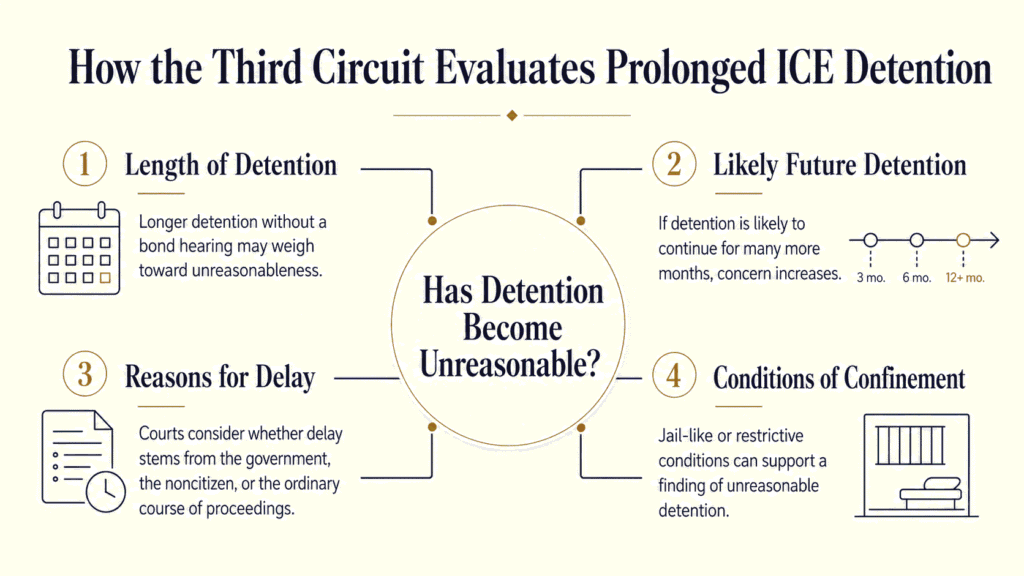
The four factors are not a point system, and every factor does not need to favor the detained person. In the 2026 Michelin/Abioye decision, the Third Circuit explained that uncertainty regarding the reasons for delay and conditions of confinement did not overcome the decisive weight of lengthy detention and the likelihood that custody would continue.
| Scenario A | Scenario B |
|---|---|
| Eight months in custody. | Eight months in custody. |
| A final individual hearing is scheduled next week. | The merits hearing remains six months away. |
| Several substantial continuances were requested without a clear need. | Most delay resulted from court scheduling and agency processing. |
| The record reflects fewer restrictions than a jail setting. | The person reports severe confinement, limited legal calls, and significant medical concerns. |
| The expected remaining detention may be relatively short. | An appeal is likely to extend custody well beyond one year. |
Both people have been detained for the same number of months, but their constitutional claims may be materially different. A strong habeas analysis connects the entire procedural and factual record to the Third Circuit factors rather than relying on a single date.
What a Habeas Petition Can Ask the Court to Do
A prolonged-detention challenge is generally brought through a petition for a writ of habeas corpus under 28 U.S.C. § 2241. The habeas case does not ordinarily ask the federal judge to decide asylum, cancellation of removal, or the ultimate removability question. It challenges whether the government may continue holding the person without constitutionally adequate review.
Habeas Does Not Always Mean Immediate Release
Depending on the legal violation and requested remedy, a petition may ask the federal court to:
- Declare that continued detention without a hearing has become unconstitutional as applied to the individual case.
- Order an individualized bond hearing within a defined period.
- Require the government to bear the correct burden of proof.
- Require consideration of less restrictive alternatives to detention.
- Order release if the government fails to provide the required hearing or satisfy the ordered standard.
- Grant other relief tailored to the constitutional violation.
Winning a prolonged-detention habeas petition therefore does not always mean the federal judge immediately releases the detainee. A common remedy is an order requiring a meaningful bond hearing that was not otherwise available under the statutory detention framework.
The Government’s Burden at a § 1226(c) Hearing
Under German Santos, once detention under § 1226(c) has become unreasonable, the government must justify continued detention by clear and convincing evidence. The hearing should address whether continued custody is actually necessary based on individualized evidence, including asserted danger or flight risk.
A successful habeas petition may create a meaningful opportunity for release by requiring an individualized hearing—it does not guarantee the outcome of that hearing.
For a broader explanation of the difference between immigration-court custody proceedings and federal litigation, review our guide to habeas corpus versus an immigration bond hearing.
Evidence That May Support a Prolonged-Detention Challenge
The strongest petitions organize the record around the governing constitutional factors. A pile of documents is less useful than a clear timeline showing what happened, why custody continued, and why continued detention now requires individualized justification.
| Third Circuit Factor | Potentially Relevant Evidence |
|---|---|
| Length of detention | ICE arrest date, booking records, facility intake documents, custody notices, transfer records, and a dated detention timeline. |
| Likelihood detention will continue | Immigration-court hearing notices, master and merits hearing dates, BIA briefing schedules, remand orders, pending applications, and appellate dockets. |
| Reasons for delay | Continuance orders, hearing transcripts, party motions, government production history, scheduling notices, remand decisions, and procedural correspondence. |
| Conditions of confinement | Medical records, grievance forms, declarations, housing restrictions, recreation schedules, visitation records, legal-call logs, disciplinary records, and evidence of interrupted treatment or attorney access. |
If a bond hearing is ordered, additional evidence may become important:
- Proof of a stable proposed residence.
- Family and community ties.
- Prior compliance with ICE check-ins, court dates, and supervision requirements.
- Employment history and a realistic release plan.
- Certified criminal dispositions and evidence addressing rehabilitation.
- Medical needs and treatment arrangements.
- Support letters and sponsor declarations.
A complete file should distinguish between evidence supporting the constitutional habeas claim and evidence addressing release conditions at a later bond hearing. Both matter, but they answer different legal questions.
Why the New Jersey Location Matters
New Jersey falls within the Third Circuit, so federal courts in the District of New Jersey must apply controlling Third Circuit precedent. That makes German Santos and the 2026 Michelin/Abioye decision especially important when evaluating a prolonged § 1226(c) detention claim.
A federal habeas petition is separate from the removal case in immigration court. It is filed in federal district court and focuses on the legality of custody. The correct filing strategy can depend on the person’s current facility, immediate custodian, transfer history, and the timing of any move outside New Jersey.
For information about New Jersey detention facilities, local federal-court structure, transfer concerns, and representation, visit our ICE detention lawyer in New Jersey page. For a broader overview of the practice area, see our page on challenging prolonged ICE detention.
When ICE claims the person is categorically ineligible for bond, families may also need an assessment of the underlying custody classification. Our mandatory detention challenge page explains why classification and prolonged-detention arguments sometimes overlap but remain legally distinct.
When Should a Family Request a Habeas Evaluation?
There is no requirement that a family wait for an exact anniversary before asking counsel to review the detention. A location-specific assessment may be appropriate when one or more of the following warning signs appear:
- The person has been detained for several months and no clear endpoint is visible.
- ICE or the immigration judge says the person is under mandatory detention and cannot receive a routine bond hearing.
- The individual hearing, BIA appeal, remand, or petition for review may extend custody for many more months.
- Hearings have repeatedly been postponed because of court or agency scheduling.
- The person is pursuing relief or an appeal in good faith but remains detained solely because proceedings are unresolved.
- Conditions of confinement resemble criminal punishment or are causing documented physical or psychological harm.
- The person has strong family ties, a stable release plan, and a history of complying with court or ICE requirements.
- A prior custody request was denied, but detention has since become substantially longer.
Early review allows counsel to identify missing records, preserve the custody timeline, and evaluate whether the existing facts support a petition now or whether additional developments would materially strengthen the claim.
Frequently Asked Questions
Is ICE required to release someone after six months?
No. Six months is not an automatic release deadline for a person detained under § 1226(c). The Third Circuit evaluates duration together with the expected future length of custody, reasons for delay, and conditions of confinement.
Can a habeas petition be filed before six months?
Potentially, depending on the facts. The Third Circuit has not imposed a mandatory waiting period. A shorter detention may be harder to challenge based on duration alone, but unusual delay, severe conditions, a clearly extended future timeline, or another legal defect may justify earlier review.
Does filing an appeal make the detainee responsible for the delay?
Not automatically. The Third Circuit generally does not hold a good-faith appeal or application for relief against the detained person merely because it extends the proceedings. Unnecessary continuances or bad-faith litigation may be evaluated differently.
Does every factor have to favor the detainee?
No. The factors are nonexclusive and are weighed together. Duration is the most important. In the 2026 Michelin/Abioye decision, the first two factors carried decisive weight even though the remaining factors did not clearly favor the same side.
Does winning habeas guarantee release?
No. A federal court may order an individualized bond hearing rather than immediate release. The result of that hearing depends on the evidence, the governing burden of proof, and the person’s individualized circumstances.
Who bears the burden at a hearing ordered under German Santos?
Once detention under § 1226(c) has become constitutionally unreasonable, German Santos requires the government to justify continued detention by clear and convincing evidence.
Does the same test apply after a final removal order?
Not necessarily. Post-final-order detention is generally governed by § 1231 and a different body of case law. This article addresses prolonged detention during ongoing removal proceedings under § 1226(c).
What the Third Circuit Factors Mean for New Jersey Families
The central question is not whether a person has crossed a universal six-month line. The question is whether continued detention, viewed in light of the entire record, has become unreasonable without an individualized hearing.
In New Jersey, that analysis should begin with the four Third Circuit factors: duration, likely future detention, reasons for delay, and conditions of confinement. A careful habeas petition ties each factor to specific documents, procedural events, and evidence rather than relying on general claims about detention.
Families should also remember that prolonged-detention habeas litigation and the removal case serve different purposes. The immigration court decides whether the person may remain in the United States. The federal habeas court examines whether the government may lawfully continue holding the person while that process unfolds.
Has a loved one remained in New Jersey ICE detention without a clear end date?
Detention length matters, but the complete record determines whether a federal challenge may be available. Our team can review the custody statute, bond history, removal-case timeline, reasons for delay, likely future detention, and conditions of confinement.
Phone: (+1) 862-799-2200
Email: info@gozellaw.com
Legal Disclaimer
This article is provided for general informational purposes only and does not constitute legal advice. Every immigration detention case has unique facts, procedural history, statutory issues, and venue considerations. Prior results do not guarantee a similar outcome. For legal guidance specific to a detention matter, consult an experienced immigration and federal habeas attorney. The information in this article reflects laws and publicly available authorities as of July 22, 2026; subsequent legal developments may affect its accuracy.
Sources
- German Santos v. Warden Pike County Correctional Facility, 965 F.3d 203 (3d Cir. 2020).
- Michelin v. Warden Moshannon Valley Correctional Center and Abioye v. Warden Moshannon Valley Processing Center, Nos. 24-2990 & 24-3198 (3d Cir. Feb. 2, 2026).
- Chavez-Alvarez v. Warden York County Prison, 783 F.3d 469 (3d Cir. 2015).
- Diop v. ICE/Homeland Security, 656 F.3d 221 (3d Cir. 2011).
- Jennings v. Rodriguez, 583 U.S. 281 (2018).
- Demore v. Kim, 538 U.S. 510 (2003).
- 8 U.S.C. § 1226 — Apprehension and Detention of Aliens, Legal Information Institute.
- 28 U.S.C. § 2241 — Power to Grant Writ, U.S. House Office of the Law Revision Counsel.
Every day in detention is a day away from your family.
If the immigration system has failed you, federal court may be the only answer. Let us review your case for free.
Get a Free Case Evaluation