There is no automatic rule requiring ICE to release someone in Virginia after six months. Federal courts first identify which statute authorizes custody, what review has already occurred, why the immigration case remains unresolved, and what relief a habeas court may lawfully order. For facility, venue, transfer, and representation information, review our page on Virginia ICE detention representation.
Detention under 8 U.S.C. § 1226(a), mandatory detention under § 1226(c), and post-order detention under § 1231 are governed by different procedures and legal standards. The same number of months may therefore have different significance depending on the person’s procedural posture.
This article explains how the Fourth Circuit and the Eastern District of Virginia analyze prolonged ICE detention in Virginia, including bond procedure, the Portillo factors, removal foreseeability, and the evidence needed to support federal habeas review.
In This Article
- Why the Detention Statute Controls the Analysis
- Comparing the Main Immigration Detention Authorities
- Section 1226(a): What Miranda Means for Bond Procedure
- Section 1226(c): Prolonged Mandatory Detention in Virginia
- The Portillo Factors Used in the Eastern District of Virginia
- What Virginia Prolonged Detention Decisions Show
- Section 1231: Post-Order Detention and Removal Foreseeability
- Why Six Months Is Not a Universal Release Rule
- Evidence That Builds a Prolonged Detention Record
- What Relief a Federal Habeas Court May Order
- Virginia Habeas Pre-Filing Checklist
- Frequently Asked Questions

Why the Detention Statute Controls the Analysis
A habeas lawyer evaluating prolonged detention must first determine the legal authority under which ICE is holding the person. A petition under 28 U.S.C. § 2241 may challenge custody that violates the Constitution, federal law, or a treaty of the United States. For foundational context, review our guide to federal habeas jurisdiction under 28 U.S.C. § 2241.
Detention during pending removal proceedings may arise under 8 U.S.C. § 1226. Detention after a final or reinstated removal order is generally governed by 8 U.S.C. § 1231. Certain arriving noncitizens may instead be detained under § 1225(b), which presents a separate legal framework and is outside the principal scope of this article.
The statutory classification affects:
- Whether an immigration judge ordinarily has authority to hold a bond hearing;
- Which party bears the burden under existing immigration bond procedures;
- Whether removal foreseeability is central to the habeas claim;
- Whether the requested remedy is release, a bond hearing, a new custody review, or correction of the detention classification;
- Which Supreme Court and Fourth Circuit decisions govern the claim.
The number of months matters, but it does not select the legal test. The strongest Virginia habeas petitions first identify the custody statute and then explain why continued detention is unlawful under that specific framework.
Comparing the Main Immigration Detention Authorities
The following table summarizes the principal distinctions. It is a starting point, not a substitute for reviewing the custody documents and full immigration history.
| Detention Authority | Typical Procedural Posture | Ordinary Custody Process | Common Habeas Question |
|---|---|---|---|
| 8 U.S.C. § 1226(a) | Removal proceedings remain pending and detention is discretionary | Bond review may be available before an immigration judge, with administrative appeal to the BIA | Has the person received constitutionally sufficient and meaningful custody review under current circumstances? |
| 8 U.S.C. § 1226(c) | Removal proceedings remain pending, but ICE asserts mandatory detention | Routine release on bond is generally unavailable unless the classification is defeated or federal relief is ordered | Has mandatory detention become unreasonable or unjustified as applied to this individual? |
| 8 U.S.C. § 1231 | A final or reinstated removal order governs custody | ICE post-order custody reviews; no general statutory right to an immigration judge bond hearing | Is there a significant likelihood of removal in the reasonably foreseeable future? |
The same detention length may therefore carry different legal consequences. A person held for ten months under § 1226(c) may present a due process claim focused on the absence of an individualized hearing. A person held for ten months under § 1231 may need evidence showing that ICE cannot carry out removal in the reasonably foreseeable future.
Has ICE detention continued without a clear review or release path?
Our federal litigation team can examine the custody statute, immigration docket, prior bond decisions, and ICE review records to assess whether a Virginia federal habeas petition fits the current procedural posture.
Section 1226(a): What Miranda Means for Bond Procedure
Section 1226(a) generally permits detention while removal proceedings remain pending and gives the government discretion to release a person on bond or conditional parole. Under the existing regulatory system, a person may seek review of the initial custody determination before an immigration judge and may appeal an adverse bond ruling to the Board of Immigration Appeals. Our guide to habeas corpus versus an immigration bond hearing explains why those proceedings serve different legal functions.
In Miranda v. Garland, the Fourth Circuit reviewed a preliminary injunction that would have changed several procedures used in § 1226(a) bond hearings. The court concluded that the plaintiff had not shown a likelihood of success on claims that due process required the government to bear the burden of proof or required immigration judges to consider ability to pay and alternatives to detention in the manner ordered by the district court.
The majority emphasized that the existing process gives a § 1226(a) detainee multiple opportunities to request release and places on the detainee the burden of showing, by a preponderance of the evidence, that the person is not a danger to the community or a flight risk. The court held that those procedures did not violate due process on the record before it.
What Miranda does and does not resolve
Miranda makes a broad challenge to the ordinary § 1226(a) bond system difficult within the Fourth Circuit. A habeas petition should not assume that a federal judge will automatically shift the burden to the government, require consideration of every proposed release alternative, or order recurring bond hearings based only on the passage of time.
The decision does not mean that every detention following a § 1226(a) bond hearing is immune from federal review. A case-specific petition may still require analysis of issues such as:
- Whether ICE has applied the correct detention statute;
- Whether the immigration judge actually had and exercised bond jurisdiction;
- Whether the custody proceeding provided notice and a meaningful opportunity to present evidence;
- Whether a material change in circumstances was ignored;
- Whether continued custody rests on a legal error rather than a discretionary disagreement about bond;
- Whether the petition challenges prolonged detention as applied to an unusual procedural history rather than seeking a systemwide rule.
A federal district court does not ordinarily sit as an appellate bond court to reweigh every danger or flight-risk finding. The petition must identify a federal constitutional or statutory defect that is distinct from simple disagreement with the immigration judge’s exercise of discretion.
Section 1226(c): Prolonged Mandatory Detention in Virginia
Section 1226(c) requires detention of specified categories of noncitizens during removal proceedings and sharply limits ordinary release authority. When ICE classifies a person under this provision, an immigration judge may conclude that no routine bond jurisdiction exists.
The Supreme Court held in Jennings v. Rodriguez that § 1226(c) does not contain an implied statutory requirement for automatic bond hearings every six months. The decision rejected a reading that inserted periodic hearings into the statute, but it did not eliminate constitutional challenges to prolonged detention as applied to an individual case. Our overview of mandatory detention habeas petitions addresses the separate questions of custody classification, bond jurisdiction, and prolonged detention.
The Eastern District of Virginia has repeatedly examined whether mandatory detention that was lawful at its outset became unreasonable after an unusually long period without individualized review. These decisions do not establish a fixed deadline. They use a fact-dependent analysis that compares the detention period and procedural history with the government’s interests in ensuring appearance and protecting the public.
Classification and duration are separate questions
A person may challenge whether § 1226(c) applies at all. That classification issue is different from the argument that detention became constitutionally excessive even if mandatory custody was initially lawful.
Counsel should therefore determine:
- Which charging or conviction records ICE relies upon;
- Whether the relevant statutory category actually covers those records;
- Whether the detention authority changed during the proceedings;
- How long the person has remained in continuous ICE custody;
- Whether any meaningful hearing has assessed current danger and flight risk.
The Portillo Factors Used in the Eastern District of Virginia
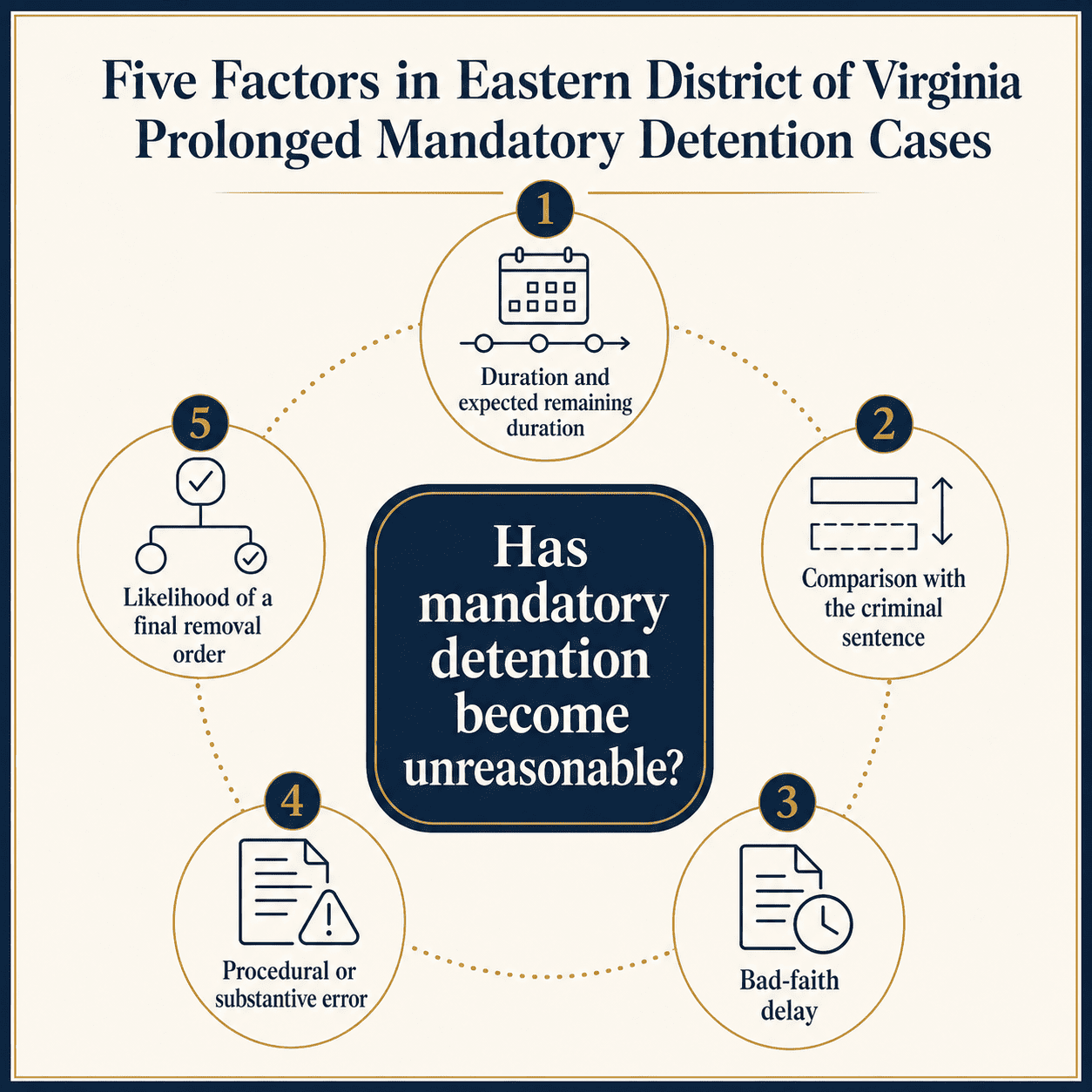
In Portillo v. Hott, the Eastern District of Virginia used a multi-factor approach to decide whether prolonged detention under § 1226(c) required an individualized bond hearing. Later EDVA decisions, including Santos Garcia v. Garland, applied the same framework.
The five factors are:
- Duration and expected remaining duration. The court considers how long detention has lasted and the likely time needed to complete removal proceedings.
- Comparison with the underlying criminal sentence. The court may compare civil immigration detention with the sentence imposed or potentially served for the offense associated with mandatory custody.
- Bad-faith delay. The court examines whether a party or adjudicator used dilatory tactics in bad faith.
- Procedural or substantive error. Repeated legal errors, remands, or other defects that materially extend custody may affect the analysis.
- Likelihood of a final removal order. The strength and procedural posture of the removal case may inform the government’s interest in continued custody.
The duration factor has been described as the most important, but no factor operates alone. Courts also distinguish between legitimate use of appeals and conduct intended only to prolong proceedings. Requesting review, pursuing relief, or obtaining a remand does not automatically make the resulting detention reasonable or place all delay on the detained person. For a broader practice-area overview, see our resource on challenging prolonged ICE detention.
What Virginia Prolonged Detention Decisions Show
Virginia district decisions demonstrate why a detailed chronology is more useful than a general statement that detention has lasted too long.
| Decision | Detention Discussed | Procedural Lesson |
|---|---|---|
| Portillo v. Hott | Approximately fourteen months under mandatory detention | The court used a fact-specific balancing framework and ordered an individualized bond hearing. |
| Martinez v. Hott | Approximately sixteen months | The analysis considered duration and the procedural source of delay rather than treating lawful appeals as automatic bad faith. |
| Santos Garcia v. Garland | Fifty-five months without an individualized bond hearing | The court found the detention unreasonable and ordered a bond hearing within thirty days, while denying broader relief. |
In Santos Garcia, the court emphasized the extreme duration of custody, compared civil detention with the much shorter potential criminal sentences, and reviewed delays associated with BIA proceedings and repeated appeals. The court did not order immediate release. It ordered an individualized bond hearing under the circumstances presented.
These cases do not create a statewide promise that a particular month count will produce the same result. Assigned judges may weigh the record differently, later appellate authority may affect the analysis, and the requested remedy matters. They do show that EDVA has treated prolonged mandatory detention as an as-applied due process question requiring close review of the complete procedural history.
Section 1231: Post-Order Detention and Removal Foreseeability
A different framework applies after a final or reinstated removal order. Section 1231 establishes a ninety-day removal period and permits continued detention of certain individuals after that period. The Supreme Court’s decision in Zadvydas v. Davis construed § 1231(a)(6) to contain a reasonable-time limitation because the statute could not be read to authorize potentially permanent civil detention without federal review. Our guide to habeas after a final removal order explains the distinct post-order custody framework in greater detail.
Under Zadvydas, six months is a presumptively reasonable period for post-removal-period detention. After that point, the detained person must provide good reason to believe there is no significant likelihood of removal in the reasonably foreseeable future. If that showing is made, the government must respond with sufficient evidence to rebut it.
The Supreme Court later held in Johnson v. Arteaga-Martinez that § 1231 does not itself require an immigration judge bond hearing after six months. The statutory remedy is therefore not an automatic bond hearing based solely on elapsed time.
The Fourth Circuit’s decision in Vasquez Castaneda
In Vasquez Castaneda v. Perry, the Fourth Circuit considered detention under § 1231 during withholding-only proceedings following reinstatement of a removal order. The detention had extended well beyond six months, but the court held that duration alone did not show that removal was not reasonably foreseeable.
The court focused on several facts:
- The withholding-only proceedings were continuing through ordinary litigation processes;
- There was no showing that the government had delayed the proceedings through bad faith or careless conduct;
- ICE regularly removed people to the designated country;
- The petitioner had received multiple administrative custody reviews;
- The record did not establish that removal would be impossible if the pending proceedings ended in the government’s favor.
The Fourth Circuit also assumed, without deciding, that an as-applied constitutional challenge outside the ordinary Zadvydas framework might remain available in an exceptional case. It concluded that the circumstances before it were not exceptional. The court stressed that detention length, considered alone, presented an incomplete picture.
Evidence relevant to removal foreseeability
A § 1231 petition should address the practical ability to carry out removal. Relevant records may include:
- Travel-document requests and responses;
- Embassy or consular correspondence;
- Prior failed removal attempts;
- Evidence that the designated country will not accept the person;
- ICE statements identifying barriers or a projected removal date;
- Whether removal to a third country is legally and practically available;
- Administrative custody-review decisions under 8 C.F.R. §§ 241.4 or 241.13;
- Any material change affecting danger, flight risk, cooperation, or travel documentation.
Why Six Months Is Not a Universal Release Rule
The phrase “six-month rule” is often used too broadly. Its clearest doctrinal role comes from Zadvydas and post-order detention under § 1231. It does not mean that every ICE detainee must be released or receive a bond hearing on day 181.
| Common Statement | More Accurate Legal Explanation |
|---|---|
| “ICE must release everyone after six months.” | No. The statute, procedural posture, available review, and requested remedy determine the analysis. |
| “Six months automatically creates a bond hearing.” | No. Jennings and Arteaga-Martinez reject automatic statutory bond-hearing requirements under the provisions they addressed. |
| “Time does not matter if detention was initially lawful.” | Time remains important. EDVA decisions recognize that detention lawful at the beginning may require a new constitutional analysis after an extraordinary period. |
| “Appealing the immigration case defeats habeas.” | Not automatically. Courts examine the nature of the proceedings, the source of delay, good faith, and whether removal remains foreseeable. |
A legally useful detention timeline therefore records more than the custody start date. It shows the governing statute, every hearing and appeal, who requested each continuance, why each remand occurred, what custody review was provided, and whether the government has a realistic path to removal.
Evidence That Builds a Prolonged Detention Record
The habeas record should permit counsel and the federal court to reconstruct the entire custody history without relying on assumptions. Organize documents by date and identify the legal purpose of each record.
| Evidence Category | Examples | What It May Establish |
|---|---|---|
| Custody authority | ICE custody determination, Notice to Appear, reinstatement documents, final removal order, classification notices | Whether § 1226(a), § 1226(c), § 1231, or another provision governs |
| Procedural chronology | Immigration court orders, hearing notices, BIA briefing, remand orders, petitions for review, stay orders | Why the case remains pending and which events extended detention |
| Bond and custody review | Bond decisions, hearing transcripts, BIA bond appeals, post-order custody reviews, parole requests | What process occurred, what evidence was considered, and how current the findings are |
| Danger and flight risk | Criminal dispositions, supervision compliance, sponsor evidence, residence, employment, rehabilitation, medical records | Whether continued detention remains necessary and whether conditions could address risk |
| Removal feasibility | Travel-document records, consular correspondence, failed removal attempts, country acceptance evidence | Whether removal is significantly likely in the reasonably foreseeable future |
| Release plan | Verified address, sponsor declaration, transportation plan, financial support, reporting proposal, medical-care plan | Whether release can be structured through enforceable conditions |
A concise master chronology should identify the detention start date, every meaningful custody review, each immigration court or BIA event, the source of material delays, and the present stage of the case. Avoid treating all elapsed time as legally identical. A six-month period awaiting a scheduled merits hearing is different from a six-month period caused by repeated agency errors or an inability to obtain travel documents.
What Relief a Federal Habeas Court May Order
Habeas relief is not limited to one outcome. The available remedy depends on the custody statute, the legal violation established, and the court’s assessment of the record.
Potential forms of relief may include:
- An individualized bond hearing before an immigration judge;
- A new custody review using constitutionally sufficient procedures;
- Correction of an erroneous mandatory-detention classification;
- Release under appropriate conditions where continued detention is unlawful;
- An order requiring the government to respond to a supported Zadvydas showing;
- Other case-specific relief necessary to address unlawful custody.
A federal court may order a hearing without deciding that release is required. In Santos Garcia, for example, the EDVA court ordered an individualized bond hearing and denied the remaining requested relief. The immigration judge then evaluates release under the procedures specified or left in place by the federal order.
A petition should request relief that follows from the identified violation. Demanding immediate release without addressing why a hearing or administrative review would be inadequate may weaken an otherwise supportable claim.
Virginia Habeas Pre-Filing Checklist
Before filing a prolonged detention petition in Virginia, counsel should be able to answer the following questions:
- Where is the person physically detained? Confirm the facility and any pending transfer because custody location can affect the proper federal district and respondent.
- Which statute currently authorizes detention? Do not rely solely on the statute identified at the beginning of custody.
- Has the detention authority changed? A final or reinstated removal order may shift the case from § 1226 to § 1231.
- When did continuous ICE custody begin? Verify the date through official records.
- What custody review has occurred? Obtain the bond decision, transcript, BIA appeal, or post-order review record.
- What caused each significant delay? Separate government appeals, petitioner appeals, continuances, backlogs, legal errors, and remands.
- Is any delay alleged to be in bad faith? Support that assertion with specific docket events or records.
- What has changed since the last review? Identify new evidence concerning danger, flight risk, family circumstances, medical needs, or removal feasibility.
- What release plan is available? Confirm housing, sponsorship, transportation, reporting, and financial support.
- What exact relief can the court order? Match the request to the statute and alleged legal violation.
A prolonged detention petition should read as a custody analysis, not a calendar complaint. Each period of detention must be connected to the governing statute, the process provided, the reason for delay, and the federal remedy requested.
Frequently Asked Questions
Is ICE detention automatically unlawful after six months in Virginia?
No. Six months is especially important in post-order detention under Zadvydas, but it is not a universal deadline. Courts examine the detention statute, procedural history, custody review, source of delay, and removal feasibility.
Can a person file habeas after an immigration judge denied bond?
Potentially. A federal petition must identify a constitutional or statutory defect. It ordinarily cannot ask the district court merely to reconsider the same discretionary bond evidence because the detained person disagrees with the result.
Does Miranda v. Garland prevent every § 1226(a) habeas claim?
No. Miranda rejected the broad procedural claims before the Fourth Circuit, including the requested burden shift and required consideration of ability to pay. A distinct, case-specific constitutional or statutory defect may still require federal analysis.
Can prolonged mandatory detention under § 1226(c) be challenged?
Yes. EDVA decisions have considered as-applied due process challenges when mandatory detention became unusually long. The outcome depends on the complete record, and no fixed detention period guarantees relief.
Does a pending immigration appeal count against the detained person?
Not automatically. Courts examine whether litigation was pursued in good faith, whether either party caused avoidable delay, whether legal errors produced repeated remands, and how the pending proceedings affect the likely duration or feasibility of removal.
Does § 1231 require a bond hearing after six months?
No. Johnson v. Arteaga-Martinez held that § 1231 does not create that statutory bond-hearing requirement. A post-order claim generally must address whether removal is significantly likely in the reasonably foreseeable future.
What is the most important document in a prolonged detention review?
There is rarely one controlling document. The most useful starting record is a verified chronology supported by the custody determination, immigration orders, bond or custody-review decisions, and evidence explaining each material period of delay.
Where is a Virginia ICE habeas petition filed?
The answer commonly depends on the person’s physical place of detention, the immediate custodian, and any transfer that occurred before filing. Facility location and transfer timing should be confirmed before the petition is prepared.
Does Prolonged ICE Detention in Virginia Require Federal Review?
A prolonged detention claim should begin with the custody statute, not a generalized six-month rule. Section 1226(a), § 1226(c), and § 1231 create different procedural systems and different habeas theories. Fourth Circuit authority also distinguishes between ordinary bond procedure, prolonged mandatory custody, and post-order detention where removal may or may not remain foreseeable.
The record should support a precise theory: ICE is holding this person under this authority, the detention has developed through this documented procedural history, the available review has not corrected this legal problem, and the federal court can grant this specific form of relief. Each factual allegation should connect the custody timeline to the governing statute, the process already provided, and the remedy requested.
Has a loved one remained in ICE custody in Virginia without a meaningful path to release?
Send us the custody documents, immigration court history, prior bond records, and any ICE review decisions. Our team can identify which detention framework applies and evaluate whether federal habeas review is legally available.
Phone: (+1) 862-799-2200
Email: info@gozellaw.com
Legal Disclaimer: This article is provided for general informational purposes only and does not constitute legal advice. Immigration detention analysis is highly fact-specific and depends on the governing statute, procedural posture, detention location, and current case law. The information reflects laws and publicly available decisions as of July 24, 2026; later developments may affect its accuracy. Prior results do not guarantee a similar outcome.
Sources
- 28 U.S.C. § 2241: Power to Grant Writ
- 8 U.S.C. § 1226: Apprehension and Detention of Aliens
- 8 U.S.C. § 1231: Detention and Removal of Aliens Ordered Removed
- Miranda v. Garland, 34 F.4th 338 (4th Cir. 2022)
- Portillo v. Hott, 322 F. Supp. 3d 698 (E.D. Va. 2018)
- Martinez v. Hott, 527 F. Supp. 3d 824 (E.D. Va. 2021)
- Santos Garcia v. Garland, No. 1:21-cv-742 (E.D. Va. Mar. 31, 2022)
- Johnson v. Arteaga-Martinez, 596 U.S. 573 (2022)
- Vasquez Castaneda v. Perry, 95 F.4th 750 (4th Cir. 2024)
- 8 C.F.R. Part 241: Apprehension and Detention of Aliens Ordered Removed
Every day in detention is a day away from your family.
If the immigration system has failed you, federal court may be the only answer. Let us review your case for free.
Get a Free Case Evaluation