Your loved one is being held at Delaney Hall in Newark. Maybe the immigration judge said there is no jurisdiction to set bond. Maybe ICE says detention is mandatory. Or perhaps the person already had a bond hearing, remains detained, and the family is trying to understand whether federal court offers another path.
For families in that position, the location matters. A Delaney Hall detention habeas case is litigated in the U.S. District Court for the District of New Jersey, where federal judges have handled a large number of immigration detention petitions in 2026. Recent Delaney Hall cases show several possible outcomes: some petitioners have received court-ordered bond hearings, some have been released, and others have been denied additional relief because they had already received meaningful custody review.
That means there is no single “Delaney Hall rule.” The first questions are more specific: What statute does ICE say authorizes the detention? Has there been a real bond hearing? Where was the person arrested? How long has detention lasted? And has ICE transferred, or threatened to transfer, the person out of New Jersey?
This guide explains how those questions fit together, what recent District of New Jersey decisions actually show, and when a federal habeas petition under 28 U.S.C. § 2241 may be worth evaluating.
In This Guide
- Delaney Hall, Newark, and Why Location Matters for Habeas
- Why Some Delaney Hall Detainees Are Being Held Without Bond
- What Recent Delaney Hall Habeas Cases Show
- When Prolonged Detention Becomes a Separate Issue
- What a Federal Judge Can Actually Order
- What If ICE Transfers the Person Out of New Jersey?
- Documents Families Should Gather in the First 48 Hours
- When Should a Delaney Hall Family Ask for a Habeas Review?
- Frequently Asked Questions
Delaney Hall, Newark, and Why Location Matters for Habeas
Delaney Hall is located at 451 Doremus Avenue in Newark, New Jersey. ICE’s current detention contract identifies the facility as part of the Newark Enforcement and Removal Operations area of responsibility. Because the facility is in Newark, a core habeas challenge to custody there generally belongs in the U.S. District Court for the District of New Jersey.
That is different from asking where the family lives, where the removal case began, or which immigration court is handling the underlying case. A petition under 28 U.S.C. § 2241 challenges the legality of federal custody. In a traditional detention habeas case, the place where the person is confined and the identity of the immediate custodian are therefore central jurisdictional questions.
The broader New Jersey ICE detention page explains the statewide detention and federal-court structure. Delaney Hall deserves a separate analysis because the District of New Jersey has seen a substantial volume of immigration habeas litigation involving people held at this particular facility.
The District of New Jersey also has an emergency habeas procedure
In 2026, the District of New Jersey adopted a special procedure for immigration-related § 2241 petitions that include a request for a temporary restraining order seeking immediate release. The court’s Second Amended Standing Order 2026-02, dated August 5, 2026, states that the district continues to experience a surge in immigration detention petitions and sets additional notice requirements for qualifying emergency filings.
That Standing Order does not mean every Delaney Hall case is an emergency or that every petition will move on the same schedule. It does show, however, that immigration custody litigation has become a significant and active part of the District of New Jersey’s docket.
Why Some Delaney Hall Detainees Are Being Held Without Bond
One of the most important disputes in Delaney Hall cases is not the amount of bond. It is whether the immigration judge has authority to consider bond at all.
The government has argued in many recent cases that certain people who entered the United States without admission and were later arrested inside the country must be detained under 8 U.S.C. § 1225(b)(2). Under that theory, the immigration judge has no ordinary authority to conduct a discretionary bond hearing.
The competing position is that an interior arrest during pending removal proceedings falls under 8 U.S.C. § 1226(a), which provides a route to discretionary release on bond unless another detention provision applies.
This conflict became especially visible after Matter of Yajure Hurtado, 29 I&N Dec. 216 (BIA 2025). The Board of Immigration Appeals adopted the broader § 1225 interpretation for certain people present without admission. Immigration judges may therefore say that they lack jurisdiction to hear the bond request.
But federal judges are not the BIA. The District of New Jersey has repeatedly considered the federal statutory question independently. Our separate guide to Matter of Yajure Hurtado and bond denials explains that controversy in detail. For a Delaney Hall family, the practical point is narrower: a “no jurisdiction” decision in immigration court may not be the final word on whether the detention statute has been applied correctly.
What Recent Delaney Hall Habeas Cases in New Jersey Show
The strongest reason not to make broad promises about Delaney Hall is the court record itself. Recent cases have produced materially different results.
Jeddou: the court ordered an individualized bond hearing
In Jeddou v. Warden of Delaney Hall Detention Facility, decided February 25, 2026, the petitioner had entered without inspection, was later arrested by ICE, and had not received an individualized bond hearing because the government treated him as detained under § 1225(b)(2). The federal judge concluded that § 1226(a) governed and ordered a bond hearing within seven days.
That is an important example of a federal court correcting the legal framework while leaving the ultimate bond decision to the immigration judge.
Canstro Chino: the court ordered direct release
A different remedy appeared in Canstro Chino v. Delaney Hall Detention Center, decided July 22, 2026. The court rejected § 1225 as the legal basis for that petitioner’s detention and ordered release, subject to the conditions described in the court’s order.
That does not create a rule that a person at Delaney Hall who challenges § 1225 is automatically entitled to immediate release. It demonstrates that direct release is one remedy federal judges have used where the court found the detention unlawful on the facts before it.
Garcia Baeza: correcting the statute did not produce release
Garcia Baeza v. Soto illustrates the other side. The court rejected the government’s position that § 1225(b)(2) controlled and directed that the petitioner be treated under § 1226 while his removal case remained pending. But he had already received a § 1226(a) bond hearing and another custody proceeding. After reviewing that history, the court declined to order release or additional relief.
The lesson is important: a disagreement over the detention statute is not always enough by itself to produce release. Prior bond hearings, what happened at those hearings, detention length, and the specific relief requested can all change the result.
Was your loved one denied bond at Delaney Hall because the immigration judge said there was “no jurisdiction”?
The written bond decision matters. Send us the A-Number, detention date, current facility, entry history, and any immigration court or BIA custody decision. We can review whether the detention presents a federal habeas issue in the District of New Jersey.
When Prolonged Detention Becomes a Separate Due Process Issue
A dispute over § 1225 versus § 1226 asks whether ICE is using the correct statutory authority. Prolonged detention raises a different question: even if detention began under a lawful statute, has it continued so long without adequate review that due process now requires more?
There is no automatic rule that requires release after six months. The Third Circuit, which governs New Jersey, looks at the circumstances of the detention rather than using a single calendar deadline. Duration matters, but so do the likely future length of custody, the reasons the case has taken time, the process already provided, and—in some detention settings—the conditions of confinement.
Our guide to prolonged ICE detention under Third Circuit law explains that analysis in detail. The key point for this facility page is that a Delaney Hall detainee may have one type of claim based on a wrongful no-bond classification and a separate claim based on the duration or fairness of continued custody.
The distinction matters after an earlier bond hearing as well. Garcia Baeza shows that receiving meaningful § 1226(a) process can make a later due process claim harder even when detention has lasted many months. A federal court will look at what process actually occurred, not merely the number of days spent in detention.
What Can a Federal Judge Actually Order?
A habeas petition is not simply a request to “get someone out.” The requested remedy should match the legal problem.
- An individualized bond hearing. A judge may conclude that § 1226(a), rather than § 1225(b)(2), governs and order the government to provide access to a lawful bond hearing.
- Direct release. In some cases, federal judges have ordered release after finding the detention unlawful and concluding that a narrower remedy was not sufficient on the facts presented.
- Correct treatment under the proper detention statute. A court may order the government to stop treating the petitioner under one statutory framework even when it does not order immediate release.
- Emergency protection while the case is pending. Depending on the circumstances, a petitioner may seek temporary relief addressing an imminent transfer or removal while the court considers the detention claim.
A federal habeas judge does not simply take over the underlying immigration case. The § 2241 proceeding generally addresses custody. It does not ask the district judge to decide whether the person should ultimately win asylum, cancellation of removal, adjustment of status, or another form of immigration relief.
For a more detailed explanation of the narrower bond remedy, see our guide to using a habeas petition to obtain a § 1226(a) bond hearing.
What If ICE Transfers the Person Out of New Jersey?
Transfer risk is especially important in a facility-specific case because the place of detention helps determine where the habeas action begins.
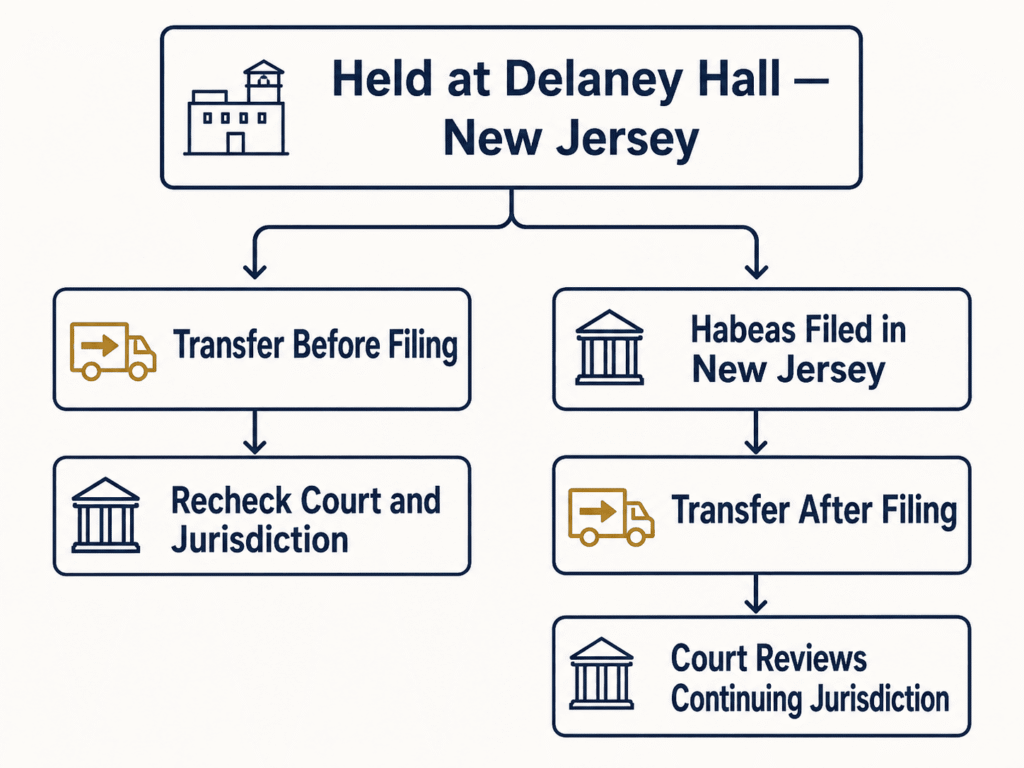
If ICE moves someone out of Delaney Hall before a habeas petition is filed, counsel must reassess the proper district, respondent, and controlling appellate law. A transfer can therefore change more than the family’s travel burden.
A transfer after filing is different. In Sigcha Caiza v. Warden, Delaney Hall Detention Facility, the petitioner was at Delaney Hall when he filed but was later transferred to the Karnes County Immigration Processing Center in Texas. The District of New Jersey concluded that it retained habeas jurisdiction because he had been detained in New Jersey when the petition was filed. The court ultimately granted the petition and ordered release.
That decision should not be read to mean every post-filing transfer is legally irrelevant. Respondent questions, the relief requested, and the posture of the case can matter. The safer practical approach is to treat a planned transfer as time-sensitive and tell federal counsel immediately.
Our guide on ICE transfers to another state explains the broader emergency issues that can arise when ICE begins moving a detainee.
Documents Families Should Gather in the First 48 Hours
A Delaney Hall habeas review usually starts with a simple question: Can the paperwork show exactly why this person is being detained? Families do not need to understand every document before contacting counsel, but gathering the right records early can make the screening much faster.
- A-Number and detention date. Confirm when ICE took the person into custody and keep the nine-digit A-Number available.
- Current facility information. Confirm that the person remains at Delaney Hall and save any ICE Online Detainee Locator screenshot showing the location.
- Notice to Appear and ICE custody paperwork. These records can help identify the removal charges and government’s asserted custody framework.
- Bond decision or bond hearing record. Look for references to § 1225(b)(2), § 1226(a), § 1226(c), “applicant for admission,” “mandatory detention,” “no jurisdiction,” or Matter of Yajure Hurtado.
- BIA decisions, if any. If DHS or the detainee appealed a bond decision, preserve the Board’s order and briefing.
- Entry, parole, and prior release records. I-94 records, parole documents, border paperwork, prior bond orders, orders of supervision, or earlier ICE release documents may change the custody analysis.
- ICE check-in notices. These are particularly important when a person was living in the community and was re-detained during a scheduled reporting appointment.
- Criminal court dispositions, if relevant. The precise disposition can matter because § 1226(c) raises a different mandatory-detention analysis.
- Upcoming EOIR dates. Include the next master calendar, individual hearing, bond, or BIA deadline.
If the family is not certain where the person is currently being held, check the official ICE Online Detainee Locator System before assuming Delaney Hall remains the current facility. Our first 24 hours after an ICE arrest guide covers the broader steps families can take immediately after detention.
When Should a Delaney Hall Family Ask for a Habeas Review?
Families sometimes assume they must wait six months before speaking with a habeas lawyer. That is not a safe general rule.
If the only issue is whether otherwise lawful detention has become unreasonably prolonged, the length and history of custody will naturally be central. But a case involving the wrong detention statute, a complete denial of bond jurisdiction, an allegedly unlawful re-detention, or an imminent interstate transfer can raise a different problem much earlier.
In other words, the first screening question should not be only, “How many months has this person been detained?” It should be:
- Why does ICE say detention is authorized?
- Has an immigration judge actually considered release on the merits?
- Was the person instead told the judge had no jurisdiction?
- Has the person previously been released or supervised in the community?
- Is there a final or reinstated removal order that changes the governing detention statute?
- Is ICE preparing to move the person away from Delaney Hall?
If bond was denied because the immigration court said it had no jurisdiction, our denied bond hearing practice page explains why that type of decision deserves a different review from an ordinary bond denial based on danger or flight risk.
Frequently Asked Questions
Can someone detained at Delaney Hall file a habeas petition immediately?
There is no universal six-month waiting period for every habeas claim. A challenge based on the wrong detention statute, denial of access to a bond hearing, unlawful re-detention, or an urgent transfer can arise earlier. A claim based only on prolonged detention requires a separate timing analysis.
Does entering the United States without inspection automatically mean there is no bond hearing?
Not necessarily. Matter of Yajure Hurtado adopted a broad no-bond interpretation for certain noncitizens, but federal courts have disagreed with that interpretation in multiple jurisdictions. District of New Jersey judges have repeatedly considered whether § 1226(a), rather than § 1225(b)(2), governs people arrested in the interior. The answer remains fact- and jurisdiction-specific.
Does Matter of Yajure Hurtado prevent a federal judge from reviewing detention?
No. Matter of Yajure Hurtado is BIA precedent affecting immigration-court bond jurisdiction. A federal district court hearing a § 2241 petition independently considers whether detention complies with federal law and the Constitution, subject to controlling appellate precedent and jurisdictional limits.
Can a federal judge order someone at Delaney Hall released?
Yes, direct release is a possible habeas remedy and District of New Jersey judges have ordered it in some recent cases. Other successful petitions have resulted in an individualized bond hearing instead. The appropriate remedy depends on the legal violation, procedural history, and facts of the particular case.
What if the person already had a bond hearing?
That can materially change the analysis. A federal court may examine whether the hearing provided meaningful and fundamentally fair process, whether circumstances have changed, and whether detention has separately become unreasonably prolonged. Prior access to a real § 1226(a) hearing can make a later habeas claim more difficult.
What happens if ICE transfers the detainee out of New Jersey after filing?
A transfer after filing does not automatically end an existing District of New Jersey habeas case. In Sigcha Caiza, the court retained jurisdiction after the petitioner was transferred from Delaney Hall to Texas because he was detained in New Jersey when the petition was filed. The effect of a transfer still requires a case-specific jurisdictional analysis.
Is there an automatic six-month rule for release from Delaney Hall?
No. Six months can be an important reference point in some detention cases, but there is no automatic rule requiring release on day 181. The governing statute, prior custody review, reasons for continued detention, expected future duration, and controlling Third Circuit law all matter.
Delaney Hall Is the Location; the Custody History Decides the Legal Theory
Delaney Hall matters because detention there places the habeas case within a federal district that has been actively deciding immigration custody disputes. But the facility name alone does not tell you whether a petition should be filed or what relief a judge might order.
The stronger analysis starts with the detention statute, the person’s entry and release history, the reason an immigration judge did or did not hold a bond hearing, any BIA custody ruling, how long detention has continued, and whether a transfer is pending.
Recent Delaney Hall cases demonstrate why those distinctions matter. One federal judge ordered a § 1226(a) bond hearing. Another ordered direct release. Another corrected the statutory framework but declined additional relief because meaningful bond proceedings had already taken place. Federal habeas is therefore a tool for reviewing unlawful custody—not a guaranteed outcome tied to a particular detention facility.
For the wider federal framework, our habeas corpus and ICE detention guide explains how § 2241 works and what federal court can and cannot review.
Is your loved one detained at Delaney Hall?
Send us the A-Number, detention date, current facility, entry history, custody documents, and any immigration court or BIA bond decision. We can review the detention basis, prior bond process, transfer risk, and whether a federal habeas option should be considered in the District of New Jersey.
Phone: (+1) 862-799-2200
Email: info@gozellaw.com
Legal Disclaimer: This article is provided for general informational purposes only and does not constitute legal advice. Reading it does not create an attorney-client relationship. Immigration detention law is changing rapidly, and the authorities discussed here reflect the legal landscape reviewed through September 2, 2026. Whether habeas relief is available depends on the person’s detention location, entry history, custody statute, prior bond proceedings, criminal and immigration history, transfer status, and controlling federal precedent. Later appellate or Supreme Court action may change the legal framework discussed here. Prior results do not guarantee a similar outcome. Consult qualified counsel regarding a specific case.
Sources
- Delaney Hall Detention and Transportation Contract, U.S. Immigration and Customs Enforcement.
- Second Amended Standing Order 2026-02: In Re Increase in Immigration-Related Habeas Corpus Petitions Seeking Emergent Relief, U.S. District Court for the District of New Jersey, August 5, 2026.
- Newark Courthouse and County Jurisdiction, U.S. District Court for the District of New Jersey.
- 28 U.S.C. § 2241 — Power to Grant Writ, Cornell Legal Information Institute.
- 8 U.S.C. § 1225 — Inspection and Applicants for Admission, Cornell Legal Information Institute.
- 8 U.S.C. § 1226 — Apprehension and Detention of Aliens, Cornell Legal Information Institute.
- Matter of Yajure Hurtado, 29 I&N Dec. 216 (BIA 2025), Executive Office for Immigration Review.
- Jeddou v. Warden of Delaney Hall Detention Facility, No. 2:26-cv-01203, U.S. District Court for the District of New Jersey, February 25, 2026.
- Garcia Baeza v. Soto, No. 2:26-cv-05532, U.S. District Court for the District of New Jersey, June 2, 2026.
- Sigcha Caiza v. Warden, Delaney Hall Detention Facility, No. 2:26-cv-08248, U.S. District Court for the District of New Jersey, July 13, 2026.
- Canstro Chino v. Delaney Hall Detention Center, No. 1:26-cv-08696, U.S. District Court for the District of New Jersey, July 22, 2026.
- Khalil v. President of the United States, 164 F.4th 259, U.S. Court of Appeals for the Third Circuit, 2026.
- ICE Online Detainee Locator System, U.S. Immigration and Customs Enforcement.
Every day in detention is a day away from your family.
If the immigration system has failed you, federal court may be the only answer. Let us review your case for free.
Get a Free Case Evaluation