Your loved one asked an immigration judge for bond. Instead of hearing evidence about family ties, work history, community support, or flight risk, the judge said something much more basic: “I don’t have jurisdiction.”
For many families, that answer traces back to one precedential decision: Matter of Yajure Hurtado, 29 I&N Dec. 216 (BIA 2025). The Board of Immigration Appeals interpreted federal detention law to mean that immigration judges lack authority to grant bond to certain noncitizens who are present in the United States without having been admitted.
But that does not mean every federal court agrees with the Board. In 2026, federal appellate courts divided sharply over the same statutory question, a federal district court tried to vacate Yajure Hurtado, the Ninth Circuit stayed that vacatur pending appeal, and petitions asking the Supreme Court to resolve the conflict reached the Court. Understanding that distinction is essential before treating a “no jurisdiction” bond denial as the end of the road.
In This Guide
- What Is Matter of Yajure Hurtado?
- What Did the BIA Actually Decide?
- Why Immigration Judges Say They Have “No Jurisdiction”
- What Matter of Yajure Hurtado Does Not Decide
- How Federal Courts Have Responded
- Is Matter of Yajure Hurtado Still in Effect?
- What a Bond Denial Means for Federal Court
- What Families Should Check in the Bond Decision
- Frequently Asked Questions

What Is Matter of Yajure Hurtado?
Matter of Yajure Hurtado is a precedential decision issued by the Board of Immigration Appeals on September 5, 2025. Its full citation is Matter of Jonathan Javier Yajure Hurtado, 29 I&N Dec. 216 (BIA 2025).
The respondent was a Venezuelan national who crossed the U.S. border without inspection near El Paso, Texas, in November 2022. USCIS later granted him Temporary Protected Status. After that TPS expired on April 2, 2025, immigration authorities apprehended him and DHS placed him in removal proceedings.
He requested a bond hearing. The immigration judge concluded that the court lacked jurisdiction to set bond because the government considered him detained under INA § 235(b)(2), codified at 8 U.S.C. § 1225(b)(2). The judge also stated, in the alternative, that he considered the respondent a flight risk.
The respondent appealed. That gave the BIA an opportunity to address a question it said it had not previously resolved in a precedential decision: Does an immigration judge have authority to consider bond for someone already inside the United States who entered without inspection and was never admitted?
What Did the BIA Actually Decide?
The BIA answered no. It held that, under its reading of § 1225(b)(2)(A), immigration judges lack authority to hear or grant bond requests for noncitizens who are present in the United States without admission.
The dispute centers on the relationship between two detention statutes: 8 U.S.C. § 1225 and 8 U.S.C. § 1226.
| § 1225(b)(2) | § 1226(a) | |
|---|---|---|
| Basic role | Inspection and detention of certain applicants for admission | Arrest and detention pending a removal decision |
| Immigration judge bond | No ordinary IJ bond authority under the government’s reading | Allows discretionary release on bond in qualifying cases |
| Core dispute | Whether an unadmitted person already living inside the U.S. is still “seeking admission” | Whether § 1226(a) instead governs an interior arrest |
The BIA focused on the INA’s definition of an “applicant for admission.” Section 1225(a)(1) includes a noncitizen who is physically present in the United States but has not been admitted. From there, the Board concluded that a person fitting that definition falls within the mandatory detention structure of § 1225(b)(2)(A).
That interpretation matters because § 1226(a) ordinarily permits the government to detain a person during removal proceedings while also providing a route to discretionary release. Which statute governs therefore determines whether the immigration judge can reach the bond question at all.
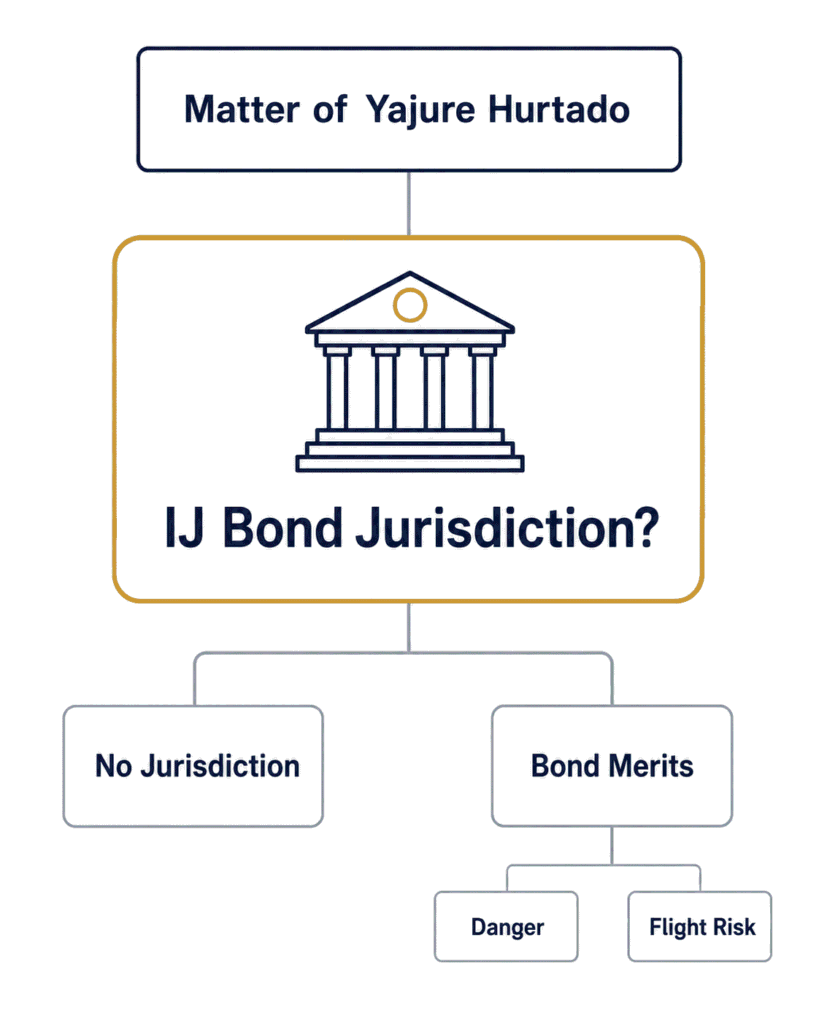
The key point: Yajure Hurtado is primarily about the immigration judge’s legal authority. A “no jurisdiction” decision is different from a judge hearing the evidence and deciding that a person is too dangerous or too likely to flee to be released.
Why Immigration Judges Say They Have “No Jurisdiction”
Published BIA precedent ordinarily binds immigration judges unless controlling federal law in the relevant jurisdiction requires a different result. That is why Matter of Yajure Hurtado changed the practical conversation in many bond cases.
If the immigration judge concludes that § 1225(b)(2) governs detention, the court may stop before asking the questions families usually prepare for. The judge may never weigh a U.S. citizen spouse, children, a long employment history, tax returns, an ICE reporting record, a sponsor, or evidence showing the person is not dangerous.
Those facts may be excellent evidence for a bond hearing. But they do not answer the preliminary question created by Yajure Hurtado: Does this immigration judge have statutory authority to conduct that hearing in the first place?
This distinction also explains why a family should read the bond order carefully. “Bond denied because of flight risk” and “bond denied because the immigration judge lacks jurisdiction” are not the same legal problem. The second may require looking outside the immigration-court system.
What Matter of Yajure Hurtado Does Not Decide
The decision is broad, but it is not unlimited.
- It does not decide whether every detention is constitutional. Constitutional challenges to detention remain questions for Article III federal courts.
- It does not turn the BIA into the final interpreter of federal law for federal judges. Courts of appeals can reject the BIA’s statutory interpretation, and several have done so.
- It does not decide whether the detained person is actually a danger or flight risk. A jurisdiction ruling can prevent the immigration judge from reaching those merits.
- It does not itself resolve the underlying removal case. The dispute concerns detention and access to bond, not whether the person ultimately receives immigration relief or is ordered removed.
For families, the most important distinction is institutional. Immigration judges operate within EOIR, which is part of the Department of Justice. Federal district judges exercise separate judicial authority. A precedential BIA decision can control the immigration court while a federal court reaches a different interpretation of the same statute.
Did the immigration judge say there was no jurisdiction to consider bond?
The reason for the denial matters. We can review the bond decision, detention location, and controlling federal law to determine whether a habeas challenge should be considered.
How Federal Courts Have Responded
The BIA’s interpretation did not end the statutory debate. Federal courts began deciding whether § 1225(b)(2)(A) really applies to people who entered without inspection, lived inside the United States, and were later arrested away from the border.
By 2026, a clear circuit split had developed. The Second, Sixth, Seventh, and Eleventh Circuits rejected the government’s broad interpretation in relevant cases and concluded that § 1226(a) governs detention for at least the interior-arrest circumstances before those courts. The Fifth and Eighth Circuits reached the opposite conclusion and accepted the government’s reading of § 1225(b)(2)(A).
For example, in Barbosa da Cunha v. Freden, the Second Circuit considered a Brazilian national who had entered without inspection roughly two decades earlier and was arrested in the interior in 2025. The court concluded that § 1226(a), not § 1225(b)(2)(A), governed his detention. The Sixth Circuit reached the same basic statutory result in Lopez-Campos v. Raycraft. The Eleventh Circuit likewise held in Hernandez Alvarez v. Warden that § 1225 addresses arriving noncitizens seeking entry while § 1226 applies to the interior circumstances before it.
The Fifth Circuit went the other way in Buenrostro-Mendez v. Bondi, holding that § 1225(b)(2)(A) reaches applicants for admission who entered without inspection and were later apprehended inside the country. The Eighth Circuit reached a similar conclusion in Herrera Avila v. Bondi.
This article does not try to turn that disagreement into a full circuit-by-circuit map. The practical point is narrower: a BIA jurisdiction denial does not answer the federal-law question everywhere in the country. The federal circuit covering the detention location can materially change the analysis.
Is Matter of Yajure Hurtado Still in Effect?
This is where simple online summaries can become misleading.
On February 18, 2026, the U.S. District Court for the Central District of California issued an order in Maldonado Bautista v. Santacruz formally vacating Matter of Yajure Hurtado as part of litigation challenging the government’s no-bond policy. But the story did not end there.
On March 31, 2026, the Ninth Circuit granted the government’s request to stay that vacatur while the appeal proceeds. The Ninth Circuit also left the district court’s December 2025 judgment in place within the Central District of California while staying its broader reach. In other words, it is inaccurate to say simply that Yajure Hurtado was vacated and disappeared nationwide.
The BIA itself reinforced that point on June 2, 2026. In Matter of N-A-G-C-, 29 I&N Dec. 662 (BIA 2026), the Board expressly followed Matter of Yajure Hurtado and again held that an immigration judge lacked authority to redetermine custody for a noncitizen who had not been admitted.
At the same time, the circuit split has now reached the Supreme Court’s doorstep. As of August 24, 2026, petitions for certiorari involving this statutory conflict are pending in cases arising from the Second, Sixth, and Fifth Circuits. The Supreme Court has not yet issued a merits decision resolving the disagreement.
That means the safest answer to “Is Yajure Hurtado still good law?” is not a nationwide yes or no. The answer depends on which court is being asked, what controlling circuit precedent exists, and where the detained person is being held.
What a Bond Denial Means for Federal Court
An immigration judge’s lack-of-jurisdiction decision does not automatically eliminate federal judicial review. A habeas corpus petition under 28 U.S.C. § 2241 can ask a federal district judge to decide whether the detention is lawful under the governing federal statutes or Constitution.
That does not mean a habeas petition automatically produces release. The federal court must first decide whether the petitioner’s legal theory is available in that jurisdiction and whether the facts fit the relevant precedent. Depending on the case, requested relief may include an order requiring a lawful bond hearing rather than immediate release.
This is also why immigration court and federal court should not be treated as interchangeable forums. The immigration judge’s authority comes from the INA, regulations, and agency precedent. A federal habeas court independently reviews whether custody violates federal law or the Constitution.
If you want the broader framework, our habeas corpus and ICE detention guide explains how federal detention review works, while the denied bond hearings page focuses specifically on cases where immigration court has refused access to bond.
What Families Should Check in the Bond Decision
Before deciding what the denial means, identify exactly what the immigration judge decided. Four details can change the analysis.
- Was bond denied for lack of jurisdiction? Look for references to § 1225(b)(2), mandatory detention, “applicant for admission,” or Matter of Yajure Hurtado.
- Did the judge also make an alternative finding? In Yajure Hurtado itself, the immigration judge also stated that the respondent was a flight risk. An alternative merits finding can affect what happens next.
- How did the person enter the United States? Entry without inspection, parole, and admission on a visa do not create identical detention questions.
- Where is the person physically detained? The federal district and circuit can determine which appellate precedent governs a habeas challenge.
Keep the written bond order, Notice to Appear, A-Number, custody documents, and the exact detention-facility name together. Those records help counsel distinguish a Yajure Hurtado jurisdiction problem from other forms of mandatory detention or an ordinary discretionary bond denial.
Frequently Asked Questions
What is Matter of Yajure Hurtado?
Matter of Yajure Hurtado, 29 I&N Dec. 216 (BIA 2025), is a precedential Board of Immigration Appeals decision issued on September 5, 2025. The BIA held that immigration judges lack authority to hear or grant bond requests for noncitizens who are present in the United States without admission under its interpretation of INA § 235(b)(2)(A).
Does Matter of Yajure Hurtado mean everyone who entered without inspection can never get bond?
No single nationwide answer is safe in 2026. Several federal courts of appeals have rejected the government’s broad § 1225(b)(2)(A) interpretation for interior arrests, while the Fifth and Eighth Circuits have accepted it. The detention location and controlling circuit law matter.
Can an immigration judge ignore Matter of Yajure Hurtado?
A precedential BIA decision ordinarily binds immigration judges, but immigration judges must also follow controlling federal court precedent in their jurisdiction. In circuits that have rejected the BIA’s interpretation, the controlling appellate decision can change the result.
Has Matter of Yajure Hurtado been overturned?
The Central District of California entered an order vacating the decision in February 2026, but the Ninth Circuit stayed that vacatur pending appeal on March 31, 2026. The BIA later followed Yajure Hurtado again in Matter of N-A-G-C- in June 2026. The legal status therefore cannot be reduced to a simple nationwide statement that the decision has been overturned.
Can a federal judge review detention after the immigration judge says there is no jurisdiction?
Potentially. A petition under 28 U.S.C. § 2241 can ask a federal district court to review whether detention is lawful. Whether that claim is viable depends on the facts, detention location, controlling circuit precedent, and other procedural issues.
Does the detention facility affect the answer?
Yes. Federal habeas litigation is closely tied to the place of detention, and the federal circuit covering that location may have controlling precedent on the § 1225 versus § 1226 question. A transfer can therefore materially affect the legal analysis.
A “No Jurisdiction” Decision Is Not the Same as Losing Bond on the Facts
Matter of Yajure Hurtado changed the bond analysis because it places a statutory question before the usual discussion of danger, flight risk, family ties, and community support. In many cases, the first question is now whether the immigration judge has authority to consider those facts at all.
Federal courts have not spoken with one voice. Some appellate courts have rejected the BIA’s interpretation, others have accepted it, and Supreme Court review has been requested. For a detained family, that makes the precise reason for the bond denial and the location of detention more important than a generalized statement that “bond was denied.”
Did the immigration judge cite a lack of jurisdiction?
Federal court may still be available. Our team can review the bond decision, detention facility, and controlling law to assess whether a habeas corpus petition under 28 U.S.C. § 2241 should be considered.
Phone: (+1) 862-799-2200
Email: info@gozellaw.com
Legal Disclaimer: This article is provided for general informational purposes only and does not constitute legal advice. Reading it does not create an attorney-client relationship. Immigration detention law is changing rapidly, and the authorities discussed here reflect the legal landscape reviewed as of August 24, 2026. The law applicable to a particular person may depend on the detention location, procedural history, immigration history, and controlling federal precedent. Prior results do not guarantee a similar outcome. Consult qualified counsel for advice regarding a specific case.
Sources
- Matter of Yajure Hurtado, 29 I&N Dec. 216 (BIA 2025), U.S. Department of Justice, Executive Office for Immigration Review.
- Matter of N-A-G-C-, 29 I&N Dec. 662 (BIA 2026), U.S. Department of Justice, Executive Office for Immigration Review.
- 8 U.S.C. § 1225, Cornell Legal Information Institute.
- 8 U.S.C. § 1226, Cornell Legal Information Institute.
- 28 U.S.C. § 2241, Cornell Legal Information Institute.
- Barbosa da Cunha v. Freden, 175 F.4th 61 (2d Cir. 2026).
- Lopez-Campos v. Raycraft, 175 F.4th 706 (6th Cir. 2026).
- Hernandez Alvarez v. Warden, 175 F.4th 1258 (11th Cir. 2026).
- Buenrostro-Mendez v. Bondi, 166 F.4th 494 (5th Cir. 2026).
- Herrera Avila v. Bondi, 170 F.4th 1128 (8th Cir. 2026).
- Maldonado Bautista v. Santacruz, Nos. 25-7958 & 26-1044 (9th Cir. Mar. 31, 2026) (stay pending appeal).
- Supreme Court dockets: Raycraft v. Lopez-Campos, No. 25-1415; Rhoney v. Barbosa da Cunha, No. 26-104; and Buenrostro-Mendez v. Blanche, No. 26-43.
Every day in detention is a day away from your family.
If the immigration system has failed you, federal court may be the only answer. Let us review your case for free.
Get a Free Case Evaluation