You filed the petition on Monday. By Friday the docket shows one scheduling order and nothing else, and your family is asking the same question: how much longer?
So how long does habeas corpus take? The statute behind every petition, 28 U.S.C. § 2243, gives the government three days to answer, or up to twenty with good cause. In practice, each federal court sets its own schedule, and a ProPublica review of more than 70,000 immigration habeas cases found median times to close from six days in the fastest districts to 92 in the slowest.
This page is about time only. Filing fees and attorney costs are covered in our habeas corpus cost guide.
In This Article · The Habeas Timeline
- The Short Answer: Days by Law, Weeks in Practice
- Day by Day: From Filing to Decision
- When Does the Court Issue the Order to Show Cause?
- How Long Does the Government Have to Respond?
- Why Some Courts Decide Faster Than Others
- How an ICE Transfer Resets the Clock
- Emergency Motions: How Fast Can a Court Act?
- What This Means for Your Family
- Frequently Asked Questions

The Short Answer: Days by Law, Weeks in Practice
How long does habeas corpus take in your family’s case? It depends on three clocks that rarely agree. The statute sets the fastest pace the law contemplates, the court’s scheduling order sets the working calendar, and the judge decides when the case ends.
What 28 U.S.C. § 2243 Requires
The judge must act “forthwith,” either granting the writ or ordering the government to show cause why it should not be granted. The return is due in three days, extendable for good cause to no more than twenty, and a hearing follows within five days of the return unless the court allows more time. On paper, that is a matter of weeks. Our habeas corpus and ICE detention guide explains how this statute fits with the others that govern detention.
What Our Own Cases Show
In a New Jersey case, we filed within two to three days of detention, and our client was released on bond within days of filing. For a client detained at an ICE check-in, the judge ruled within five business days and ordered a bond hearing. A contested prolonged-detention case in Tacoma took 13 months to reach a release order. Prior results do not guarantee a similar outcome; the full cases are on our habeas corpus case results page.
Day by Day: From Filing to Decision
This table follows a typical immigration habeas corpus timeline under the statute and under two courts’ 2026 orders. Days run from filing, and the assigned judge can change any of them.
| Step | 28 U.S.C. § 2243 | C.D. California (GO 26-05) | W.D. Washington (GO 08-26) | What your family can do |
|---|---|---|---|---|
| Petition filed | Day 0 | Day 0; clerk emails it to the U.S. Attorney | Day 0; served once a judge is assigned | Send counsel the A-Number and custody papers |
| Order to show cause | “Forthwith” | Issued with the clerk’s scheduling notice | Standard order on assignment | Ask for the answer and reply dates |
| Government’s return | 3 days; up to 20 for good cause | 7 days after the notice | 14 days after the order | Collect declarations for the reply |
| Petitioner’s reply | No set deadline | 3 days after the answer | 5 days after the return is due | Confirm dates and family ties |
| Hearing or decision | Hearing within 5 days of the return | Submitted on the reply; hearing only if ordered | Considered on the reply date | Report any transfer notice at once |
Under these standard schedules, a represented case is fully briefed around day 10 in the Central District of California and around day 19 in the Western District of Washington. Neither order sets a date for the decision itself.
When Does the Court Issue the Order to Show Cause?
The order to show cause is the first date that matters, because every later deadline runs from it. The statute requires it “forthwith,” unless the petition itself shows the person is not entitled to relief.
In many busy districts it is now close to automatic: the Central District of California’s clerk issues it with the standard scheduling notice, and the Western District of Washington enters it when a judge is assigned.
Louisiana shows what happens without that machinery. Until this summer, petitioners in the Western District of Louisiana had to serve the lawsuit in person and by certified mail before the response clock started, ProPublica reported. Standing Order 1.74, issued in July 2026, now has the court set deadlines at initial screening and handle service, although lawyers say scheduling orders can still take days or weeks.
Once it is on the docket, ask your lawyer for two dates: the answer deadline and the reply deadline.
How Long Does the Government Have to Respond?
How long does the government have to respond to a habeas petition? The statute says three days, and up to twenty with good cause. Courts treat that as a starting point; the Western District of Washington’s standard order cites Ninth Circuit precedent allowing a longer response time. What courts actually set varies:
- Minnesota: judges have ordered responses in three or four days.
- Central District of California: 7 calendar days.
- Western District of Washington: 14 days.
- Louisiana: attorneys report deadlines of up to 60 days, as in ordinary civil lawsuits.
Either side can ask to change the schedule. If delay is causing concrete harm, such as a medical condition, a scheduled removal or a child left without a caregiver, your lawyer can ask the judge to shorten it. Records of that harm, gathered early, give the request something to stand on.
Not sure what your court’s schedule says?
Send us the case number, or the facility name and A-Number. We will read the docket, tell you when the government’s answer is due, and whether a faster schedule is worth requesting, at no cost.
Why Some Courts Decide Faster Than Others
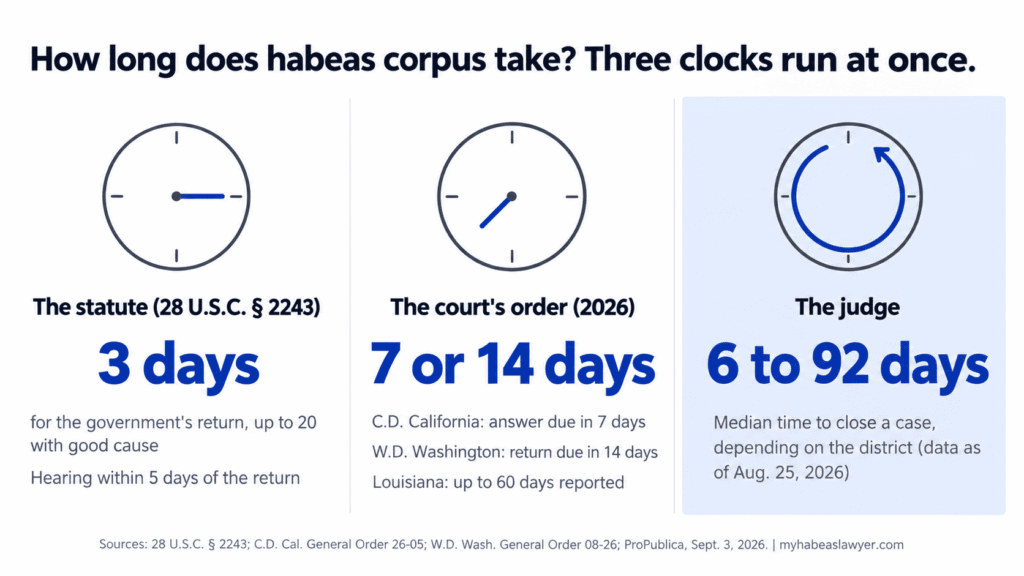
The statute is the same everywhere; the calendars are not. As of August 25, 2026, Minnesota closed habeas cases in a median of about 12 days, while resolved Louisiana cases took a median of 89. Our look at what the 2026 habeas data shows covers the district-by-district numbers. The reasons are mostly structural:
- A standard schedule. A standing order gives every case the same deadlines from day one; without one, deadlines are set case by case.
- Who decides. In the Central District of California, consenting to a magistrate judge at filing skips a report and recommendation to a district judge.
- Shortcuts for repeat issues. Standing Order 2026-01 in the Middle District of Georgia lets magistrate judges order a bond hearing within seven days in qualifying Stewart Detention Center cases; see what the Stewart standing order means.
- Pauses for an appeals court. Some judges hold cases while a higher court decides the same question.
If Your Loved One Is Held in Texas, Louisiana or Mississippi
The full Fifth Circuit heard argument on September 24, 2026 on detention without bond hearings, and some Louisiana judges have paused habeas cases until it rules. A pause does not end a case, and petitions raising other grounds may still move. Our Fifth Circuit bond hearing update tracks the litigation.
How an ICE Transfer Resets the Clock
A habeas petition is generally filed where the person is held. If ICE moves someone before filing, the petition goes to the new district, with a new judge, a new schedule and possibly a different circuit’s law. These moves are common: in the first year of the second Trump administration, ICE moved nearly 41,700 people to another state within 24 hours of detention, more than double the prior year, according to The Marshall Project.
Filing first changes the picture. In one Oregon case, lawyers filed eight minutes before their client was moved out of state, and the case stayed in Oregon. Once a case is pending, some courts require notice before any move: two court days in the Central District of California, and at least 48 hours in the Western District of Washington. Our page on where to file habeas after an ICE transfer covers the jurisdiction rules.
Check the ICE Online Detainee Locator daily and tell your lawyer the moment anything changes; the locator can lag behind a real move.
Emergency Motions: How Fast Can a Court Act?
When harm is imminent, a lawyer can file a motion for a temporary restraining order (TRO) with the petition. Courts reserve these for serious, immediate harm; the Louisiana and Washington orders name imminent removal as the example.
A TRO runs on a much shorter clock. In the Central District of California, a TRO filed with the petition gives the government 24 hours, not three days, to withdraw its consent to a magistrate judge. Speed still has limits: in a New Jersey case, a judge barred the woman’s transfer out of state four days after filing, but ICE had moved her to Oklahoma the day before.
A TRO also does not replace the petition itself. Our page on stopping an ICE transfer explains when this motion is used.
What This Means for Your Family
A habeas case has no single timeline. The statute promises days, the court’s order sets the working calendar, and the judge decides when it ends. The next step is concrete: find the scheduling order, write down the answer and reply dates, and tell your lawyer at once about any transfer notice or new harm. If you are still choosing a lawyer, our questions to ask before you hire include how each firm tracks these deadlines.
Frequently Asked Questions
Is there a deadline to file a habeas petition for ICE detention?
Not the one-year deadline many people hear about. That limit, in 28 U.S.C. § 2244(d), applies to people held under a state court judgment. A § 2241 challenge to immigration detention has no comparable fixed deadline, but waiting can cost options. For criminal cases, see our comparison of habeas corpus and an appeal.
How fast can a habeas petition be filed?
In an urgent case, often within a day or two once the lawyer has the facility name, the A-Number and the custody papers.
Does an emergency motion pause the regular schedule?
Usually not. In the Central District of California, a TRO application does not change the briefing deadlines for the petition. The two run side by side.
Why hasn’t the judge ruled yet?
Once the reply is filed, neither the statute nor the standing orders set a decision date. Heavy dockets, the individual judge and pauses for a pending appeal all add time. If circumstances change, your lawyer can ask the court to rule sooner.
How long does ICE take to release someone after habeas is granted?
The judge’s order usually sets the deadline, for release or for a bond hearing within a fixed number of days. What to expect in the first 48 hours is covered in our guide to release after habeas is granted.
Is a loved one in ICE detention?
Time is critical. A habeas corpus petition can be a powerful tool to challenge unlawful detention. Reach out to us now.
Phone: +1 (862) 799-2200
Legal Disclaimer: This article is provided for general informational purposes only and does not constitute legal advice. Every immigration case has unique circumstances. For legal guidance specific to your situation, we recommend consulting with an experienced immigration attorney. The information in this article reflects laws and policies as of the publication date; subsequent changes may affect its accuracy. Sources were reviewed as of September 30, 2026. Prior results do not guarantee a similar outcome.
Sources
- 28 U.S.C. § 2243 — Issuance of writ; return; hearing; decision, U.S. Code, hosted by Cornell Legal Information Institute; accessed September 30, 2026.
- 28 U.S.C. § 2244 — Finality of determination, U.S. Code, hosted by Cornell Legal Information Institute; accessed September 30, 2026.
- General Order No. 26-05, In the Matter of Immigration Habeas Petitions Under 28 U.S.C. § 2241, U.S. District Court for the Central District of California, filed April 1, 2026; accessed September 30, 2026.
- General Order 08-26, In re: Immigration Habeas Petitions Under 28 U.S.C. § 2241, U.S. District Court for the Western District of Washington, July 7, 2026; accessed September 30, 2026.
- Standing Order 1.74, Immigration Habeas Petitions Under 28 U.S.C. § 2241, U.S. District Court for the Western District of Louisiana, July 2026; accessed September 30, 2026.
- Standing Order No. 2026-01, § 2241 Immigration Petitions for Bond Hearings, Stewart Detention Center, U.S. District Court for the Middle District of Georgia, January 29, 2026; accessed September 30, 2026.
- These Judges Take Months to Decide If Immigrants Have Been Unlawfully Detained, ProPublica, September 3, 2026, updated September 16, 2026; accessed September 30, 2026.
- ICE Detained Them, and Then They Vanished, The Marshall Project, June 1, 2026; accessed September 30, 2026.
- Fifth Circuit Hears Major Case Over Right to Challenge Immigration Detention, American Immigration Council, September 24, 2026; accessed September 30, 2026.
- Online Detainee Locator System, U.S. Immigration and Customs Enforcement; accessed September 30, 2026.
Every day in detention is a day away from your family.
If the immigration system has failed you, federal court may be the only answer. Let us review your case for free.
Get a Free Case Evaluation