Your loved one is detained at Stewart Detention Center, the immigration judge will not give them a bond hearing, and then you discover something unusual: the federal court covering Stewart has already issued a standing order specifically for habeas petitions asking for bond hearings.
It sounds as though the problem should already be solved. It is not that simple.
Stewart Detention Center habeas cases now sit at the intersection of two important developments. In January 2026, the Middle District of Georgia issued Standing Order 2026-01 after receiving what the court called an extraordinary number of § 2241 petitions from Stewart. Then, in May, the Eleventh Circuit issued a binding decision rejecting the government’s broad use of § 1225(b)(2) for certain people arrested inside the United States.
The result is a much stronger legal framework than families at many other detention facilities have. But the Standing Order does not automatically open a case, guarantee release, or put every person detained at Stewart into the same category. This guide explains what the order actually changes, who may fit within it, and why an individual habeas filing can still matter when a bond hearing is not being provided.
In This Guide
- Why Stewart Detention Center Is Different
- What Standing Order 2026-01 Actually Does
- What the Standing Order Does Not Do
- Why an Individual Habeas Petition Can Still Be Necessary
- Who May Fall Within the J.A.M. and P.R.S. Framework
- What Happens After a Stewart Habeas Petition Is Filed
- What Families Should Gather Before Filing
- Transfer Risk Before the Court Acts
- Frequently Asked Questions
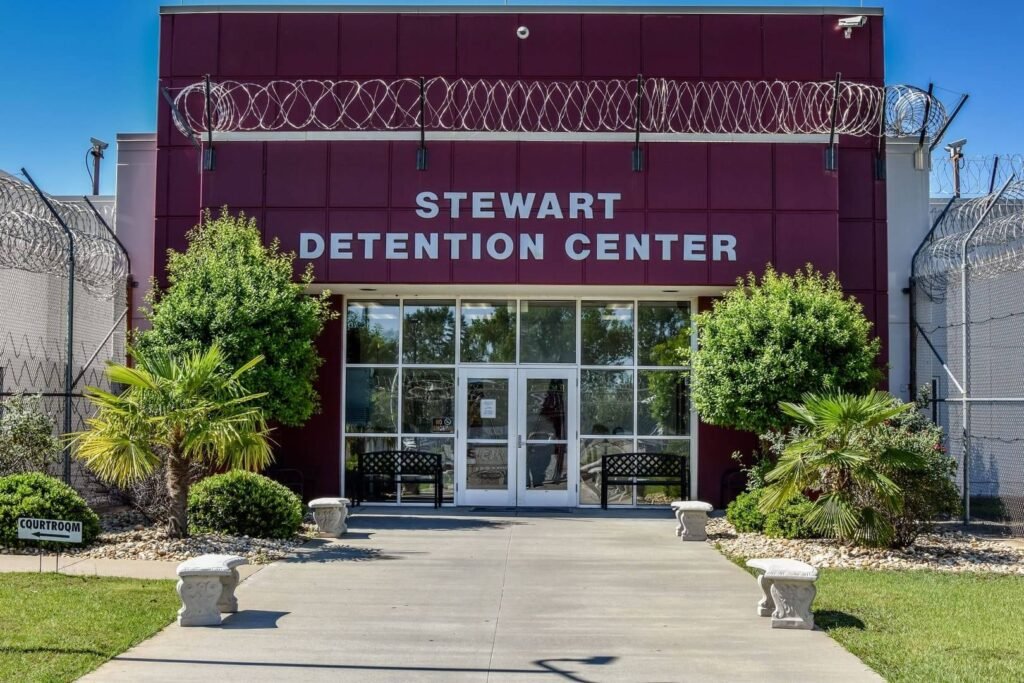
Why Stewart Detention Center Is Different for Habeas Cases
Stewart Detention Center is located at 146 CCA Road in Lumpkin, Georgia. Because Lumpkin is in Stewart County, a federal habeas case arising from detention there falls within the Middle District of Georgia, and Stewart County is part of that court’s Columbus Division.
That location matters. A habeas petition under 28 U.S.C. § 2241 challenges the legality of custody in federal district court. For Stewart detainees, the Middle District of Georgia has developed an unusually specific body of procedure addressing one recurring problem: people arrested inside the United States who are denied access to an ordinary immigration bond hearing.
Our broader page on ICE detention and habeas cases in Georgia covers the state’s facilities and federal districts. Stewart is different enough to require its own analysis because the Middle District went beyond deciding individual cases and adopted a Standing Order specifically addressing petitions coming from this facility.
What Standing Order 2026-01 Actually Does
On January 29, 2026, U.S. District Judge Clay D. Land entered Standing Order 2026-01. The order says the court was receiving an “extraordinary number” of habeas petitions from Stewart seeking bond hearings.
The court had already ruled in J.A.M. v. Streeval and P.R.S. v. Streeval that certain noncitizens arrested inside the country after entering without inspection were governed by 8 U.S.C. § 1226(a), rather than mandatory detention under § 1225(b)(2), unless another statutory provision such as § 1226(c) required mandatory detention.
Standing Order 2026-01 created a way to process repeated petitions raising that issue more efficiently. It directs magistrate judges to screen each § 2241 petition arising from Stewart and determine whether it falls within the parameters of J.A.M. and P.R.S.. If it does, the magistrate judge is authorized to issue the model order attached to the Standing Order.
The Eleventh Circuit strengthened the underlying rule in May
The legal landscape became even more important on May 6, 2026. In Hernandez Alvarez v. Warden, 175 F.4th 1258 (11th Cir. 2026), the Eleventh Circuit held that § 1225(b)(2)(A) applies to arriving aliens seeking entry at the border, while § 1226 governs people unlawfully present in the interior in the circumstances before the court.
That published decision is binding in federal district courts in Georgia unless it is vacated or otherwise overturned. The government has sought rehearing en banc, so this remains an active area of appellate litigation. But as of late August 2026, courts inside the Eleventh Circuit continue to apply Hernandez Alvarez as controlling precedent.
What the Standing Order Does Not Do
The most important thing for a family to understand is what Standing Order 2026-01 does not say.
- It does not automatically release everyone detained at Stewart.
- It does not automatically give every detainee a bond hearing.
- It does not eliminate statutory exceptions such as mandatory detention under § 1226(c).
- It does not file a habeas petition on anyone’s behalf.
- It does not decide whether an immigration judge will ultimately grant bond.
The distinction between a right to have bond considered and a right to be released is critical. A federal court may conclude that the immigration judge has authority to conduct a bond hearing. At that hearing, the judge can still evaluate the ordinary bond questions, including danger and flight risk, and may set bond or deny release based on the individual record.
For a deeper explanation of that distinction, see our guide to using a habeas petition to obtain a § 1226(a) bond hearing.
Why an Individual Habeas Petition Can Still Be Necessary
This is the part of the Standing Order that often surprises families most.
When Judge Land entered the order, he explained that despite the court’s rulings in J.A.M. and P.R.S., the government was not providing bond hearings to people within those rulings unless the federal court ordered it to do so in each individual case. That repeated need for separate orders was one reason the court described the volume of petitions as an administrative judicial emergency.
The Standing Order solved part of the court’s processing problem. It did not turn habeas relief into a class-wide automatic remedy. A person seeking relief still begins with an individual § 2241 case that the court can screen against the relevant legal framework.
The May 2026 Eleventh Circuit decision changes the strength of the legal argument, but not the basic point that a Standing Order does not itself create a lawsuit for a detainee. If an immigration judge now provides the hearing required under controlling law, federal litigation may not be necessary for that issue. But if the person remains held without access to a bond hearing despite falling within the governing rule, an individual habeas petition may provide the mechanism for enforcing it.
Is your loved one at Stewart and still being told there is no bond hearing?
Send us the A-Number, the detention paperwork, and the reason the immigration judge gave for refusing bond. We can review whether the case falls within the current Eleventh Circuit and Middle District of Georgia framework.
Who May Fall Within the J.A.M. and P.R.S. Framework?
The Standing Order is not a general rule for every person in Stewart. Its model order focuses on the situation addressed in J.A.M. and P.R.S.: a noncitizen who entered without inspection, was later found and arrested inside the United States, and is being treated as subject to mandatory detention under § 1225(b)(2).
The court concluded that § 1226(a) supplies bond authority for people within that framework unless a separate statutory exception applies under § 1226(c). The Eleventh Circuit’s later decision in Hernandez Alvarez reinforced the border-versus-interior distinction at the circuit level.
But entry and custody histories matter. A person arrested while actually seeking admission at the border is not situated the same way. Nor is someone independently subject to mandatory detention under § 1226(c). Parole history, prior custody decisions, criminal history, and the exact point at which ICE took custody may also affect the analysis.
This article deliberately does not repeat the entire statutory dispute. Our guide to what § 1225(b)(2) means after entry without inspection explains the competing detention statutes, while our analysis of Matter of Yajure Hurtado explains why immigration judges began saying they lacked jurisdiction to hear these bond requests.
What Happens After a Stewart Habeas Petition Is Filed?
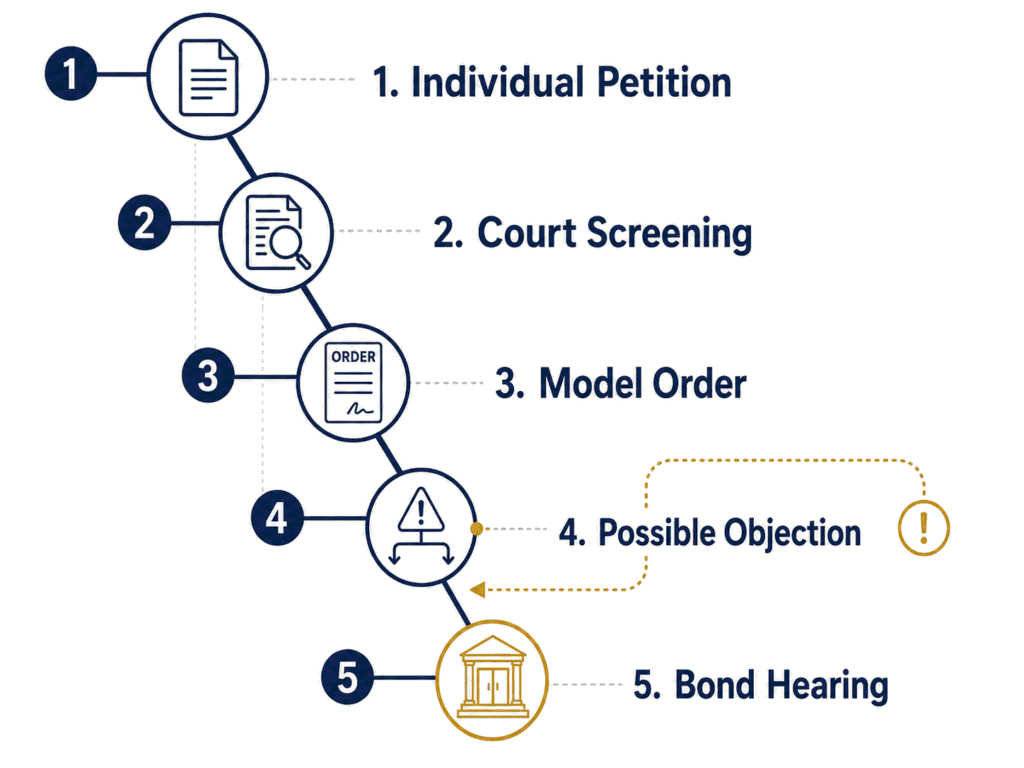
The Standing Order describes a much more specific path than families usually see in federal habeas litigation.
- An individual § 2241 petition is filed. The petition identifies the custody, the detention statute being used, and the legal basis for requesting a bond hearing.
- The petition receives preliminary review. A magistrate judge screens a Stewart petition to determine whether it falls within the framework addressed by J.A.M. and P.R.S..
- A model order may issue. If the case appears to fit, Standing Order 2026-01 authorizes use of the attached model order.
- The government may raise a case-specific objection. If respondents contend in good faith that the earlier cases do not control the particular petition, they may seek relief from the order and explain why.
- A qualifying order calls for a bond hearing. The model order directs respondents to provide the petitioner a § 1226(a) bond hearing within seven days.
That seven-day period begins from the court’s individual order. It does not mean everyone at Stewart must receive a hearing within seven days of filing a petition. The Standing Order also provides that if the government files the permitted good-faith motion, the model order is stayed while the court resolves that dispute.
And even when the hearing occurs, it is still a bond hearing rather than an automatic release order. The immigration judge then makes the custody decision under the applicable § 1226(a) framework.
What Families Should Gather Before Filing
A Stewart case can turn on a few facts that are easy to describe but difficult to prove without the paperwork. Families can save valuable time by gathering documents that show exactly how the person entered, why ICE says they are detained, and what happened when bond was requested.
- A-Number and current facility information. Confirm that the person is still at Stewart and note any prior transfers.
- Notice to Appear and ICE custody paperwork. These documents help identify the government’s removal and detention theory.
- Bond hearing records. Save the written bond order, hearing notice, transcript or recording if available, especially anything referring to § 1225(b)(2), lack of jurisdiction, or Matter of Yajure Hurtado.
- Entry and inspection records. I-94 records, parole documents, border paperwork, prior orders of release, or other records can materially change the statutory analysis.
- Criminal dispositions, if any. They matter because § 1226(c) can create a separate mandatory-detention issue.
- A short custody timeline. Include the ICE arrest date, every transfer, every bond request, and the exact reason given for any denial.
If the family does not know where the person is currently held, the official ICE Online Detainee Locator is the first place to confirm the facility before analyzing federal court options.
Transfer Risk Before the Court Acts
Stewart’s location is part of what gives this article its answer. That is also why a transfer cannot be treated as a minor logistical event.
If ICE moves a detainee before a petition is filed, the proper court and immediate custodian may change. A transfer after filing raises a more complicated jurisdictional question and does not automatically erase an already filed habeas case, but it can create delay and additional litigation over the correct respondent and the court’s continuing authority.
Families who hear that a transfer is being planned should record the date, destination if known, transportation information, and anything the detainee was told. Our ICE transfer prevention page explains the separate emergency-relief issues that can arise when time is measured in hours rather than weeks.
Frequently Asked Questions
Does Standing Order 2026-01 automatically give everyone at Stewart a bond hearing?
No. The Standing Order directs magistrate judges to screen individual § 2241 petitions from Stewart and determine whether they fall within the J.A.M. and P.R.S. framework. It does not automatically open a case or grant relief to every person detained at the facility.
Do I still need to file a habeas petition if the Standing Order already exists?
The Standing Order itself does not file a case for a detainee. If the person is already receiving the bond hearing required under current law, a habeas petition may not be necessary for that issue. If the person remains detained without a hearing despite falling within the governing framework, an individual § 2241 petition may be used to seek federal court enforcement.
Does winning the Stewart habeas petition mean immediate release?
Not necessarily. The model order attached to Standing Order 2026-01 generally provides a bond hearing under § 1226(a). The immigration judge then decides whether bond should be granted and, if so, on what terms. A right to a hearing is different from a guaranteed right to release.
How quickly can a bond hearing happen under Standing Order 2026-01?
The model order directs respondents to provide a qualifying petitioner with a bond hearing within seven days of the individual court order. That is not a seven-day deadline measured from detention or from the filing of every petition. A permitted government objection can also stay the order while the court resolves the dispute.
Can the government object after the court applies the Standing Order?
Yes. The model order allows respondents to file a good-faith motion explaining why J.A.M. and P.R.S. should not control the particular case. Standing Order 2026-01 states that the bond-hearing order is stayed while such a motion is resolved.
What changed after Hernandez Alvarez v. Warden?
On May 6, 2026, the Eleventh Circuit held that § 1225(b)(2)(A) applies to arriving aliens seeking entry at the border, while § 1226 governs people unlawfully present in the interior in the circumstances before the court. That published decision is presently binding in Georgia federal courts, although the government has sought rehearing en banc.
What happens if ICE transfers someone out of Stewart?
A transfer can affect the court, respondent, and law relevant to a new habeas filing. A transfer after a petition has already been filed requires a separate jurisdictional analysis and does not automatically terminate the case. Families should tell counsel immediately if a transfer is planned or has occurred.
The Standing Order Creates a Path, Not an Automatic Result
Standing Order 2026-01 matters because the Middle District of Georgia recognized a repeated problem at Stewart and created a specific procedure for addressing it. The Eleventh Circuit’s later decision in Hernandez Alvarez strengthened the legal landscape for many people arrested in the interior who are being denied bond under § 1225(b)(2).
But neither development makes every Stewart case identical. The person’s entry history, the statute actually governing detention, possible § 1226(c) issues, the reason bond was refused, and the current facility all matter. If no bond hearing is being provided, those are the facts to examine before deciding whether an individual federal petition is necessary.
For the wider federal framework, our habeas corpus and ICE detention guide explains what § 2241 can and cannot accomplish.
Is your loved one detained at Stewart Detention Center?
If the immigration court has refused to provide a bond hearing, the reason for that refusal matters. Send us the A-Number, current facility, entry history, custody documents, and any bond decision. We can review whether the current Middle District of Georgia and Eleventh Circuit framework provides a federal habeas option.
Phone: (+1) 862-799-2200
Email: info@gozellaw.com
Legal Disclaimer: This article is provided for general informational purposes only and does not constitute legal advice. Reading it does not create an attorney-client relationship. Immigration detention law is changing rapidly. The legal landscape described here reflects authorities reviewed through August 31, 2026. The government has sought rehearing en banc in Hernandez Alvarez, and later appellate action could change the governing rule. Whether Standing Order 2026-01 or other habeas relief applies depends on the person’s entry history, detention statute, criminal and procedural history, present facility, and other case-specific facts. Prior results do not guarantee a similar outcome. Consult qualified counsel regarding a specific case.
Sources
- Standing Order 2026-01, 28 U.S.C. § 2241 Immigration Petitions for Bond Hearings — Stewart Detention Center, U.S. District Court for the Middle District of Georgia, January 29, 2026.
- General Orders, U.S. District Court for the Middle District of Georgia.
- Hernandez Alvarez v. Warden, Federal Detention Center Miami, 175 F.4th 1258, U.S. Court of Appeals for the Eleventh Circuit, May 6, 2026.
- 28 U.S.C. § 2241 — Power to grant writ, Cornell Legal Information Institute.
- 8 U.S.C. § 1225 — Inspection by immigration officers; expedited removal, Cornell Legal Information Institute.
- 8 U.S.C. § 1226 — Apprehension and detention of aliens, Cornell Legal Information Institute.
- Matter of Yajure Hurtado, 29 I&N Dec. 216 (BIA 2025), Executive Office for Immigration Review.
- Columbus Division, U.S. District Court for the Middle District of Georgia.
- Stewart Detention Center PREA Audit, U.S. Immigration and Customs Enforcement.
- ICE Online Detainee Locator System, U.S. Immigration and Customs Enforcement.
Every day in detention is a day away from your family.
If the immigration system has failed you, federal court may be the only answer. Let us review your case for free.
Get a Free Case Evaluation