Can you get a free habeas lawyer for someone in ICE detention? Sometimes. There is no right to one, and neither ICE nor the immigration court provides lawyers. But a federal judge can appoint a lawyer for a person who cannot pay, and in 2026 several federal courts do so routinely.
In most of those courts, the request starts with the same paperwork that waives the $5 filing fee. This guide covers who decides, where appointments are happening, what the fee waiver form asks, and the mistakes that leave a petition sitting closed on the docket. If you plan to hire a lawyer, fees are covered in our habeas corpus cost guide; this page is for families who cannot pay.
Last updated: October 26, 2026. Based on federal statutes, court orders and public dockets current on that date.
In This Article · Free and Appointed Habeas Lawyers
- Is There a Right to a Free Habeas Lawyer?
- Where Federal Courts Appoint Habeas Lawyers in 2026
- The Fee Waiver Form Comes First
- Pay the $5 or Ask for a Waiver?
- How to Ask the Court for a Lawyer
- What Happens If the Fee or the Form Is Missing
- If the Court Does Not Appoint a Lawyer
- Frequently Asked Questions
- What to Do Next if You Cannot Afford a Lawyer
Is There a Right to a Free Habeas Lawyer?
No. A habeas petition is a civil case, and the constitutional right to an appointed lawyer belongs to criminal prosecutions. What exists instead is a power: a federal judge may appoint one. Families often hear different answers from different offices, so it helps to know who holds that power.
The Immigration Court Does Not Appoint Lawyers
In removal proceedings, the law lets your relative be represented, but only “at no expense to the Government” (8 U.S.C. § 1362). Outside a narrow program for people found not competent to represent themselves, immigration judges do not appoint lawyers, and ICE never does. What the immigration court system offers is a list of free legal service providers, covered below.
A Federal Judge Can
The habeas petition is a separate case in a separate court. Under the Criminal Justice Act, 18 U.S.C. § 3006A(a)(2)(B), a federal judge may appoint a lawyer for a financially eligible person seeking relief under § 2241 when the interests of justice require it. The lawyer usually comes from the Federal Public Defender’s office or the court’s panel of private lawyers, and the court pays. That means two conditions: your relative cannot afford a lawyer, and the judge decides one is needed.
Judges weigh the second condition differently. In an April 2026 order in the Central District of California, a magistrate judge noted that there is no absolute right to counsel in habeas and said the decision turns on how well the petitioner can present the claims alone, given their complexity and likely merit (Dhiman v. Marin).
Where Federal Courts Appoint Habeas Lawyers in 2026
Some courts no longer decide these requests one at a time. The table shows programs and practices visible in court orders and public dockets as of October 26, 2026.
| Federal court | What the court does | Who it covers |
|---|---|---|
| District of Utah | General Order 26-005 (April 20, 2026) provisionally appoints the Federal Public Defender, which files the petition with a fee waiver motion showing financial eligibility | People in immigration custody in Utah who contact the office, appear financially eligible and have a colorable claim |
| District of Arizona | General Order 26-05 (February 19, 2026) provisionally appoints the Federal Public Defender and provisionally waives the fee | People held under a final order of removal; the court can appoint in other cases |
| Western District of Louisiana | Standing Order 1.73 (April 10, 2026), on the same model as Arizona | Final-order cases only; see our Western District of Louisiana guide |
| Middle District of Louisiana | General Order 2026-11 provisionally appoints the Federal Public Defender in pro se ICE petitions, as this August 2026 docket shows | Pending a check of financial need and the petitioner’s consent |
| District of Nevada | Judges have appointed the Federal Public Defender when screening pro se ICE petitions, as in this April 2026 order | Case by case, by court order |
| Other districts | Judges decide individual motions; some, as in Central District of California, refer pro se petitions to the Federal Defender | Case by case |
These programs change quickly, several cover only people with final removal orders, and a provisional appointment can be withdrawn if the judge is not satisfied about finances. What counts is the court where your relative is held now, not the state where your family lives.
Not sure what the court in your relative’s district does?
Send us the facility name and A-Number. We will tell you whether a fee waiver, an appointed lawyer or a nonprofit option is realistic there. The initial evaluation is free.
The Fee Waiver Form Comes First
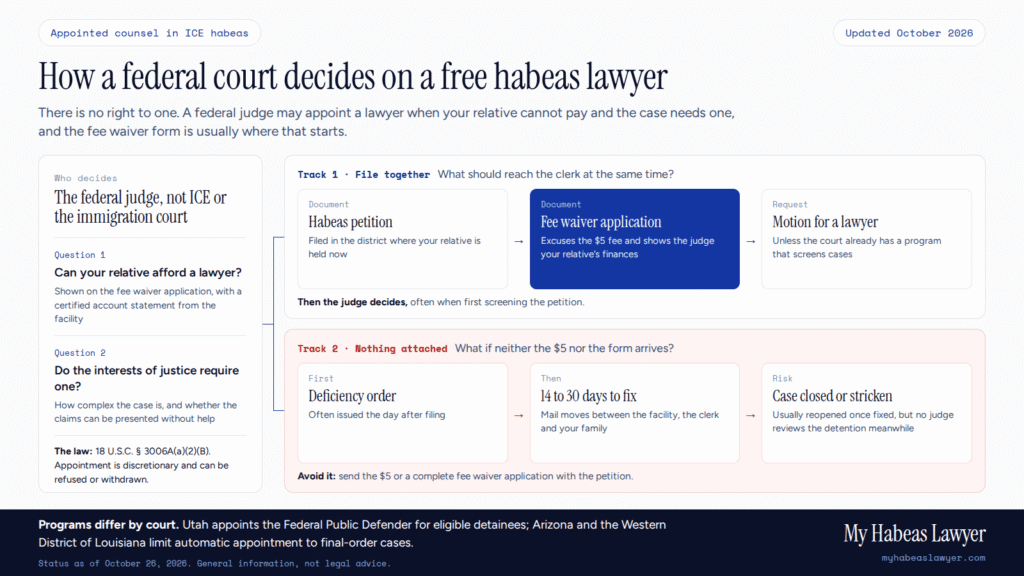
The fee waiver is formally an application to proceed in forma pauperis, or IFP, under 28 U.S.C. § 1915. Its first job is to excuse the $5 habeas filing fee. In many courts it does a second job: it is the financial record the judge reads before appointing a lawyer. Utah’s order says so directly. Legal aid materials make the same link: the National Immigration Project’s August 2026 habeas packet notes that some courts require the IFP motion before appointing counsel, and that when the motion is granted, the court handles service of the petition.
What the Application Asks
Forms differ by court, but most ask for the same things:
- A statement of your relative’s detention account, signed by a facility officer, or a signed statement that there is no account.
- Any income received in the past year, from any source.
- Cash on hand and money in any bank account.
- Property of real value, such as a car or home owned outright.
- Monthly expenses, dependents and debts. Minor children are listed by initials.
The account statement causes most delays, because only the facility can produce it. In a 2026 case in the Southern District of Mississippi, the court set a deadline to file the certificate completed by a facility officer, or a sworn statement naming the official the petitioner had asked and explaining why it was missing (Abbasi docket).
One Example: The Western District of Louisiana Form
The federal court that hears most Louisiana ICE petitions has a separate IFP application for prisoners and ICE detainees. It requires an affidavit listing all assets and a certified copy of the account statement for the past six months, typed or handwritten in pen on letter-size paper. The court’s rules require pro se petitions and fee waiver requests on its approved forms, and a request on the wrong form draws a deficiency notice, as one 2026 Pine Prairie petition showed. If the application is denied, an ICE detainee owes the $5 habeas fee, not the $405 charged in other civil cases.
No Installment Payments for ICE Detainees
Prisoners who sue in federal court usually pay fees in monthly installments under the Prison Litigation Reform Act. That system does not apply here. In Ojo v. INS (1997), the Fifth Circuit held that a person held for an immigration violation is not a “prisoner” under the Act, and other circuits agree. The Western District of Louisiana form says the same for ICE detainees.
Pay the $5 or Ask for a Waiver?
If your family can pay $5, paying is usually the fastest way to get the petition opened. The waiver is worth the extra paperwork when you also want the court to consider an appointed lawyer.
| Question | Paying the $5 | Fee waiver application |
|---|---|---|
| Speed | The clerk opens the case without a financial review | The court reviews the application first; errors trigger a deficiency order |
| Paperwork | A check or money order sent with the petition | The court’s form plus a certified account statement from the facility |
| Appointed lawyer | Paying does not show that your relative cannot afford a lawyer; some courts expect the application anyway | In many courts, this is the financial showing the judge reads |
| Service on the government | Some courts leave it to the petitioner | If granted, the court often arranges it |
| Main risk | Low | Inaccurate answers can get the waiver denied or the case terminated |
Accuracy matters more than the amount. In February 2026, a judge in the Western District of New York terminated a case because the petition said the detainee had a full-time job while the waiver application reported no income at all (Babaka docket). In the Western District of Texas, a waiver was denied two days after filing because the applicant reported $25,000 in a checking account; the fee was paid by the deadline and the case went on (Morales v. Watkins).
How to Ask the Court for a Lawyer
In courts without a standing program, the request is a short motion to appoint counsel, filed with the petition or soon after. It usually covers three points:
- That your relative cannot afford a lawyer, with the fee waiver application as support.
- Why the case is hard to handle alone: the detention statute ICE relies on, language barriers, health problems or the length of detention.
- The attempts already made to find a free lawyer, and why they did not work.
The National Immigration Project packet includes a form motion and suggests listing every nonprofit or pro bono lawyer contacted. A next friend, usually a spouse or parent, can file the petition and these requests when the detained person cannot; our guide explains who can file for someone else. Courts still expect the fee or a signed application: in next-friend cases in the Southern District of New York, the court has given the next friend 30 days to provide one (Ndoye v. Joyce).
Timing varies. In September 2026, an order in the Northern District of Texas barred motions for counsel until the court finished screening the petition (Acosta docket). Check the court’s instructions before filing a motion that will simply be set aside.
What Happens If the Fee or the Form Is Missing
A petition that arrives with neither the $5 nor a fee waiver application is not thrown out at once, but it stops. Courts handle the gap differently:
| Court | What the court did in 2026 | Time to fix |
|---|---|---|
| Western District of Pennsylvania | Marked a case in its Johnstown division closed the day after filing, open to reopening once the deficiency is cured (Garcia Moran v. Noem) | About 30 days |
| Northern District of Texas | Sent a deficiency notice with a blank IFP form and warned of dismissal (Acosta) | 30 days |
| Western District of New York | Terminated a case over an inaccurate application (Babaka) | 30 days to reopen |
| Western District of Louisiana | Issued a deficiency order the day after a Pine Prairie filing; the fee arrived four days later | Set by each order |
Each problem is fixable. The cost is time: mail moves between the facility, the clerk and the family, and while a case sits closed, no judge is reviewing the detention. If ICE moves your relative in that window, the right court can change too; see where to file habeas after an ICE transfer. Send the fee or the application with the petition, and keep copies of everything.
If the Court Does Not Appoint a Lawyer
A denied request does not end the case. The petition can go forward without counsel, and the request can be renewed if the case becomes harder. Other options:
- Nonprofits. EOIR publishes a list of pro bono legal service providers by immigration court. Many focus on removal cases and may lack capacity for federal habeas, so ask directly.
- Self-help tools. The National Immigration Project and partner groups offer DetentionHelp, a free online tool that prepares a habeas petition with the fee waiver form and a motion to appoint counsel.
- Paid counsel. Our practice areas show the detention problems we take on, and payment arrangements are possible in some cases.
Filing without a lawyer is possible, but the risks are real. Our guide to problems with pro se habeas petitions covers them, and what a habeas lawyer does in an ICE case explains what a lawyer adds.
Frequently Asked Questions
Does ICE give detained people a free lawyer?
No. In removal proceedings, the law allows representation only at no expense to the government, and ICE does not assign lawyers. A federal judge can appoint a lawyer in a habeas case, but that is the federal court’s decision.
Does a court-appointed habeas lawyer cost anything?
Appointed lawyers are paid by the court under the Criminal Justice Act. If the judge later finds that money is available, the court can order a payment toward the cost under 18 U.S.C. § 3006A(f), so answer the financial questions accurately.
If the fee waiver is denied, how much do we have to pay?
For a habeas petition, the filing fee is $5. Some court forms mention $405, but that amount applies to other civil cases. Courts usually set a deadline to pay, often between 14 and 30 days.
Can a family member ask the court to appoint a lawyer?
Yes, when the family member files as next friend because the detained person cannot. The court will still expect the $5 or a signed fee waiver application, and it may ask about the detained person’s finances.
Can a lawyer be appointed after the petition is filed?
Yes. Many appointments happen when the judge first screens the petition, and some courts will not consider a request before then. A request can also be renewed later if the case becomes harder.
What to Do Next if You Cannot Afford a Lawyer
Find out which federal court covers the facility and whether it has an appointment program. Then send the petition with either the $5 or a complete fee waiver application, plus a motion for counsel where the court accepts one. Our guide to habeas corpus in ICE detention walks through the federal process, and our federal habeas team page explains who handles these petitions at our firm.
Is a loved one in ICE detention?
Time is critical. A habeas corpus petition can be a powerful tool to challenge unlawful detention. Reach out to us now: call +1 (862) 799-2200 or email info@gozellaw.com.
Legal Disclaimer
This article is provided for general informational purposes only and does not constitute legal advice. Every immigration case has unique circumstances. For legal guidance specific to your situation, we recommend consulting with an experienced immigration attorney. The information in this article reflects laws and policies as of the publication date; subsequent changes may affect its accuracy. Prior results do not guarantee a similar outcome.
Review Note
Prepared October 26, 2026. Court programs follow the orders cited as of that date: District of Utah General Order 26-005 (April 20, 2026), District of Arizona General Order 26-05 (February 19, 2026) and Western District of Louisiana Standing Order 1.73 (April 10, 2026). Docket examples come from public records and reflect filed entries only, not outcomes. Appointment programs change; check the court’s current orders before relying on them.
Sources
- 8 U.S.C. § 1362, Right to counsel, U.S. Code, Cornell Legal Information Institute; accessed October 26, 2026.
- 18 U.S.C. § 3006A, Adequate representation of defendants, U.S. Code, Cornell Legal Information Institute; accessed October 26, 2026.
- 28 U.S.C. § 1915, Proceedings in forma pauperis, U.S. Code, Cornell Legal Information Institute; accessed October 26, 2026.
- General Order 26-005, Appointment of Counsel for Immigration Detainees Seeking Habeas Relief Under 28 U.S.C. § 2241, U.S. District Court for the District of Utah. April 20, 2026.
- General Order 26-05, Appointment of the Federal Public Defender for Habeas Petitions Under 28 U.S.C. § 2241, U.S. District Court for the District of Arizona. February 19, 2026.
- Standing Order 1.73, Appointment of the Federal Public Defender in Immigration Habeas Cases, U.S. District Court for the Western District of Louisiana. April 10, 2026.
- Application to Proceed In Forma Pauperis, Prisoners and ICE Detainees, U.S. District Court for the Western District of Louisiana; accessed October 26, 2026.
- Habeas Explainer Packet, National Immigration Project. August 2026.
- Ojo v. INS, 106 F.3d 680 (5th Cir. 1997), U.S. Court of Appeals for the Fifth Circuit.
- List of Pro Bono Legal Service Providers, Executive Office for Immigration Review; accessed October 26, 2026.
Every day in detention is a day away from your family.
If the immigration system has failed you, federal court may be the only answer. Let us review your case for free.
Get a Free Case Evaluation