The immigration judge said there is nothing more the court can do about bond. Or ICE moved your loved one two states away overnight. Either way, someone has now told your family that you need a habeas lawyer, and it is fair to ask what that person will actually be doing while you wait.
So what does a habeas lawyer do? In an ICE case, a habeas lawyer is a federal litigator who asks a U.S. District Judge to decide whether the government has legal authority to keep a person in immigration custody. The work is a petition under 28 U.S.C. § 2241, filed where the person is held, and the emergency motions that go with it. It is a different practice from criminal habeas, which challenges a conviction; our guide explains the difference between the two kinds of habeas.
This article covers the work itself: what happens in the first 72 hours, what goes into the petition, and what continues after filing. How immigration court and a federal habeas case differ, and the courts where our firm files, are set out on our firm page.
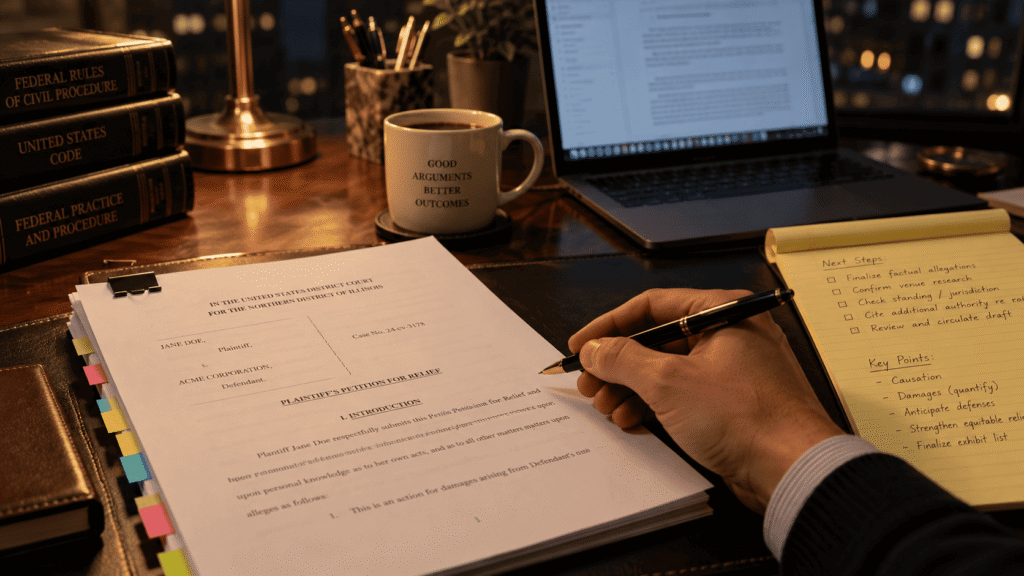
The First 72 Hours: What a Habeas Lawyer Is Doing
Most of the first three days is diagnosis. Four questions decide what kind of petition is filed, where, and how fast.
Which custody statute ICE is relying on
Detention rests on one of a handful of statutes, each pointing to a different argument.
- 8 U.S.C. § 1226(a): detention while removal proceedings are pending, with bond available. The dispute is usually whether a fair bond hearing took place.
- § 1226(c): mandatory detention tied to certain criminal convictions and, since the Laken Riley Act of 2025, certain charges and arrests. The question is whether the person actually falls in the category.
- § 1225(b): the provision ICE has used since 2025 to deny bond hearings to people who entered without inspection, an approach the immigration appeals board adopted in Matter of Yajure Hurtado.
- § 1231: custody after a final removal order, where the issue is whether removal is still reasonably foreseeable.
The statute is rarely stated plainly. The lawyer reads it from the custody paperwork, the charging document and, above all, what the immigration judge said about bond. Getting it wrong means arguing the wrong case.
Which federal district, and which circuit’s law
The petition is filed in the federal district where the person is physically held, and that brings the law of the circuit above it. As of CLINIC’s September 11 update, nine federal appeals courts have rejected the government’s no-bond reading of § 1225(b), and two, the Fifth and Eighth Circuits, have accepted it. The same facts can win in New Jersey and lose in Louisiana.
The lawyer therefore checks the district’s recent rulings and the risk of a transfer. As Bloomberg Law noted in August 2026, a transfer before filing can change the governing law overnight; our page on where to file after an ICE transfer explains the mechanics.
Whether an emergency filing has to come first
A transfer notice or a medical crisis changes the order of work. The lawyer may file a short petition together with a motion for a temporary restraining order, asking the judge to keep the person in the district while the case is heard, and build the fuller record afterward. Our page on stopping ICE transfers explains when that motion is used.
Building the record the petition will stand on
In parallel, the lawyer assembles the documents a judge will actually read: the Notice to Appear, custody and bond decisions, the case status from the immigration court’s Automated Case Information system, any prior removal order, certified criminal dispositions if there are any, and a dated custody timeline. Our guide to the records that matter in a long detention goes through them in detail.
Families supply much of this; the lawyer decides what goes in and what the gaps mean. For the family’s side, see the first 24 hours after an ICE arrest and how families request a habeas review.
Not sure which statute ICE is using?
Send us the facility name, the A-Number and whatever the immigration judge said about bond. We can tell you which statute ICE appears to be relying on, which court would hear a petition, and whether an emergency filing is needed, at no cost.
What a Habeas Attorney Files: Inside a § 2241 Petition

The petition is usually shorter than the work behind it. Federal law requires it to be in writing, signed and verified by the detained person or someone acting on their behalf, and to state the facts of the detention, who holds the person and under what claimed authority (28 U.S.C. § 2242). Inside that frame, the lawyer makes four decisions.
The claims
Most ICE petitions rest on one or both of two grounds. The statutory claim says ICE is using the wrong detention law, for example § 1225(b) where § 1226(a) applies. The constitutional claim says that detention without an individualized hearing, or detention that has gone on too long, violates due process. Our guide to 28 U.S.C. § 2241 explains what a federal judge can and cannot review.
The respondents
A habeas petition names the person with custody, usually the warden of the facility. Many petitions also name the ICE field office director and senior officials, and local practice varies. Naming the wrong custodian can cost days, which is one of the common problems with self-filed petitions.
The relief requested
The petition tells the judge exactly what to order: release or, in the alternative, a bond hearing within a set number of days, often with a request that the person not be moved while the case is pending. Judges frequently choose the narrower remedy, so asking in the alternative is standard.
Exhibits, declarations and verification
Behind the petition sit the exhibits from the record, declarations from family members or employers about ties and history, and the verification page. The official AO 242 form instructions direct petitioners to attach copies of the decisions they challenge. The filing fee is $5, and a waiver can be requested; our habeas corpus cost guide covers the fee and attorney costs. For the filing steps themselves, see how to file a habeas petition for ICE detention.
After Filing: The Work Most Families Never See
Filing starts a federal case, and most of the lawyer’s hours come after it.
- Getting the court to act. Under 28 U.S.C. § 2243, the court issues an order to show cause, and the government’s return is due within three days unless the judge allows more time, up to twenty. The lawyer asks for speed when delay causes harm.
- Answering the government. The return usually argues that a mandatory detention statute applies or that the court should not intervene. The written reply is often where the case is won or lost.
- The hearing, if there is one. Many petitions are decided on the papers; some judges hear argument. See what to expect at a habeas corpus hearing.
- Making the order work. The lawyer tracks the release deadline or the ordered bond hearing and returns to court if ICE does not act; see what happens when ICE ignores a release order.
- Deciding what comes after a denial. The options are an appeal or, if the facts change, a new petition, and the choice has its own deadline.
When You Need an Immigration Lawyer Instead, or Both
A habeas lawyer handles one question: custody. Several situations belong somewhere else first.
- A bond hearing is still available. If the immigration judge can set bond and no one has asked, a bond request in immigration court is usually faster and cheaper.
- The problem is status, not custody. Asylum, adjustment of status and other relief are decided by USCIS or the immigration court, not by a federal district judge.
- The goal is to overturn a removal order. That generally goes to a federal court of appeals by petition for review, not to a district court in habeas, as the AO 242 instructions note.
Often the answer is both. When a federal judge orders a bond hearing, that hearing takes place in immigration court, and the removal case continues there whatever happens in federal court. The two filings have to tell the same story. Dates, entry history and family facts in a habeas petition can be read against the asylum or adjustment case, and the reverse.
What This Means for Your Family
A habeas lawyer’s first days go into finding the statute, the court and the risk. The petition then asks for something specific and proves it, and the work after filing decides whether an order becomes a release. If you are comparing lawyers, ask how each stage is handled and what the fee covers. Our questions to ask before you hire work for any firm, including ours, and the habeas corpus and ICE detention guide covers the wider picture.
Frequently Asked Questions
Is a habeas lawyer for ICE detention the same as a criminal habeas lawyer?
No. Criminal habeas challenges a conviction or sentence, usually under 28 U.S.C. § 2254 or § 2255, with its own deadlines and exhaustion rules. An ICE case challenges civil custody under § 2241, where no one has been sentenced. Some lawyers handle both, but the law is different.
Does the habeas lawyer handle the bond hearing if the judge orders one?
It depends on the engagement. The ordered hearing takes place before an immigration judge, so it is immigration court work. Some habeas lawyers appear there; others coordinate with the family’s immigration counsel. At our firm, that hearing is handled by our main practice, Gozel Law Firm PC. Ask about it before you sign.
Who is on the other side of a habeas case?
Usually the U.S. Attorney’s Office for the district, which defends the warden and the federal officials named in the petition. ICE officers and immigration judges are not the opposing lawyers, which is one reason federal court experience matters.
Can the petition ask for release and a bond hearing at the same time?
Yes. Petitions routinely ask for release and, in the alternative, an order requiring a bond hearing within a set time. Courts often grant the narrower remedy, so asking for both gives the judge an option.
What does a habeas lawyer do if the petition is denied?
Two paths are usually considered. One is an appeal to the federal court of appeals, which generally must be filed within 60 days when the government is a party under Federal Rule of Appellate Procedure 4(a). The other is a new petition if the facts change materially, for example when detention becomes prolonged. Which one fits depends on why relief was denied.
Is a loved one in ICE detention?
Time is critical. A habeas corpus petition can be a powerful tool to challenge unlawful detention. Reach out to us now.
Phone: +1 (862) 799-2200
Legal Disclaimer: This article is provided for general informational purposes only and does not constitute legal advice. Every immigration case has unique circumstances. For legal guidance specific to your situation, we recommend consulting with an experienced immigration attorney. The information in this article reflects laws and policies as of the publication date; subsequent changes may affect its accuracy. Sources were reviewed as of September 28, 2026. Prior results do not guarantee a similar outcome.
Sources
- 28 U.S.C. § 2241 — Power to grant writ, U.S. Code, hosted by Cornell Legal Information Institute; accessed September 28, 2026.
- 28 U.S.C. § 2242 — Application, U.S. Code, hosted by Cornell Legal Information Institute; accessed September 28, 2026.
- 28 U.S.C. § 2243 — Issuance of writ; return; hearing; decision, U.S. Code, hosted by Cornell Legal Information Institute; accessed September 28, 2026.
- 8 U.S.C. § 1225 — Inspection by immigration officers, U.S. Code, hosted by Cornell Legal Information Institute; accessed September 28, 2026.
- 8 U.S.C. § 1226 — Apprehension and detention of aliens, U.S. Code, hosted by Cornell Legal Information Institute; accessed September 28, 2026.
- 8 U.S.C. § 1231 — Detention and removal of aliens ordered removed, U.S. Code, hosted by Cornell Legal Information Institute; accessed September 28, 2026.
- Petition for a Writ of Habeas Corpus Under 28 U.S.C. § 2241 (AO 242), effective September 1, 2017, Administrative Office of the U.S. Courts; accessed September 28, 2026.
- Federal Rule of Appellate Procedure 4 — Appeal as of Right, hosted by Cornell Legal Information Institute; accessed September 28, 2026.
- A Circuit Split Ripe for Review: Mandatory Detention Under INA § 235(b)(2)(A), Catholic Legal Immigration Network (CLINIC), updated September 11, 2026; accessed September 28, 2026.
- Noncitizen Detention Circuit Split Is Built for Supreme Court, Bloomberg Law, August 25, 2026; accessed September 28, 2026.
- Automated Case Information, Executive Office for Immigration Review, U.S. Department of Justice; accessed September 28, 2026.
Every day in detention is a day away from your family.
If the immigration system has failed you, federal court may be the only answer. Let us review your case for free.
Get a Free Case Evaluation