ICE did not take your loved one into immigration custody when they left jail. Months or even years passed. Can the government still say mandatory detention applies? That question sounds as if it should turn on the length of the gap between criminal release and ICE detention. Under current law, however, the answer is more complicated.
The Supreme Court’s decision in Nielsen v. Preap rejected the argument that INA § 236(c) applies only when immigration officials take a person into custody immediately after release from criminal custody. A delay by ICE, even a long one, does not by itself remove a person from mandatory detention under § 236(c).
But that does not make the custody timeline irrelevant. In 2026, a careful review still asks which statutory category ICE is using, which criminal event supports that category, what release actually occurred, whether the criminal record matches the statute, and whether the 2025 Laken Riley Act changes the analysis. Those questions can matter when a family is trying to determine whether the mandatory-detention label was applied correctly and whether a habeas corpus challenge should be considered.
In This Article
- What Does INA § 236(c) Mean by Mandatory Detention?
- What Did Nielsen v. Preap Decide About Release Timing?
- If ICE Can Wait, Why Does Timing Still Matter?
- How Did the Laken Riley Act Change § 236(c)?
- When May the Mandatory-Detention Classification Be Wrong?
- How Should Families Build the Custody Timeline?
- When May Habeas Corpus Enter the Picture?
- Frequently Asked Questions

What Does INA § 236(c) Mean by Mandatory Detention?
INA § 236 governs detention while the government is deciding whether certain noncitizens should be removed from the United States. The current statutory text appears at 8 U.S.C. § 1226.
Under § 236(a), the government generally has discretionary detention authority and may, depending on the circumstances, release a person on bond or conditional parole. Section 236(c) is different. It directs the government to take into custody people who fall within specified statutory categories and sharply limits ordinary bond options.
Not every arrest, criminal charge, or conviction automatically creates mandatory detention. The analysis depends on the exact immigration provision, the criminal record, and the statutory category DHS claims applies. Our broader mandatory detention practice page explains the general distinction. This article focuses on the narrower problem of what a criminal release and later ICE arrest mean after Preap.
Why the Words “When Released” Became So Important
The statute says that the government shall take specified people into custody “when” they are released from criminal custody. For years, detainees argued that this language required immigration officials to act promptly. If ICE allowed someone to return to family, employment, and community life for months or years before making an immigration arrest, the argument was that the person should instead fall under ordinary § 236(a) detention and receive a normal bond process.
The Supreme Court addressed that statutory argument directly in 2019.
What Did Nielsen v. Preap Decide About Release Timing?
In Nielsen v. Preap, the named detainees had not necessarily been placed into immigration custody immediately after release from the criminal custody connected to the government’s mandatory-detention theory. Some gaps lasted years.
The detainees argued that the phrase “when the alien is released” meant that DHS lost access to mandatory detention if it failed to take the person into immigration custody promptly. The Supreme Court rejected that interpretation. A person who is otherwise described by § 236(c)(1) does not become exempt from mandatory detention merely because immigration officials waited before taking that person into custody.
That distinction is critical for families reviewing older criminal histories. A five-day gap, a five-month gap, or even a multi-year gap cannot, by itself, establish that § 236(c) does not apply.
After Preap, the stronger question is usually not “How long did ICE wait?” It is “Does this person actually fit the mandatory-detention category the government is invoking?”
Preap was primarily a statutory interpretation decision. It does not mean that every form of detention under § 236(c) is immune from constitutional challenge regardless of length, procedural posture, or the facts of an individual case. Those questions can depend on the governing federal circuit and the specific detention record.
If ICE Can Wait, Why Does Timing Still Matter?
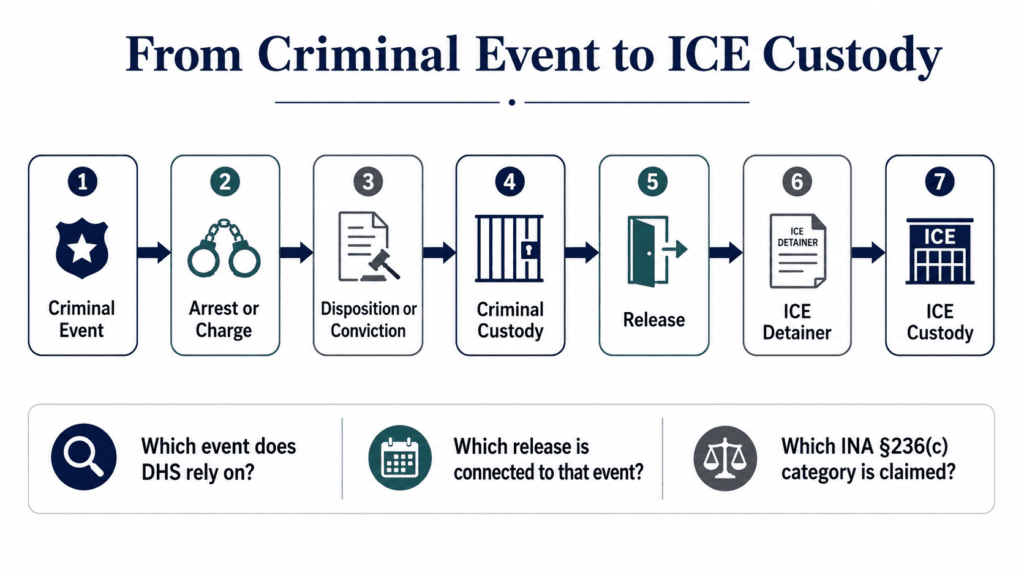
Timing still matters because a custody timeline can reveal whether DHS is relying on the correct criminal event and the correct statutory basis. The analysis simply has to be more precise than arguing that ICE waited too long.
Which Criminal Event Is ICE Relying On?
A person may have several events in a criminal history: an old conviction, a later arrest, probation, a new charge that was dismissed, a brief jail stay, or release after an unrelated case. Those events should not automatically be treated as interchangeable.
For the traditional § 236(c)(1)(A)-(D) categories, Matter of Garcia Arreola held that the relevant post-1998 release from non-DHS custody must be directly tied to the basis for mandatory detention. In that case, later releases involving assault charges that did not supply the relevant § 236(c) ground could not simply be used to activate mandatory detention based on an older drug conviction.
That decision predates the Laken Riley Act and specifically analyzed the older § 236(c)(1)(A)-(D) framework. The new § 236(c)(1)(E) category therefore requires a separate analysis under the current statute rather than mechanically extending an older case beyond what it decided.
What Kind of Release Actually Occurred?
The record should identify the criminal custody associated with the government’s theory, the date of release, and what happened next. Court dispositions, sentencing records, jail release paperwork, probation documents, and ICE detainers can clarify a chronology that may otherwise be reduced to an inaccurate statement such as “he was released from jail in 2022.”
Is the Real Problem Timing or Classification?
A delayed ICE arrest and a mistaken mandatory-detention classification are different legal issues. Preap makes the first argument difficult when it rests only on elapsed time. But a person may still have a serious classification issue if the offense, immigration ground, criminal record, or release event does not match the provision DHS says controls.
How Did the Laken Riley Act Change § 236(c)?
The mandatory-detention statute changed significantly in 2025. The Laken Riley Act, signed January 29, 2025, added a new category at INA § 236(c)(1)(E).
The new category applies when the statute’s specified inadmissibility requirement is satisfied and the person is charged with, arrested for, convicted of, or admits conduct involving certain listed offenses. Those offenses include burglary, theft, larceny, shoplifting, assault of a law-enforcement officer, and crimes resulting in death or serious bodily injury.
This matters because older mandatory-detention discussions often focus heavily on qualifying convictions. Under the new category, a conviction is not always necessary for the statutory inquiry to begin. But neither is an arrest alone enough in every case. Section 236(c)(1)(E) also contains a separate immigration-status component tied to specified grounds of inadmissibility.
| Traditional § 236(c) Review | Additional 2025-2026 Question |
|---|---|
| Which § 236(c)(1)(A)-(D) ground does DHS invoke? | Does the new § 236(c)(1)(E) category also apply? |
| Which conviction or criminal ground supports detention? | Is DHS relying on an arrest, charge, conviction, or qualifying admission? |
| Is the relevant release tied to the statutory basis for detention? | Does the person also satisfy the specific inadmissibility component in § 236(c)(1)(E)(i)? |
| Does the record actually fit the claimed immigration ground? | Does the alleged offense fall within the offense definitions used by the new provision? |
The January 30, 2025 EOIR implementation memorandum confirms that the Act added this mandatory-detention category and instructs adjudicators to apply the amended statute in relevant custody determinations.
The Laken Riley Act expanded who may fall within § 236(c); it did not turn every arrest into mandatory detention. A case-specific review still has to match the person’s immigration circumstances and criminal record to the exact statutory language.
Was your loved one labeled “mandatory” after being released from criminal custody?
A focused review should examine the exact criminal record, the release chronology, the statutory category ICE is using, and whether the current version of INA § 236(c) actually fits the case.
When May the Mandatory-Detention Classification Be Wrong?
An ICE custody label should not substitute for a legal analysis. The central question is whether the person is actually “properly included” in a mandatory-detention category.
Current 8 C.F.R. § 1003.19 generally prevents an Immigration Judge from redetermining custody conditions for a person who is genuinely subject to § 236(c). But the regulation also preserves the ability to seek a determination that the person is not properly included in the mandatory category. EOIR’s Laken Riley Act guidance repeats that distinction.
Potential classification issues may include:
- DHS relies on a criminal event that does not fit the asserted statutory category;
- The underlying record does not establish the conviction or offense DHS claims;
- For a traditional § 236(c)(1)(A)-(D) theory, the government relies on an unrelated later release rather than the release connected to the statutory basis;
- DHS invokes § 236(c)(1)(E), but the required inadmissibility provision or qualifying offense is not established;
- The criminal disposition has been misunderstood, modified, vacated, or inaccurately summarized in the custody record; or
- A different immigration detention statute may govern the person instead.
For a broader discussion of what “no bond” may mean and how a mandatory classification can be reviewed, see our guide on no bond and mandatory ICE detention.
How Should Families Build the Custody Timeline?
When release timing is disputed, a dated timeline is more useful than a general statement that ICE “waited a long time.” Counsel needs to see which event occurred, what legal consequence followed, and which document proves it.
| Event | Documents to Preserve | Why It May Matter |
|---|---|---|
| Underlying offense or arrest | Police records, complaint, charging documents | Identifies the conduct DHS may be relying on. |
| Criminal disposition | Judgment, plea records, dismissal, sentencing order | Shows whether there was a conviction and what the actual offense was. |
| Criminal custody | Booking records, sentence computation, jail records | Establishes which custody period corresponds to the criminal event. |
| Release | Release certificate, probation or supervision records | Fixes the date and legal basis of release. |
| ICE detainer | Form I-247 or other detainer documentation, if available | Shows when immigration enforcement entered the custody timeline. |
| ICE detention | Custody notice, I-286, transfer and facility records | Shows when DHS actually assumed immigration custody and under what claimed authority. |
| Immigration court custody ruling | Bond decision, Joseph-related determination, hearing notice | May reveal whether an Immigration Judge accepted or questioned the mandatory classification. |
The sequence can be especially important when the criminal history contains multiple arrests or convictions. A later jail release may look relevant at first glance but involve conduct unrelated to the mandatory-detention ground DHS is using. Conversely, after the Laken Riley Act, an arrest or charge that would previously have seemed insufficient may require closer examination if the other requirements of § 236(c)(1)(E) are present.
Families should also preserve every ICE custody document rather than relying on oral explanations. Phrases such as “mandatory,” “no bond,” or “236(c)” should be tied to an actual record whenever possible.
When May Habeas Corpus Enter the Picture?
A mandatory-detention dispute does not always remain inside immigration court. Federal habeas corpus under 28 U.S.C. § 2241 can provide a separate forum for certain challenges to unlawful immigration custody.
A habeas petition does not ask the federal judge to cancel the removal case, grant immigration status, or decide the merits of an asylum or green card application. The custody question is narrower: whether the government has lawful authority to continue holding the person under the circumstances presented.
Our guide to 28 U.S.C. § 2241 in ICE detention cases explains the federal habeas statute in more detail. Our separate article on mandatory detention and federal habeas petitions discusses the broader relationship between the mandatory label and federal court review.
A detention-focused review may examine whether:
- DHS is applying the correct detention statute;
- The criminal record actually places the person within § 236(c);
- The release and predicate offense have been matched correctly under applicable law;
- The new § 236(c)(1)(E) category genuinely applies;
- An available administrative custody procedure has been used or improperly denied; and
- Continued detention raises a separate constitutional issue based on its duration and the law of the federal circuit where the person is detained.
No single timing fact guarantees release. A viable federal challenge depends on the detention statute, controlling precedent, procedural history, location of detention, and the evidence supporting the claim.
Frequently Asked Questions
Does ICE have to detain someone immediately after they leave jail?
No. The Supreme Court’s decision in Nielsen v. Preap rejected the argument that a person otherwise covered by § 236(c)(1) escapes mandatory detention simply because DHS did not take the person into immigration custody immediately after criminal release.
Can mandatory detention apply years after criminal release?
Potentially, yes. The length of the gap alone does not defeat § 236(c) after Preap. The separate question is whether the person actually falls within the statutory category DHS invokes.
Why should we document the release date if ICE can arrest someone later?
Because the timeline may reveal which criminal event and release DHS is relying on, whether that event corresponds to the claimed detention ground, and whether the custody record contains a classification error. Timing matters as part of the statutory history even though delay alone is not enough.
What did the Laken Riley Act change?
The 2025 Act added INA § 236(c)(1)(E), expanding mandatory detention to an additional category involving specified grounds of inadmissibility and certain arrests, charges, convictions, or admissions involving listed offenses. The new provision should be checked directly rather than relying on older mandatory-detention summaries.
Can an Immigration Judge decide that ICE used the wrong mandatory category?
Current regulations allow a person to seek a determination that they are not properly included within the relevant mandatory-detention category. This is different from asking the Immigration Judge to exercise ordinary bond discretion after correctly finding that § 236(c) applies.
Can habeas corpus challenge mandatory detention?
In appropriate cases, yes. A federal habeas petition may raise a legal or constitutional challenge to detention, including certain disputes over the statutory basis for custody. The available theory and remedy depend on the facts, the procedural posture, and controlling federal law.
The Time Gap Is Only the Beginning of the Analysis
A family may understandably focus on the fact that ICE waited months or years after criminal release. After Nielsen v. Preap, however, that delay is not an automatic path out of mandatory detention.
The more useful analysis reconstructs the complete record: the underlying offense, criminal custody, exact release, later arrests or charges, ICE detainer, immigration arrest, and statutory provision DHS is invoking. The 2025 Laken Riley Act makes that record even more important because the current version of § 236(c) reaches a broader category of criminal events than many older detention guides describe.
If those records show that ICE connected the wrong offense, release, immigration ground, or statutory category to the mandatory-detention label, the case may deserve a closer custody review. And where the detention itself raises a viable federal claim, habeas corpus may provide a route to independent judicial review.
Was your loved one placed in mandatory ICE detention after criminal release?
Contact our team for an evaluation of the criminal record, release timeline, ICE custody documents, claimed INA § 236(c) category, Laken Riley Act issues, and available federal habeas options.
Phone: +1 (862) 799-2200
Email: info@gozellaw.com
Legal Disclaimer: This article is provided for general informational purposes only and does not constitute legal advice. Every immigration case has unique circumstances. For legal guidance specific to your situation, we recommend consulting with an experienced immigration attorney. The information in this article reflects laws and policies as of the publication date; subsequent changes may affect its accuracy. Prior results do not guarantee a similar outcome.
Sources
- Nielsen v. Preap, 586 U.S. 392 (2019) — U.S. Supreme Court
- 8 U.S.C. § 1226 — Apprehension and Detention of Aliens, Office of the Law Revision Counsel
- Laken Riley Act, Pub. L. 119-1 — January 29, 2025
- EOIR Policy Memorandum 25-11 — Laken Riley Act, January 30, 2025
- 8 C.F.R. § 1003.19 — Custody and Bond
- Matter of Garcia Arreola, 25 I&N Dec. 267 (BIA 2010)
- 28 U.S.C. § 2241 — Power to Grant Writ, Cornell Legal Information Institute
Every day in detention is a day away from your family.
If the immigration system has failed you, federal court may be the only answer. Let us review your case for free.
Get a Free Case Evaluation