A loved one is detained at the Northwest ICE Processing Center in Tacoma, and the family has heard that federal habeas corpus may offer a path to review. The next questions are usually procedural: Where is the case filed? Who receives it? When must the government respond? Can ICE transfer the person while the petition is pending?
The Tacoma facility is officially called the Northwest ICE Processing Center and has also long been known as the Northwest Detention Center. Because the person is physically detained in Tacoma, an immigration habeas petition will commonly involve the U.S. District Court for the Western District of Washington. For broader information about facilities, recurring custody scenarios, and representation, review our page on Washington ICE detention and habeas representation.
This guide focuses on what happens after counsel evaluates and files a petition under 28 U.S.C. § 2241. It explains the court’s July 2026 scheduling procedure, judge assignment, the government’s return, the petitioner’s traverse, transfer notices, emergency motions, and the limits of federal habeas review.
In This Article
- Why Tacoma Detention Leads to Federal Court in Western Washington
- What a § 2241 Habeas Petition Actually Challenges
- The July 2026 Procedure for Immigration Habeas Cases
- What Happens After the Petition Is Filed
- Transfer and Removal During a Pending Habeas Case
- When Emergency Relief or a TRO May Be Necessary
- Documents That Help Move the Case Forward
- What the Federal Judge Can and Cannot Order
- When Timing Becomes Critical
- Frequently Asked Questions
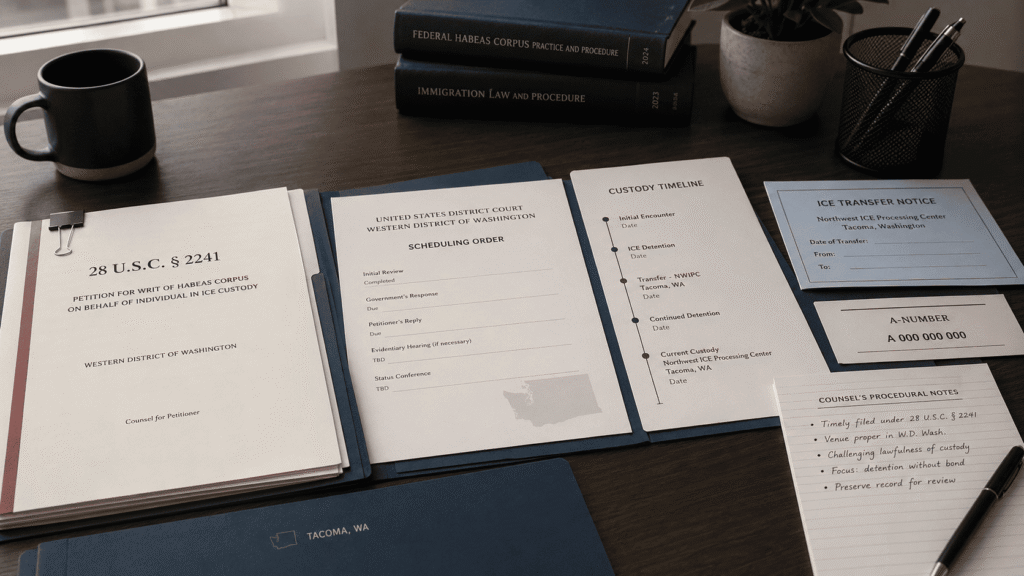
Why Tacoma Detention Leads to Federal Court in Western Washington
A physical-custody habeas petition is closely tied to where the person is actually confined. The family’s residence, the attorney’s office, the place of arrest, and the immigration court location may all be different. What matters at the filing stage is identifying the current custodian, the custody authority, and the federal district with jurisdiction over that confinement.
The Northwest ICE Processing Center is located in Tacoma, within the Western District of Washington. Section 2241 authorizes federal district courts to grant writs within their respective jurisdictions, while 28 U.S.C. § 2242 requires the petition to identify the detention facts, the person with custody, and the authority claimed for detention, if known.
A habeas lawyer must therefore confirm the person’s location immediately before filing. An incorrect district or respondent can create an avoidable jurisdiction dispute, especially when ICE has recently transferred the detainee or appears ready to do so.
The first filing question is not where the family lives. It is where the person is confined, who exercises custody, and which federal court can review that restraint.
What a § 2241 Habeas Petition Actually Challenges
A Tacoma immigration habeas petition does not ordinarily ask the district court to grant asylum, cancel removal, approve adjustment of status, or replace the immigration judge. It asks a narrower federal question: May the government lawfully continue holding this person under the Constitution and federal law?
Depending on the governing detention statute and procedural history, the requested relief may include release, an individualized bond hearing, a new custody review, or an order requiring the government to justify continued detention. Our guide to federal habeas review under 28 U.S.C. § 2241 addresses that statutory foundation in greater detail.
| Question | Immigration Court | Federal Habeas Court |
|---|---|---|
| Primary focus | Removal case or statutory bond eligibility | Legality of present detention |
| Decision-maker | Immigration judge within EOIR | Federal district or magistrate judge |
| Common custody remedy | Bond decision where jurisdiction exists | Release, bond hearing, or legally sufficient custody review |
| Underlying immigration relief | May decide asylum or other removal relief | Generally does not decide the merits of that relief |
The proceedings may interact, but they are not interchangeable. For a fuller comparison, see habeas corpus versus an immigration bond hearing.
The July 2026 Procedure for Immigration Habeas Cases
On July 7, 2026, the Western District of Washington adopted General Order 08-26. The order superseded General Order 10-25 and established a case-assignment and scheduling procedure specifically for § 2241 petitions filed by people in immigration detention.
The stated objective is prompt adjudication. The Clerk randomly assigns qualifying immigration habeas petitions to either a district judge or a magistrate judge, and the court promptly enters a standard scheduling order after assignment.
District judge or magistrate judge?
When counsel files through CM/ECF, the filer is asked whether the petitioner consents to magistrate judge jurisdiction. The United States has provided general consent for this class of cases, while reserving the ability to withdraw consent. If the petitioner consents, the government does not timely withdraw, and random assignment selects a magistrate judge, that judge may keep and decide the case under 28 U.S.C. § 636(c).
Consent does not guarantee assignment to a magistrate judge because the random pool includes both types of judges. If the petitioner declines consent or the government timely withdraws it, the case is assigned to a district judge without referral.
Service and the standard schedule
After assignment, the Clerk’s Office serves the petition on the U.S. Attorney’s Office if service has not already occurred. The court then issues a standard order setting the government’s return, the petitioner’s traverse, transfer-notice requirements, and a procedure for requesting a faster or longer briefing schedule.
Is your loved one still detained in Tacoma while the family is trying to understand federal court?
Our federal litigation team can review the current facility, custody authority, immigration history, prior bond record, and transfer risk to determine whether a § 2241 petition in the Western District of Washington may fit the case.
What Happens After the Petition Is Filed
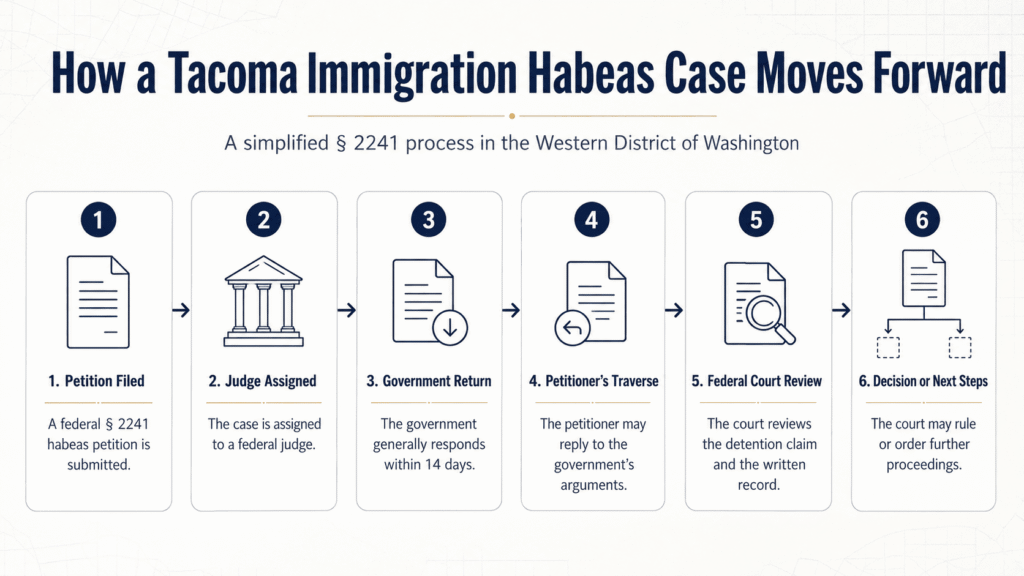
The standard scheduling order directs respondents to show cause why the writ should not be granted. In a counseled case, the government’s return is generally due 14 days after entry of the scheduling order. Any dismissal arguments are ordinarily made inside the return rather than through a separate motion.
The government’s return
The return is the government’s response to the petition. It may dispute the detention timeline, defend the asserted statutory authority, argue that the requested remedy is unavailable, contest jurisdiction, or rely on custody and immigration records that were not in the family’s possession.
The petitioner’s traverse
In a represented case, a traverse may generally be filed within five days after the return deadline. It gives the petitioner an opportunity to answer factual or legal arguments raised by the government. The standard pro se order allows 14 days for a traverse to account for mail delays.
Does every case receive a hearing?
No. A prompt briefing schedule does not guarantee oral argument, an evidentiary hearing, or release. The assigned judge may decide the petition on the written record, request supplemental briefing, schedule argument, hold a hearing, or direct other proceedings. Our separate guide explains what to expect if a federal habeas hearing is scheduled.
A fast briefing schedule is not a promise of release. It is a structured procedure that allows the federal court to examine custody without the ordinary pace of a typical civil action.
Transfer and Removal During a Pending Habeas Case
General Order 08-26 includes an important notice provision for represented petitioners. The standard order requires respondents to provide the petitioner and counsel at least 48 hours’ notice before moving the person out of the Western District of Washington or removing the person from the United States. The period becomes 72 hours when it extends into a weekend, holiday, or court closure.
Respondents must also file the notice of intent on the docket and file another notice if the transfer or removal is completed. The standard pro se scheduling order is different: it generally provides seven days’ notice.
Notice is not the same as an automatic stay
Filing a habeas petition does not automatically freeze every ICE action. A notice requirement gives counsel time to assess the threatened event, but it is not itself an order prohibiting transfer or removal. An emergency motion may still be necessary.
If ICE transfers the person before filing, counsel must reassess the current custodian, proper district, applicable circuit law, and available emergency options. Families facing an active transfer should review our page on emergency options for stopping an ICE transfer.
When Emergency Relief or a TRO May Be Necessary
The court designed the standard schedule to provide prompt review and reduce routine motions for temporary restraining orders seeking the same relief as the habeas petition. Under General Order 08-26, a TRO should be reserved for allegations of imminent, irreparable harm, such as imminent removal from the United States.
A TRO motion must satisfy Federal Rule of Civil Procedure 65 and Local Civil Rule 65. A generalized concern that ICE might act at some future point may not establish the required urgency. The filing should identify the threatened action, the expected timing, the harm that cannot later be repaired, and the evidence supporting those facts.
| Standard Habeas Track | Possible Emergency TRO Track |
|---|---|
| Petition filed and assigned | Petition and emergency motion filed |
| Government return under standard schedule | Evidence of imminent, irreparable harm |
| Traverse and court review | Rule 65 and local-rule showing |
| Decision or additional proceedings | Accelerated judicial consideration |
Documents That Help Move the Case Forward
A federal petition cannot be evaluated from the facility name alone. Counsel must identify why the person is detained now, what custody review has occurred, what procedural events changed the detention authority, and which remedy is legally available.
| Record Category | Examples | Why It Matters |
|---|---|---|
| Identity and custody | A-Number, locator result, current facility, initial custody date, transfer history | Confirms the person, district, custodian, and timeline |
| Immigration proceedings | Notice to Appear, immigration judge orders, BIA records, final order, stay documents | Shows the procedural posture and possible detention statute |
| Custody review | Form I-286, bond orders, parole requests, post-order reviews, ICE responses | Shows which review occurred and what remains unresolved |
| Urgency | Transfer notice, removal itinerary, locator change, medical records, officer communications | May support expedited review or emergency relief |
| Release planning | Verified address, sponsor declaration, transportation, treatment, reporting plan | Explains how release conditions could operate in practice |
The family should also preserve screenshots, written ICE communications, hearing notices, certified criminal dispositions where relevant, and records showing prior compliance. Documents should be arranged chronologically and connected to the legal theory rather than submitted as an unorganized hardship packet.
What the Federal Judge Can and Cannot Order
A federal habeas judge has substantial authority over unlawful custody, but the available remedy depends on the claim proved. Possible outcomes may include immediate release, an individualized bond hearing, a new custody review, limited protective relief, denial of the petition, or resolution through an agreement before a final decision.
| Possible Outcome | Practical Effect |
|---|---|
| Release | Custody ends, potentially subject to lawful conditions |
| Bond hearing order | An immigration judge must provide the ordered process |
| New custody review | The government must conduct a legally sufficient review |
| Protective relief | The court may address an imminent custody-related action |
| Petition denied | Detention continues unless another remedy is available |
| Case resolved by agreement | Custody changes before final adjudication |
The district court generally does not use this proceeding to grant asylum, cancel a removal order, decide adjustment eligibility, or conduct a routine appeal from the immigration judge. A separate petition for review, motion to reopen, stay request, or immigration proceeding may be necessary to challenge the removal decision itself.
A Tacoma case on our site shows how a § 2241 petition led to release after approximately 13 months of detention. The 13-month Tacoma ICE detention case illustrates one possible remedy, but its result does not establish that another petition will end the same way.
When Timing Becomes Critical
Early review becomes particularly important when ICE announces a transfer, a removal date appears imminent, custody continues without meaningful review, or an immigration judge states that no bond jurisdiction exists. Other warning signs include a detention theory that does not match the procedural record, serious medical deterioration, or continued post-order custody when removal cannot realistically be carried out.
The correct strategy depends on the actual detention authority and timeline. Readers can review our resources on prolonged ICE detention and cases where an immigration judge denied a bond hearing. These are related issues, but neither the passage of a particular number of days nor a prior bond denial automatically proves a habeas claim.
Frequently Asked Questions
Is the Northwest ICE Processing Center the same as the Northwest Detention Center?
They refer to the same Tacoma facility. Northwest ICE Processing Center is the current official name used in ICE materials, while Northwest Detention Center remains a widely recognized former name. Using both names once in the article helps families confirm that they are researching the correct location.
Why are Tacoma immigration habeas cases filed in the Western District of Washington?
The facility is located in Tacoma, within the Western District of Washington. A physical-custody petition generally requires counsel to identify the present custodian and the court with jurisdiction over the confinement. A recent transfer can change that analysis, so location should be verified immediately before filing.
Will a district judge or magistrate judge decide the case?
General Order 08-26 places qualifying petitions in a random assignment pool that includes both district and magistrate judges. A magistrate judge may keep and decide the entire case when the required consent exists. If consent is declined or timely withdrawn, the petition is assigned to a district judge.
How quickly must the government respond?
Under the standard counseled-case scheduling order, the return is generally due 14 days after entry of the order. That is a response deadline, not a guaranteed final-decision date. The judge may request further briefing, hold argument, conduct a hearing, or decide the petition on the record.
What is the difference between a return and a traverse?
The return is the government’s formal response explaining why the petition should not be granted. The traverse is the petitioner’s reply to the government’s factual and legal arguments. General Order 08-26 generally allows five days for a counseled petitioner’s traverse and 14 days under the standard pro se order.
Does filing habeas automatically stop a transfer or removal?
No. The standard scheduling order provides advance notice before specified transfers or removal, but notice is not an automatic stay. Counsel may need to request emergency relief if the threatened action creates imminent and irreparable harm.
What if ICE transfers the person before filing?
Counsel must confirm the new facility, identify the current custodian, and reassess the appropriate federal district and governing circuit law. The effect of a pre-filing or post-filing transfer can be fact-specific, so the family should preserve locator screenshots and written transfer information.
Can the federal judge cancel the removal order?
A § 2241 immigration detention petition generally focuses on custody rather than asking the district court to reverse the removal order. Challenges to removal may require a petition for review, motion to reopen, stay application, or another procedure in the appropriate tribunal.
Does every Tacoma habeas petition lead to release?
No. The result depends on the detention statute, custody history, prior process, government justification, evidence, requested remedy, and the assigned judge’s analysis. A prompt local schedule provides review, not a guaranteed outcome.
How to Evaluate the Next Step in a Tacoma Detention Case
A Tacoma immigration habeas case begins with several precise questions: Where is the person detained today? Which authority does ICE rely upon? What review has already occurred? Is transfer or removal imminent? What federal violation and custody remedy can the record support?
General Order 08-26 gives immigration habeas cases in the Western District of Washington a defined assignment and briefing framework. That procedure can move quickly, but effective litigation still depends on accurate jurisdiction, correct respondents, organized evidence, a focused legal claim, and prompt action when an emergency develops.
Is your loved one detained at the Northwest ICE Processing Center in Tacoma?
A federal habeas petition may provide a way to challenge prolonged or unlawful custody, but timing, jurisdiction, and procedural history all matter. Send us the current facility information, custody documents, immigration court history, prior bond records, and any transfer or removal notice for an urgent evaluation.
Phone: (+1) 862-799-2200
Email: info@gozellaw.com
Legal Disclaimer: This article is provided for general informational purposes only and does not constitute legal advice. Every immigration detention case has unique circumstances. For legal guidance specific to your situation, consult an experienced immigration attorney. The information reflects laws, rules, and publicly available court procedures as of July 29, 2026; later orders or decisions may affect its accuracy. Prior results do not guarantee a similar outcome.
Sources
- U.S. District Court for the Western District of Washington, General Order 08-26: Immigration Habeas Petitions Under 28 U.S.C. § 2241
- 28 U.S.C. § 2241: Power to Grant Writ
- 28 U.S.C. § 2242: Application
- 28 U.S.C. § 2243: Issuance of Writ; Return; Hearing; Decision
- 28 U.S.C. § 636: Magistrate Judge Jurisdiction and Powers
- Federal Rules of Civil Procedure, Rule 65
- Western District of Washington Local Civil Rules, effective January 13, 2026
- ICE, Northwest ICE Processing Center (NWIPC) — Tacoma, Washington
Every day in detention is a day away from your family.
If the immigration system has failed you, federal court may be the only answer. Let us review your case for free.
Get a Free Case Evaluation