If your loved one was arrested by ICE at immigration court, first find out what the judge did with the case that day and where ICE is holding them now. Since two 2026 federal rulings, ICE may make these arrests only in narrow circumstances, and how the arrest happened can matter in federal court.
This guide covers arrests at or right after an immigration court hearing. An arrest at a scheduled ICE check-in, at an ICE field office, is a different situation under different rules; our guide to being detained at an ICE check-in covers it.
Carmen Aracely Pablo Sequen, an asylum seeker from Guatemala, was arrested as she left a routine hearing at the San Francisco immigration court. Her lawsuit led a federal judge to vacate ICE’s courthouse arrest policies nationwide on June 23, 2026 (Pablo Sequen v. Albarran). A federal judge in New York reached the same result on September 30. Here is what changed, what did not, and what a habeas petition can do now.
Last updated: October 30, 2026. Based on court decisions and agency policies current on that date.
In This Article · Arrested at Immigration Court
- Why People Were Arrested by ICE at Immigration Court
- The 2026 Rulings: Are Courthouse Arrests Still Allowed?
- Why a Courthouse Arrest Is a Strong Habeas Case
- The First 24 Hours After the Arrest
- Which Federal Court Hears the Petition, and Why Transfers Happen Fast
- Should You Still Go to Immigration Court?
- Frequently Asked Questions
- What to Do Next After a Courthouse Arrest

Why People Were Arrested by ICE at Immigration Court
Beginning in May 2025, immigration courts became one of ICE’s main arrest sites. People who came to court as required were taken into custody in hallways, at elevators and at building exits. As a federal court in Georgia noted in January 2026, those arrested included longtime residents, people with no criminal record and asylum seekers (H.F.S.R. v. Francis).
Case Dismissed, Then Detained
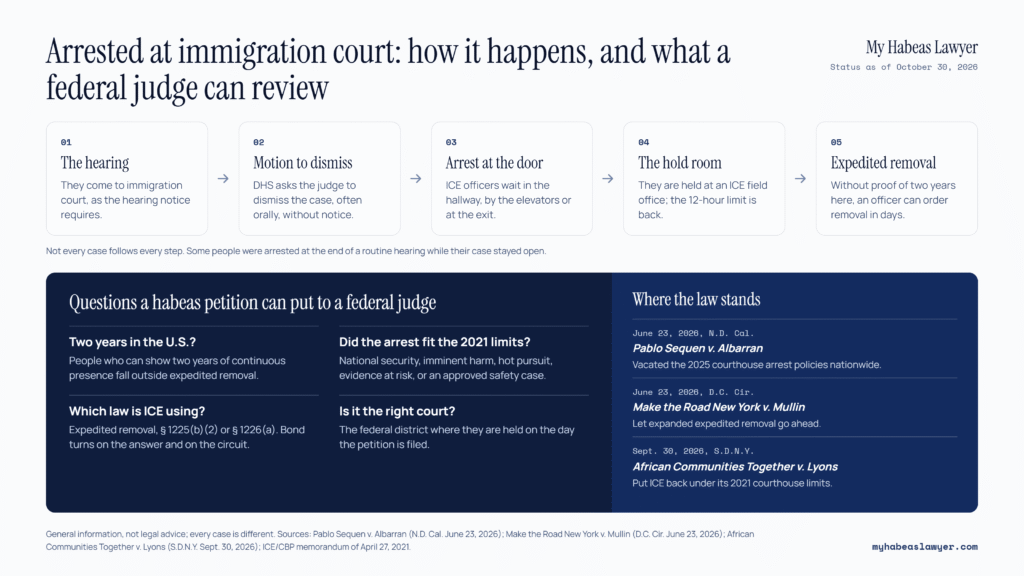
The same order quotes the D.C. Circuit’s description of the pattern: the government asks, often orally and without advance notice, to end the case in immigration court, and agents take the person into custody the moment it is dismissed. The next step is expedited removal, a fast-track process in which an immigration officer, not a judge, orders removal. The D.C. Circuit has noted that decisions and removals in that process often come within days (Make the Road New York v. Mullin).
Expedited removal reaches people who were not admitted or paroled and who cannot show two years of continuous presence in the United States. That is why the date your relative arrived, and the papers that prove it, matter so much.
Arrests While the Case Was Still Open
Not every arrest followed a dismissal. Federal decisions collected in the Georgia order describe people arrested as soon as a routine master calendar hearing ended. When the immigration case stays open, the main question becomes which detention law ICE says it is using, covered below.
The 2026 Rulings: Are Courthouse Arrests Still Allowed?
Mostly not. Two federal courts have set aside the 2025 policies behind these arrests, with nationwide effect.
Two Federal Rulings, One Result
| Case | Court and date | What it did |
|---|---|---|
| Pablo Sequen v. Albarran | N.D. Cal., June 23, 2026 | Vacated the 2025 ICE and immigration court arrest policies nationwide, plus an ICE waiver allowing hold room stays of up to 72 hours (AILA) |
| African Communities Together v. Lyons | S.D.N.Y., September 30, 2026 | Struck down ICE’s 2025 immigration court arrest policy nationwide, effective immediately (ACLU) |
An earlier order in the New York case put ICE’s April 2021 courthouse memo back in force (S.D.N.Y. order of July 16, 2026), and a 2025 immigration court policy encouraging quick dismissals has been withdrawn, according to the ACLU.
Under the 2021 memo, a civil arrest in or near a courthouse, immigration courts included, needs a national security threat, an imminent risk of harm, hot pursuit of a public safety threat or a risk that criminal evidence will be destroyed. A public safety threat can also be arrested there with advance approval when no safe alternative exists. “Near” includes entrances, exits and an adjacent parking lot (ICE and CBP memorandum).
What the Ban Does Not Do
The rulings change where and when ICE may arrest. They do not release anyone already detained or end a removal case. Arrests at court have not disappeared either: after the New York court’s first order, the government reported that they slowed significantly but did not stop, and one judge found an arrest fit the exceptions partly because of a criminal history (Courthouse News). Both rulings can still be challenged on appeal, so check for updates.
Was your loved one arrested at immigration court?
Send us their full name, their A-Number if you have it, and the court where it happened. We will tell you what can be filed and where. The initial evaluation is free.
Why a Courthouse Arrest Is a Strong Habeas Case
A habeas petition under 28 U.S.C. § 2241 asks a federal judge whether a detention is lawful. When someone is arrested by ICE at immigration court, the facts often help: they showed up as required, many have years of residence, some have a pending asylum case. Our guide to habeas corpus in ICE detention covers the process; these are the questions specific to a courthouse arrest.
The Two-Year Presence Question
Under 8 U.S.C. § 1225(b)(1)(A)(iii), the person must show the officer two years of continuous presence; the burden is theirs. If your relative has been here longer, proof can take them outside expedited removal: leases, pay stubs, tax returns, school and medical records, bank statements, earlier court notices. Cover the full two years without gaps.
Was There a Lawful Basis for This Arrest?
Write down where the arrest happened and what officers said. If none of the 2021 exceptions fit, that belongs in the record, but the memo says it creates no right enforceable in court on its own, so the stronger arguments usually concern the detention itself.
The detention law ICE relies on matters most. ICE has held many people who entered without inspection under 8 U.S.C. § 1225(b)(2)(A), without bond; our guide to no bond after entering without inspection explains that fight. In January 2026, a federal judge in Atlanta ruled that a longtime TPS holder facing likely arrest at his hearing was not an “arriving alien” and ordered a bond hearing within 48 hours of any detention, or release (H.F.S.R. v. Francis). Outcomes now depend on the circuit: the Supreme Court has agreed to decide the question, and on October 23, 2026 the full Fifth Circuit ruled against individualized bond hearings. Our circuit bond map tracks each circuit, and our traffic stop guide explains the October rulings.
What Habeas Cannot Do Here
Habeas challenges custody. It does not decide the asylum case, revive a dismissed case or cancel a removal order, and federal review of an expedited removal order itself is narrow under 8 U.S.C. § 1252(e)(2). That is why the question of whether expedited removal applies at all carries so much weight. If the hearing itself went wrong, our page on challenging an unfair hearing explains that separate route.
The First 24 Hours After the Arrest
Work through these steps in order. One relative with a phone can do most of them.
- Write down what happened. The time, the courtroom, where the arrest took place and what officers said. Note anyone who saw it.
- Find out what the judge did. Was the case dismissed, or was a new date set? EOIR’s Automated Case Information portal shows the status with the A-Number.
- Locate your relative. Search the ICE Online Detainee Locator and keep checking. New arrests can take time to appear, and since September 2026 ICE has stopped listing people with final removal orders (AP). Our guide to finding someone in ICE detention lists other routes.
- Watch the hold room clock. People arrested at court are often taken first to an ICE field office. The June 2026 ruling restored a 12-hour limit on those hold rooms; if it passes, tell the lawyer.
- Collect proof of presence. Anything that shows two years or more in the United States, as described above.
- Pass on two messages if you can reach them. Do not sign papers you do not understand without a lawyer. If you fear return to your country, say so clearly to the officers.
- Call a habeas lawyer before a transfer. The first days decide which court hears the case.
Our guide to the first 24 hours after an ICE arrest has more detail.
Which Federal Court Hears the Petition, and Why Transfers Happen Fast
The District Where They Are Held, Not Where the Court Is
A habeas petition is generally filed in the federal district where the person is held when it is filed, not where the immigration court sits or where the family lives. Someone arrested at a court in one state and moved to a facility in another files in the second district. Our guide on where to file habeas after an ICE transfer explains the rule.
Why Moving Quickly Matters
After a courthouse arrest, the path often runs from a hold room to a processing site to a detention facility, sometimes in another state. Each move can change the court and the circuit’s law. Filing while your relative is still nearby fixes the court, and lawyers can ask the judge to bar a transfer. Our page on emergency filings to stop an ICE transfer explains that step.
Should You Still Go to Immigration Court?
In most cases, yes. Missing a hearing usually leads to a removal order issued in the person’s absence, and those orders have surged: nearly 35,000 nationwide in May 2026 and nearly 54,000 in June, according to court data analyzed by bklg.org and reported by Gothamist. The 2026 rulings make an arrest at court far less likely, though not impossible.
What Missing a Hearing Can Cost
An in absentia order ends the case without the person being heard, and ICE has said it is prioritizing people with final removal orders for deportation (AP). Reopening one is possible in some cases but slow and uncertain. Mass hearings are often scheduled with little notice, so check the case status online regularly.
How to Prepare Before the Next Hearing
- Talk to a lawyer before the hearing. If an arrest is a concrete risk, a federal court can sometimes act in advance: in the Atlanta case, the petition was filed six days before the hearing.
- Bring copies, not originals, of immigration papers and proof of presence, and leave the originals with family.
- Have one relative wait outside with the A-Number, the lawyer’s phone number and this plan.
- Decide in advance what to say if DHS asks to dismiss. The person can tell the judge they want to keep their case. Make that decision with a lawyer, before the hearing.
Frequently Asked Questions
Can ICE still arrest someone at immigration court?
Only in narrow cases. Two 2026 rulings set aside the 2025 policies, so ICE is back under its 2021 limits, such as a national security threat or an imminent risk of harm. The rulings can still be appealed.
The judge dismissed the case. Is that good news?
Not necessarily. Dismissal at the request of DHS has been used to move people into expedited removal. If DHS may ask for dismissal, talk to a lawyer about opposing it before the hearing.
Do the rulings free people who are already detained?
No. Each person still needs a filing of their own, such as a habeas petition, to challenge their detention.
What if they have lived here for more than two years?
Expedited removal generally does not apply to people who can show two years of continuous presence. ICE may still hold them under another law, and whether bond is available depends on the circuit.
Will they be moved to another state?
It is possible, often within days. File in the district where they are held, and ask the court to stop a transfer.
Does a habeas petition stop deportation?
Not by itself. It challenges the detention, not the immigration case. A judge can sometimes order that the person not be moved out of the district while the petition is pending.
What to Do Next After a Courthouse Arrest
If your loved one was arrested by ICE at immigration court, work in order: learn what the judge did, find where ICE is holding them, and gather proof of how long they have lived here. Write down how the arrest happened while memories are fresh. Then move quickly, before a transfer, toward a habeas petition in the right federal court. Our federal habeas team page explains who handles these petitions and where we file, and our step-by-step guide for families of people detained by ICE covers the rest of the first week.
Is a loved one in ICE detention?
Time is critical. A habeas corpus petition can be a powerful tool to challenge unlawful detention. Reach out to us now: call +1 (862) 799-2200 or email info@gozellaw.com.
Legal Disclaimer
This article is provided for general informational purposes only and does not constitute legal advice. Every immigration case has unique circumstances. For legal guidance specific to your situation, we recommend consulting with an experienced immigration attorney. The information in this article reflects laws and policies as of the publication date; subsequent changes may affect its accuracy. Prior results do not guarantee a similar outcome.
Review Note
Prepared October 30, 2026. Court positions follow the decisions cited as of that date: Pablo Sequen v. Albarran, No. 5:25-cv-06487 (N.D. Cal. June 23, 2026); African Communities Together v. Lyons, No. 25-cv-6366 (S.D.N.Y. Sept. 30, 2026); Make the Road New York v. Mullin, No. 25-5320 (D.C. Cir. June 23, 2026); and H.F.S.R. v. Francis, No. 1:26-cv-238 (N.D. Ga. Jan. 20, 2026). The courthouse limits come from the ICE and CBP memorandum of April 27, 2021. Rulings can be appealed and policies change; check current sources before relying on them.
Sources
- ICE Courthouse Arrests Blocked Nationwide by California Judge, Bloomberg Government. June 23, 2026.
- Federal Judge Bars ICE from Conducting Most Courthouse Arrests and Exceeding 12-Hour Holding Cell Limit (AILA Doc. No. 26062402), American Immigration Lawyers Association. June 24, 2026.
- Judge issues final ruling against ICE immigration court arrest policy in Manhattan, Courthouse News Service. October 1, 2026.
- African Communities Together v. Lyons, No. 25-cv-6366 (PKC), Order, U.S. District Court for the Southern District of New York, via Leagle. July 16, 2026.
- Federal Court Strikes Down ICE’s Courthouse Arrest Policy Nationwide, American Civil Liberties Union. October 1, 2026.
- Civil Immigration Enforcement Actions in or near Courthouses, U.S. Immigration and Customs Enforcement and U.S. Customs and Border Protection. April 27, 2021.
- Make the Road New York v. Mullin, No. 25-5320, U.S. Court of Appeals for the D.C. Circuit. June 23, 2026.
- H.F.S.R. v. Francis, No. 1:26-cv-238-AT, Order, U.S. District Court for the Northern District of Georgia, via GovInfo. January 20, 2026.
- NYC immigration courts are ground-zero for a new deportation tool: Mass hearings, Gothamist. July 23, 2026.
- Lawsuit seeks to block ICE from hiding locations of detainees with final removal orders, Associated Press via WBUR. October 29, 2026.
Every day in detention is a day away from your family.
If the immigration system has failed you, federal court may be the only answer. Let us review your case for free.
Get a Free Case Evaluation