Home /
Blog /
The 2026 Circuit Bond Map: Where an Immigration Judge Can Still Set Bond
The 2026 Circuit Bond Map: Where an Immigration Judge Can Still Set Bond
October 12, 2026 · Guide
On October 1, 2026, the Supreme Court agreed to decide whether people who entered the United States without inspection, and were later arrested inside the country, can be held without a bond hearing. Until it rules, the question most families ask, whether an immigration judge can set bond, has no national answer. It depends on the federal circuit that covers the facility where your loved one is held.
This map collects the 2026 federal circuit ICE detention bond rulings: where each of the eleven numbered circuits stands and when it ruled. For the statutes behind the dispute, start with our guide to no bond after entering without inspection.
Last updated: October 12, 2026. Covers court of appeals rulings through September 10, 2026, and the Supreme Court’s order of October 1, 2026.
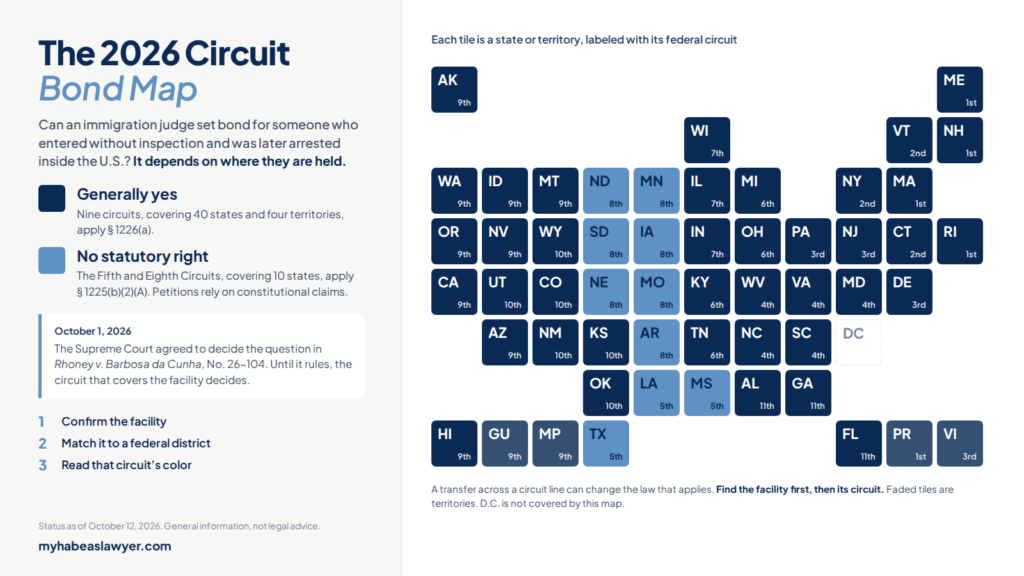
Where can an immigration judge still hold a bond hearing? In nine of the eleven numbered circuits, covering 40 states, Puerto Rico, the U.S. Virgin Islands, Guam and the Northern Mariana Islands, courts hold that people who entered without inspection and were arrested inside the country can ask an immigration judge for bond. In the Fifth and Eighth Circuits, covering 10 states, the statute is read against bond.
A habeas petition is filed in the federal district court for the place where the person is held, not where the family lives or where the immigration case is heard. The country has 94 district courts grouped into 12 regional circuits, and the federal judiciary’s maps of circuits and districts show which district covers a given area. Each district sits in one circuit, and that circuit’s precedent binds the district judge.
Step 3: Read the Circuit’s Row
Find the circuit in the table below. The last column links to our local guides, which cover details such as the court division, judge assignment and the official to name as respondent.
The Map, Circuit by Circuit
The government reads 8 U.S.C. § 1225(b)(2)(A) to require detention without bond for everyone who entered without inspection, however long ago, and the Board of Immigration Appeals adopted that reading in Matter of Yajure Hurtado in September 2025. People held under § 1226(a) instead can ask an immigration judge for bond. The table shows which reading each circuit follows; the Congressional Research Service summarizes the same circuit split.
Status as of October 12, 2026, based on the court opinions and CLINIC’s circuit tracker, updated September 11, 2026. The D.C. Circuit is not shown.
“Generally yes” means § 1226(a) applies. Other rules still apply everywhere, such as § 1226(c) for certain criminal grounds and § 1231 after a final removal order. A bond hearing is also not release; our page on immigration bond amounts after a habeas win explains what families may be asked to pay.
This is not the map for prolonged detention, a separate constitutional question with its own circuit-by-circuit answers, covered in our post on the 6 month rule for ICE detention.
Not sure which row applies to your loved one?
Send us the facility name and the A-Number. We will tell you which circuit’s law governs and what a petition would need to show there, free of charge.
Each tile shows a state and its circuit. Status as of October 12, 2026.
The circuit split formed in seven months, so counts in older articles, including some on this site, reflect the date they were written. The courts ruled in this order:
March 25: The Eighth Circuit follows in Avila v. Bondi. Count: zero to two.
April 28: The Second Circuit rejects the reading in Barbosa da Cunha v. Freden, the case now before the Supreme Court.
May 6 and May 11: The Eleventh and Sixth Circuits reject it. Count: three to two.
June 30: The Tenth Circuit rejects it in Quiroz v. Mullin.
July 30: The Seventh and Ninth Circuits reject it on the same day. Count: six to two.
August 13 and August 28: The First and Third Circuits reject it.
September 10: The Fourth Circuit rejects it, the last of the eleven numbered circuits to rule. Count: nine to two.
Some spring tallies differ because a May 5 Seventh Circuit opinion, Castañon-Nava v. DHS, produced no majority on the statute; the court settled it on July 30. CLINIC’s circuit tracker lists every decision.
The Two Circuits on the Government’s Side
In the ten states of the Fifth and Eighth Circuits, an argument that § 1226(a) applies will usually fail in federal court, because binding circuit precedent says otherwise. That does not close every case. Petitions here turn to the Constitution, arguing that detention without any individualized hearing violates due process, and the National Immigration Project’s practice advisory on habeas after Buenrostro and Avila describes the claims that remain available.
Texas, Louisiana and Mississippi
A July 2 panel decision in Sosnava Rodriguez v. Ortega held that due process requires an individualized bond hearing once detention under § 1225(b)(2)(A) passes 90 days. The full court vacated that decision on July 10 and heard the case en banc on September 24; it had not ruled when we checked on October 12. Until it does, district judges decide due process claims one petition at a time. Our coverage of Fifth Circuit bond rulings tracks each step, and our guide to habeas in the Western District of Louisiana covers the court that hears most Louisiana cases.
Minnesota, Iowa, Missouri and the Plains States
The Eighth Circuit covers Arkansas, Iowa, Minnesota, Missouri, Nebraska, North Dakota and South Dakota. Its decision in Avila v. Bondi came from a divided panel, and the dissent pointed to due process challenges ahead; on June 17, the full court declined to rehear the case. As in the Fifth Circuit, statutory arguments are closed for now, and constitutional claims depend on the facts and the judge. If an immigration judge has already refused bond, our denied bond hearings practice reviews which claims may fit.
When a Transfer Crosses a Circuit Line
Because the court and its circuit follow the place of detention, a transfer can change more than an address. A move from New Jersey to Louisiana takes a person out of the Third Circuit, where bond hearings are generally available, and into the Fifth, where the statute is read against them. A move from Illinois to Iowa does the same between the Seventh and Eighth Circuits.
The Supreme Court granted review in Rhoney v. Barbosa da Cunha, No. 26-104, on October 1, 2026. The case comes from the Second Circuit, and the question the Court agreed to decide is limited to the statute: whether § 1225(b)(2)(A) requires detention of people present in the United States without having been admitted. It does not take up the separate due process question now before the Fifth Circuit.
When we checked on October 12, no argument date had been set. A ruling would settle the statutory question nationwide and would replace most of this table with a single answer. Until then, each circuit’s precedent controls in its own courts, and a petition filed today is decided under today’s law. AP’s report on the grant summarizes what is at stake.
We review this map at least every three months, and sooner when a court of appeals or the Supreme Court changes a row. The date at the top shows the last review, and the update log at the end lists what changed.
Frequently Asked Questions
We live in one state, but ICE is holding our relative in another. Whose rules apply?
The rules of the circuit where your relative is held. A family in New York with a relative detained in Texas is dealing with Fifth Circuit law, even though New York sits in the Second Circuit. The petition goes to the federal court for the place of detention.
If the circuit rejected the government’s reading, will the immigration judge hold a bond hearing automatically?
Not always. In September 2026, a Tenth Circuit judge asked a Justice Department lawyer to look into reports that bond hearings were still being withheld in Colorado months after that court’s ruling. In some cases a federal petition is still needed to have the hearing ordered. Our page on winning back a bond hearing under § 1226(a) explains how.
Does this map apply to someone stopped at the border or who just arrived?
Generally no. The rulings on this map concern people who entered without inspection and were later arrested inside the country. Someone stopped at a port of entry or soon after crossing may be held under a different part of § 1225, and the analysis changes.
Does it apply to someone with a final removal order or a conviction that triggers mandatory detention?
No. After a removal order becomes final, detention falls under § 1231, a separate statute covered in our page on habeas after a final deportation order. Certain criminal grounds trigger detention under § 1226(c) in every circuit; our page on mandatory detention after criminal release covers that path.
How often is this map updated, and how do I know it is current?
We review it at least every three months and after any ruling that changes a row. Check the “Last updated” date near the top. If a ruling came out after that date, ask a lawyer to confirm the current law before anyone files.
What to Do Next With This Map
Start with the facility, not the headlines. Confirm where your loved one is held, find the circuit and read its row. If bond hearings are generally available there and the immigration judge still refused one, a federal petition may get a hearing ordered. In the two circuits on the government’s side, the question is whether the facts support a constitutional claim. Either way, act before a transfer changes the answer. Our guide to habeas corpus for ICE detention explains the full process, and our questions to ask a habeas lawyer help you compare counsel.
Not sure which circuit’s law applies to your loved one?
Time is critical. A habeas corpus petition can be a powerful tool to challenge unlawful detention. Reach out to us now.
Legal Disclaimer: This article is provided for general informational purposes only and does not constitute legal advice. Every immigration case has unique circumstances. For legal guidance specific to your situation, we recommend consulting with an experienced immigration attorney. The information in this article reflects laws and policies as of the publication date; subsequent changes may affect its accuracy. Sources were reviewed as of October 12, 2026.
Update Log
October 12, 2026: First published. Covers court of appeals rulings through September 10, 2026, and the Supreme Court’s October 1, 2026, grant of review in Rhoney v. Barbosa da Cunha. Pending: the Fifth Circuit’s en banc decision in Sosnava Rodriguez v. Ortega.