If your loved one was detained by ICE after a traffic stop, first find out who holds them now: a county jail on a state charge, a jail holding them for ICE, or ICE itself. Each stage runs on its own clock, and since October 2026 the chance of a bond hearing depends heavily on the federal circuit.
Rigoberto Santillan Quiroz had lived in the United States since 2006 when ICE agents detained him at a traffic stop in November 2025. He was not charged with a crime. On June 30, 2026, the Tenth Circuit ordered a bond hearing or his release within seven days (Quiroz v. Mullin). On October 23, the full Fifth Circuit ruled against three Texas men also detained after traffic stops. This guide covers the stages in between, the 48-hour ICE hold and what habeas can change.
Last updated: October 28, 2026. Based on court decisions, federal regulations and enforcement data current on that date.
In This Article · Detained After a Traffic Stop
- Why Traffic Stops Became a Main Road Into ICE Detention in 2026
- From the Roadside to ICE Custody: Where Your Loved One May Be Now
- The ICE Hold in a County Jail: The 48-Hour Window and the Bail Question
- Can They Get a Bond Hearing? It Now Depends on the Circuit
- What a Habeas Petition Can Do After a Traffic Stop Arrest, and What It Cannot
- The Records Only a Traffic Stop Case Has
- Frequently Asked Questions
- What to Do Next After a Traffic Stop Arrest

Why Traffic Stops Became a Main Road Into ICE Detention in 2026
Police have always made traffic stops. What changed is how often one now ends with ICE. Section 287(g) of the Immigration and Nationality Act lets ICE delegate certain immigration functions to state and local officers working under its supervision (ICE).
According to an October 27, 2026 analysis by FWD.us, agencies in the 287(g) Task Force Model went from zero at the start of 2025 to more than 1,850 by October 1, 2026, with more than 29,000 officers deputized in 30 states. NPR reported that Florida and Texas agencies account for about half of the more than 47,000 immigration arrests made through 287(g) between January 2025 and August 2026, much of it on routine highway stops.
The Three 287(g) Models, in Plain English
The model a department signed tells you where the handoff to ICE is likely to happen.
- Task Force Model. Officers use limited immigration authority during routine duties, such as a traffic stop, and an ICE supervisor decides what happens next. This is the model that turns a roadside stop into an immigration arrest.
- Jail Enforcement Model. Officers identify and process people with pending or active criminal charges while they are held in the local jail.
- Warrant Service Officer Program. Officers serve ICE administrative warrants on people already in their jail, so the handoff does not wait for ICE to arrive.
How to Check Whether a County Has a 287(g) Agreement
ICE’s 287(g) program page links to its list of participating agencies. Check both the agency that made the stop and the sheriff who runs the jail; they can have different agreements, or none, and the list changes often. A county with no agreement can still receive an ICE detainer, because ICE can send one to any state or local law enforcement agency (8 C.F.R. § 287.7(a)).
From the Roadside to ICE Custody: Where Your Loved One May Be Now
Which stage your relative is in decides what can be done today.
| Stage | Who holds them | What the family can do now |
|---|---|---|
| Arrested on a state charge and booked | A county or city jail, on the criminal case | Get the booking number, the charges and the court date; ask whether ICE has lodged a detainer; call a criminal defense lawyer |
| ICE hold lodged | The same jail, at ICE’s request | Get a copy of the detainer; decide on bail with both lawyers before paying it |
| Handed to ICE at the roadside | ICE | Search the ICE detainee locator, get the A-Number and prepare a habeas petition |
| Moved to an ICE facility | ICE, often in a contract facility | Confirm the facility and the federal district; watch for further transfers |
Arrested on a State Charge and Booked Into the County Jail
Many traffic arrests begin with a state charge such as driving without a license. Booking sends fingerprints to federal databases, and a detainer often follows within hours (Immigrant Legal Resource Center). The criminal case keeps its own court dates.
Handed to ICE at the Roadside
When a Task Force officer makes the arrest, or ICE agents make the stop themselves, as in Quiroz, there may be no criminal charge at all. ICE custody begins on the roadside, and the online locator can take time to show the person.
Moved From the Jail to an ICE Facility
From the jail, people usually go to an ICE processing site and then a detention facility, sometimes in another state. Each move can change the federal court and the circuit’s law.
Not sure whether your loved one is still in the county jail or already with ICE?
Send us their full name, date of birth and the county where they were stopped. We will tell you which stage they are in and what can be filed. The initial evaluation is free.
The ICE Hold in a County Jail: The 48-Hour Window and the Bail Question
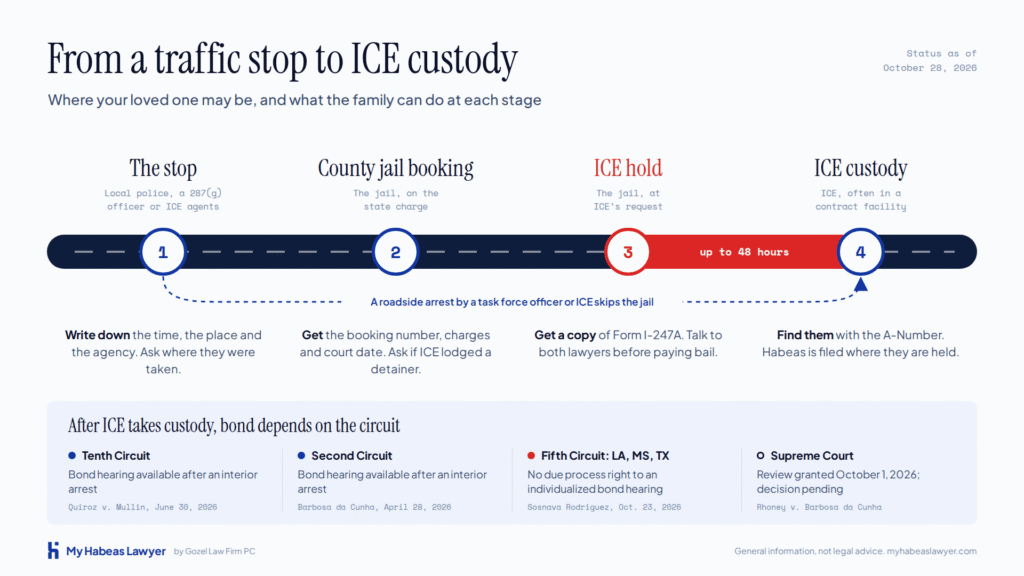
An ICE hold is a detainer, Form I-247A. It asks the jail to notify ICE before release and to keep the person long enough for ICE to take custody (8 C.F.R. § 287.7). It is a request, not a court order, and some jails decline it; in a 287(g) county, though, the sheriff has signed an agreement with ICE. Our guide to ICE detention paperwork explains the detainer form in plain language.
How the 48 Hours Are Counted
The regulation allows up to 48 hours, not counting Saturdays, Sundays and holidays, after the criminal hold ends. The detainer form itself has asked for no more than 48 hours without that exclusion, according to the Immigrant Legal Resource Center, and jails count differently. Ask the jail when the hold expires and write it down.
Should the Family Post Bail on the Criminal Charge?
Posting bail on a traffic charge often does not bring anyone home. With a detainer in place, release on bail can mean transfer to ICE, and if the person then misses a criminal court date, the court can issue a failure-to-appear warrant and the bail can be forfeited (ILRC).
Posting bail can make sense when release from ICE custody is realistic, for example where bond hearings are available in that circuit. When it is not, a short stay in local custody may leave time to prepare. Decide with the criminal defense lawyer and the habeas lawyer together, before paying.
If the Hold Runs Past 48 Hours
The detainer does not authorize detention beyond that window, and courts have treated holding someone on a detainer after release as a new seizure subject to the Fourth Amendment. If the jail still holds your relative after it closes, note the time and have a lawyer contact the jail at once. If ICE is preparing a move, our emergency filings to stop an ICE transfer are built for that window.
Can They Get a Bond Hearing? It Now Depends on the Circuit
Many people detained after a traffic stop entered without inspection years ago and have no serious record. Since 2025, ICE has treated many of them as “seeking admission” and held them without bond under 8 U.S.C. § 1225(b)(2)(A); our guide to no bond after entering without inspection explains that fight. Where it stands now:
- Tenth Circuit (Colorado, Kansas, New Mexico, Oklahoma, Utah, Wyoming). Quiroz v. Mullin held on June 30, 2026 that § 1225(b)(2)(A) applies at the border, so a person arrested in the interior can seek bond under § 1226(a).
- Second Circuit (Connecticut, New York, Vermont). The court reached the same result on April 28, 2026, in the Barbosa da Cunha case, which the Supreme Court has now taken.
- Fifth Circuit (Louisiana, Mississippi, Texas). After siding with the government on the statute in Buenrostro-Mendez, the full court ruled 10 to 7 on October 23, 2026 that three men detained after traffic stops, one here more than 22 years and two with U.S. citizen children, have no due process right to an individualized bond hearing (Sosnava Rodriguez v. Vergara).
On October 1, 2026, the Supreme Court agreed to decide whether § 1225(b)(2)(A) requires detaining people present without admission (Rhoney v. Barbosa da Cunha, No. 26-104). Until it rules, the circuit where your relative is held controls, and a transfer can change it. Our circuit bond map tracks every circuit.
When the Charge From the Stop Changes the Answer
The Laken Riley Act, signed January 29, 2025, requires mandatory detention of noncitizens charged with, arrested for, convicted of or admitting burglary, theft, larceny, shoplifting, assault of a law enforcement officer, or a crime causing death or serious bodily injury (Public Law 119-1). A speeding ticket or driving without a license is not on that list; a charge of assaulting an officer, or a crash causing serious injury, can be. Our page on no bond because of a criminal record covers how these charges are reviewed.
What a Habeas Petition Can Do After a Traffic Stop Arrest, and What It Cannot
A habeas petition under 28 U.S.C. § 2241 asks a federal judge whether the custody is lawful. In traffic stop cases, the usual argument is that ICE is using the wrong detention statute or denying a hearing the law requires; success usually means an order for a bond hearing or release, as in Quiroz. It does not decide the immigration case or erase the traffic charge. Our guide to habeas corpus in ICE detention covers the process, and our page on denied bond hearings explains how we handle these petitions.
Was the Stop Illegal? Why That Is a Separate Fight
Families often ask whether an unfair stop means automatic release. Usually it does not: in INS v. Lopez-Mendoza (1984), the Supreme Court held that the exclusionary rule generally does not apply in deportation proceedings, leaving room only for egregious violations. The stop’s legality matters most in the criminal case, through a motion to suppress. Still, write down the time, the place, the agency and the reason the officer gave.
Which Federal Court Hears the Petition
A habeas petition is generally filed in the federal district where the person is held at the time of filing. A county jail in one district and an ICE facility in another can mean different courts and different circuits, so confirm the location first. Our guide on where to file habeas after an ICE transfer explains the rule.
The Records Only a Traffic Stop Case Has
Traffic stop cases come with an extra paper trail that helps in both the criminal case and the habeas petition:
- The traffic citation, with its citation number.
- The police report or incident number, and the agency that made the stop: city police, sheriff, state patrol or federal agents.
- The jail booking record, with the booking number, the time of booking and the charges.
- A copy of the ICE detainer and of any ICE warrant served in the jail.
- The criminal case number and the next court date.
- Tow or impound papers, which often record the time and place of the stop.
- An early written request to keep body camera and dashboard camera video, since retention periods can be short.
- A one-page timeline: the stop, the booking, the moment ICE took custody and every transfer.
For the A-Number, the facility and what not to sign, use our guide to the first 24 hours after an ICE arrest and our step-by-step guide for families of people detained by ICE.
Frequently Asked Questions
What should someone say if police or ICE question them during a traffic stop?
Drivers must show the license, registration and proof of insurance that state law requires. Beyond that, a person can decline to answer questions about where they were born or their immigration status, and can ask to speak with a lawyer. They should not lie or show false documents.
Can local police ask about immigration status at a traffic stop?
Officers in a 287(g) Task Force agency can use limited immigration authority during routine duties, including traffic stops. For other officers, it depends on state law. Either way, a person does not have to answer immigration questions.
Will paying the traffic ticket get them released?
No. Resolving the ticket ends the traffic matter, not ICE custody. Still, do not ignore it: an open case or a missed court date can complicate a later bond request.
Does a work permit or a pending application make a difference?
It does not prevent an arrest, but it can help in the custody fight as evidence of ties and a case already in process. Our work permit detention guide explains how.
How fast can a habeas petition be filed?
Once the facility and the A-Number are confirmed, a petition can often be filed within a day or two. How fast the judge acts depends on the district.
Will they be moved to another state?
It is possible. People are often moved from a jail to an ICE processing site and then to a detention facility, sometimes across state lines, and each move can change the court and the circuit.
What to Do Next After a Traffic Stop Arrest
Work in order: find out whether your relative is in the county jail, on an ICE hold or with ICE, and which circuit covers that place. Have the criminal defense lawyer and the immigration lawyer talk before anyone pays bail. Collect the stop records while they are easy to get. Once ICE has custody, a habeas petition in the right federal court asks a judge to review the detention. Our federal habeas team page explains who handles these petitions, and our guide to detention with a valid work permit covers relatives who had applications pending.
Is a loved one in ICE detention?
Time is critical. A habeas corpus petition can be a powerful tool to challenge unlawful detention. Reach out to us now: call +1 (862) 799-2200 or email info@gozellaw.com.
Legal Disclaimer
This article is provided for general informational purposes only and does not constitute legal advice. Every immigration case has unique circumstances. For legal guidance specific to your situation, we recommend consulting with an experienced immigration attorney. The information in this article reflects laws and policies as of the publication date; subsequent changes may affect its accuracy. Prior results do not guarantee a similar outcome.
Review Note
Prepared October 28, 2026. Court positions follow the decisions cited as of that date: Quiroz v. Mullin, No. 26-6019 (10th Cir. June 30, 2026); Sosnava Rodriguez v. Vergara, No. 26-50183 (5th Cir. Oct. 23, 2026) (en banc); and the Supreme Court’s October 1, 2026 grant of review in Rhoney v. Barbosa da Cunha, No. 26-104. 287(g) figures come from the FWD.us analysis and NPR reporting listed below. Agreements and court positions change; check current sources before relying on them.
Sources
- Quiroz v. Mullin, No. 26-6019, U.S. Court of Appeals for the Tenth Circuit. June 30, 2026.
- Sosnava Rodriguez v. Vergara, No. 26-50183 (en banc), U.S. Court of Appeals for the Fifth Circuit. October 23, 2026.
- Rhoney v. Barbosa da Cunha, No. 26-104, docket, Supreme Court of the United States; certiorari granted October 1, 2026.
- 8 C.F.R. § 287.7, Detainer provisions, Code of Federal Regulations, Cornell Legal Information Institute; accessed October 28, 2026.
- Partner With ICE Through the 287(g) Program, U.S. Immigration and Customs Enforcement; accessed October 28, 2026.
- New FWD.us Analysis Reveals Rapid Expansion of 287(g) Partnerships to Over 1,850 Local Agencies, FWD.us. October 27, 2026.
- Partnerships between ICE and local police surge, report finds, NPR. October 28, 2026.
- Note §5A: ICE Detainers, Immigrant Legal Resource Center. December 2021.
- INS v. Lopez-Mendoza, 468 U.S. 1032 (1984), Supreme Court of the United States, via Cornell Legal Information Institute.
- Laken Riley Act, Public Law 119-1, U.S. Government Publishing Office (GovInfo). Enacted January 29, 2025.
Every day in detention is a day away from your family.
If the immigration system has failed you, federal court may be the only answer. Let us review your case for free.
Get a Free Case Evaluation