When ICE tells a family that there is “no bond because of a criminal record,” the answer can sound final. But a criminal history does not answer every immigration detention question. The key issue is not simply whether the person has an arrest or conviction. It is why bond is unavailable, which detention statute ICE is using, and whether that legal classification is correct.
Some people in immigration detention fall under the discretionary custody framework in 8 U.S.C. § 1226(a), while others may be subject to mandatory detention under § 1226(c). Those categories are different. A person who is properly detained under § 1226(c) generally cannot obtain an ordinary bond redetermination simply by showing family ties, employment, or rehabilitation.
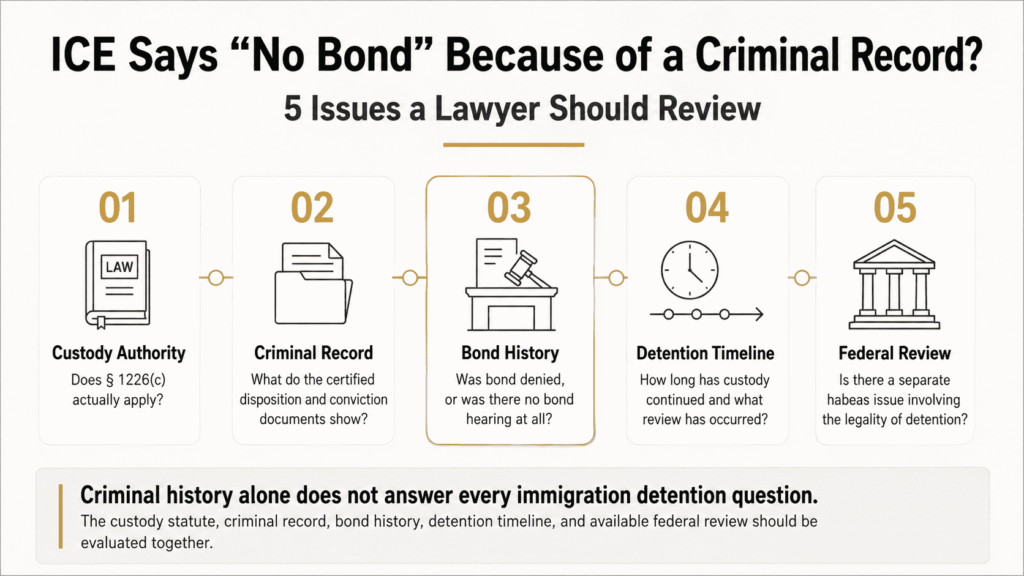
Before a family accepts “no bond” as the final answer, an attorney should identify the custody authority, review the actual criminal record, determine whether the person was denied bond or denied access to a bond hearing, and consider whether federal habeas review may present a separate issue. This guide explains the five questions that can shape that analysis.
In This Article
- What Does “No Bond” Actually Mean?
- 1. Does the Criminal Record Actually Trigger Mandatory Detention?
- 2. Is ICE Using the Correct Criminal Record?
- 3. Was Bond Denied—or Was There No Bond Hearing?
- 4. How Long Has Detention Continued Without Meaningful Review?
- 5. What Could a Federal Habeas Case Actually Ask For?
- What Documents Should the Family Collect?
- Frequently Asked Questions

ICE Said “No Bond.” What Does That Actually Mean?
Families often use “no bond” to describe several legally different situations. ICE may have declined to set bond. An immigration judge may have considered a bond request and denied release. Or the immigration judge may have concluded that the person falls within a category where the court does not have authority to conduct an ordinary bond redetermination.
That distinction matters. The EOIR bond procedures recognize immigration judge authority over custody determinations in many cases, but that jurisdiction is subject to important exceptions. One of the most important is mandatory detention under INA § 236(c), codified at 8 U.S.C. § 1226(c).
| Situation | What It May Mean | What Should Be Reviewed |
|---|---|---|
| ICE sets no bond | DHS has made an initial custody decision | Statutory custody basis and eligibility for redetermination |
| Bond denied after a hearing | An immigration judge considered release and denied it | Bond record, appeal options, and changed circumstances |
| Judge says there is no bond jurisdiction | The person may be classified under a mandatory or otherwise restricted detention category | Whether that classification is legally correct |
| ICE says “mandatory detention” | ICE may be relying on § 1226(c) | Exact criminal and immigration records supporting the classification |
“No bond” and “no bond hearing” are not the same legal problem. Before deciding what can be challenged, counsel must determine which one actually occurred.
1. Does the Criminal Record Actually Trigger Mandatory Detention?
A criminal record alone does not automatically establish mandatory detention. Section 1226(c) applies to specified immigration grounds, including certain criminal and security-related categories. The analysis can depend on the exact offense, statute of conviction, disposition, sentence, and the immigration charge DHS is pursuing.
This is why the phrase “he has a conviction” is not enough. An arrest without a conviction, a conviction under one particular subsection, and a conviction under another subsection may produce different immigration consequences. Attorneys may need to compare the criminal statute and record of conviction with the specific ground DHS says triggers mandatory detention.
For certain detainees disputing whether they are properly included in a mandatory detention category, the regulations and Matter of Joseph provide an administrative mechanism to test that classification. The issue is different from a standard bond hearing focused primarily on danger and flight risk.
One timing argument also requires caution. In Nielsen v. Preap, the Supreme Court held that a person who otherwise falls within § 1226(c) does not escape that provision merely because immigration authorities did not arrest the person immediately after release from criminal custody. A long gap may be an important fact, but delay alone does not automatically convert a mandatory detention case into an ordinary bond case.
2. Is ICE Using the Correct Criminal Record?
The next question is evidentiary: what does the actual criminal court record show? Families sometimes know only the name of the charge, the year of the case, or what they remember happening in court. That may not be enough for an immigration detention analysis.
Counsel may need the charging document, plea agreement or plea transcript, judgment, sentencing order, certificate of disposition, docket, and any later amended or vacated order. The precise statutory subsection can matter. So can the final disposition and sentence.
Matter of Joseph is important because DHS’s initial custody classification does not necessarily end the inquiry. A conviction document may give DHS a basis to place someone in mandatory custody, but the immigration judge and Board may still need to determine whether the person is properly included in the category that eliminates ordinary bond jurisdiction.
3. Was Bond Denied or Was There Never a Real Bond Hearing?
This is one of the most important distinctions in the entire case. If an immigration judge held a bond hearing, considered evidence about release, and denied bond, the record starts in one place. If the judge instead said, “I do not have jurisdiction to set bond,” the case starts somewhere else.
A true bond denial may require review of the custody decision, any available administrative appeal, the evidence presented, and whether materially changed circumstances support another request. A jurisdictional refusal requires counsel to ask why the judge concluded that an ordinary bond hearing was unavailable.
If the answer is mandatory detention, the first issue may be whether that classification can be challenged through the immigration court process. The second may be whether continued detention presents a distinct federal question. See our guides to mandatory detention challenges and federal court review after a denied bond hearing.
Was your loved one denied bond because of a criminal record?
Before accepting “no bond” as final, our team can review the custody statute, criminal disposition, immigration charges, bond history, and detention timeline to identify what type of legal issue is actually involved.
4. How Long Has Detention Continued Without Meaningful Review?
Even when criminal history is relevant to detention, the length and procedural history of custody may require separate analysis. Counsel should document when ICE took custody, whether the person has received any meaningful custody review, how removal proceedings have progressed, and which party is responsible for significant delays.
There is no universal rule that every person detained under § 1226(c) automatically receives a bond hearing after six months. In Jennings v. Rodriguez, the Supreme Court rejected a statutory interpretation that would insert periodic six-month bond hearings into the detention provisions at issue. Constitutional challenges to prolonged detention must therefore be evaluated under the controlling law of the relevant federal circuit and the specific facts of the case.
Demore v. Kim upheld mandatory detention under § 1226(c) in the circumstances before the Supreme Court, involving detention during removal proceedings. But Demore did not eliminate federal habeas jurisdiction over every detention question. A lawyer reviewing prolonged custody must therefore distinguish between a direct attack on Congress’s mandatory detention framework and a case-specific challenge involving classification, procedure, or the duration and circumstances of detention.
5. What Could a Federal Habeas Case Actually Ask For?
A federal habeas petition is not a second immigration bond application. A petition under 28 U.S.C. § 2241 may ask a federal district court to determine whether current detention violates federal law or the Constitution.
Depending on the legal theory, facts, jurisdiction, and controlling precedent, the requested relief might involve an appropriate custody hearing, correction of an unlawful detention framework, or release. But none of those results is automatic. The proper remedy can vary substantially from one federal district or circuit to another.
A detention habeas case also has important limits. It does not erase the underlying criminal conviction. It does not automatically terminate removal proceedings. And it should not be described as a guaranteed way to obtain release simply because an immigration judge cannot set bond.
The practical question is narrower: is the government lawfully detaining this particular person, under this particular custody authority, through this particular procedure? That is why an accurate review must begin with records rather than assumptions.
What Documents Should the Family Collect Now?
A family does not need to solve the legal issue before contacting counsel. But organizing the right records can make the initial review much more useful.
- A-Number and full legal name
- Current ICE detention facility
- Notice to Appear and immigration court hearing notices
- ICE custody determination or bond paperwork
- Any immigration judge bond decision or jurisdiction ruling
- Criminal complaint, indictment, or charging document
- Plea agreement or plea transcript, if available
- Judgment and sentencing order
- Certificate of disposition
- Any amended, modified, or vacated criminal court order
- Prior immigration records relating to the conviction
- A timeline of ICE custody, bond requests, hearings, and transfers
- Evidence of rehabilitation, family ties, employment, and community support where relevant
The criminal disposition and detention timeline are particularly important. A lawyer should be able to see what happened in criminal court, what DHS says the conviction means under immigration law, and what process the detained person has actually received.
Frequently Asked Questions
Does any criminal conviction automatically prevent immigration bond?
No. The effect of a criminal record depends on the detention statute, the specific offense and disposition, and the immigration ground DHS relies on. Some convictions may trigger mandatory detention while others may not.
Can ICE be wrong about mandatory detention?
Potentially. The classification may depend on criminal records and legal categories that require detailed review. In appropriate cases, the person may be able to dispute whether they are properly included in the mandatory detention category.
What if the immigration judge says there is no bond jurisdiction?
Counsel should identify the legal reason for that conclusion. If the judge believes mandatory detention applies, the analysis may focus first on whether that classification is correct and then on whether any separate federal detention claim exists.
Does an old conviction stop ICE from using mandatory detention?
Not automatically. Under Nielsen v. Preap, a delay between release from criminal custody and later immigration detention does not by itself remove an otherwise covered person from § 1226(c). The underlying conviction and statutory category still require review.
Does six months in detention automatically create a right to bond?
No nationwide statutory rule guarantees a bond hearing simply because six months have passed in § 1226(c) detention. Prolonged-detention claims are fact-specific and can depend heavily on controlling circuit precedent.
Can someone with a criminal record still file a habeas petition?
A criminal record does not automatically eliminate federal habeas review of detention. Whether a viable habeas claim exists depends on the custody statute, procedural history, detention circumstances, jurisdiction, available administrative procedures, and the particular federal claim being asserted.
A Criminal Record Is Only the Beginning of the Bond Analysis
When ICE says there is no bond because of criminal history, the most useful question is not simply, “Does this person have a conviction?” The better questions are: What conviction? What does the certified record show? Which detention statute applies? Did the person receive a bond hearing? Is the mandatory detention classification correct? And what type of review remains available?
Those distinctions can determine whether the case belongs in an ordinary bond process, a classification challenge, an administrative appeal, or a separate federal habeas analysis. For a broader explanation of federal detention review, see our guide to what a writ of habeas corpus is.
Did ICE say your loved one cannot get bond because of a criminal record?
Send us the A-Number, detention facility, ICE custody paperwork, immigration court bond decision, criminal disposition, and detention timeline. Our team can review why bond is unavailable and whether the classification, custody process, or continued detention requires further legal review.
Phone: (+1) 862-799-2200
Email: info@gozellaw.com
Legal Disclaimer: This article is provided for general informational purposes only and does not constitute legal advice. Immigration bond eligibility, mandatory detention, criminal immigration consequences, habeas jurisdiction, procedural requirements, and available remedies depend on the facts and controlling law in each case. Consult an experienced attorney regarding a specific detention matter. The information reflects laws, judicial decisions, and publicly available guidance reviewed as of August 7, 2026. Subsequent developments may affect its accuracy. Prior results do not guarantee a similar outcome.
Sources
- 8 U.S.C. § 1226 — Apprehension and Detention of Aliens
- Executive Office for Immigration Review — Bond Proceedings
- Matter of Joseph, 22 I&N Dec. 799 (BIA 1999)
- Demore v. Kim, 538 U.S. 510 (2003)
- Jennings v. Rodriguez, 583 U.S. 281 (2018)
- Nielsen v. Preap, 586 U.S. 392 (2019)
- 28 U.S.C. § 2241 — Power to Grant Writs of Habeas Corpus
Every day in detention is a day away from your family.
If the immigration system has failed you, federal court may be the only answer. Let us review your case for free.
Get a Free Case Evaluation