A loved one can be in ICE detention under deeply troubling circumstances without the case automatically being ready for a federal habeas filing. The length of detention matters, but an ICE detention habeas review usually requires a more complete question: what legal authority is being used to hold the person, what custody review has already occurred, why detention continues, what relief could a federal judge realistically provide, and which federal court would hear the challenge?
That distinction matters for families trying to decide whether it is time to move from immigration-court or ICE custody procedures into federal court. There is no nationwide formula saying that one fact, one denied hearing, or one number of months automatically makes a case “habeas-ready.”
This guide uses “ready for federal habeas review” as a practical case-assessment concept, not a statutory test. It explains the questions counsel may need to answer before deciding whether a detention problem has developed into a concrete federal habeas claim.
In This Article
- What Does “Ready for Federal Habeas Review” Actually Mean?
- 1. Which Law Is ICE Using to Hold the Person?
- 2. What Custody Review Has Already Happened?
- 3. Has Detention Reached a Legally Significant Point?
- 4. Is There a Concrete Legal Problem With the Custody?
- 5. Does the Requested Relief Match the Custody Problem?
- 6. Why Location and Circuit Law Can Change the Analysis
- 7. What Lawyers Need to Be Able to Answer
- When a Case May Need More Review Before Filing
- Frequently Asked Questions
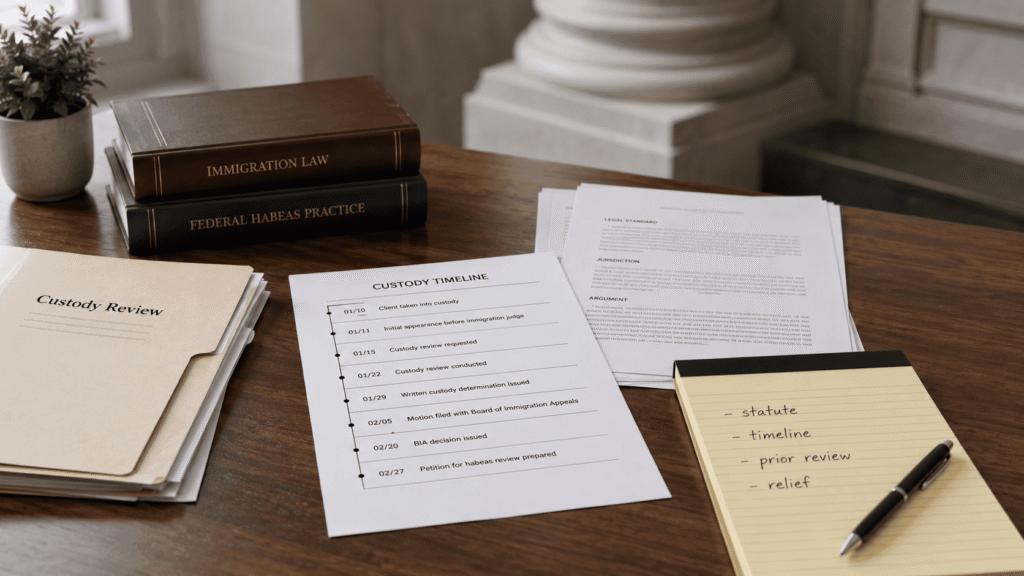
What Does “Ready for Federal Habeas Review” Actually Mean?
Being ready for federal habeas review does not mean that a person is certain to win or that a federal judge will order release. It means the custody problem can be identified with enough legal and factual precision for counsel to evaluate whether federal habeas corpus is an appropriate vehicle.
Under 28 U.S.C. § 2241, federal courts have authority to consider certain habeas petitions involving a person held in federal custody or allegedly held in violation of federal law or the Constitution. In the ICE context, the focus is generally the legality of custody itself.
That is different from asking a federal district court to decide whether the person should ultimately receive asylum, cancellation of removal, a green card, or some other immigration benefit. It is also different from directly asking the habeas court to overturn a final removal order.
“Habeas-ready” is not a prediction of victory. It means the detention history, legal authority, alleged custody defect, requested remedy, and proper federal forum can be identified well enough for meaningful legal review.
1. Which Law Is ICE Using to Hold the Person?
The first question in an ICE detention habeas review should usually be more specific than “How long has the person been detained?” Counsel first needs to understand what legal authority the government claims permits the detention.
For example, 8 U.S.C. § 1226 addresses detention during certain pending removal proceedings and contains different rules depending on the applicable subsection. After a removal order becomes final, 8 U.S.C. § 1231 creates a different statutory framework. Other detention provisions may apply in other procedural postures.
This is why two people detained for the same number of days may present very different habeas questions. One may have a pending removal case and a dispute about bond eligibility. Another may already have a final order while ICE attempts to obtain travel documents. A third may dispute the government’s classification of the detention from the beginning.
| Question | Why It Matters |
|---|---|
| Is the removal case still pending? | Pre-order custody may involve a different statutory and constitutional analysis. |
| Has a removal order become final? | Post-order detention brings § 1231 and removal feasibility into the analysis. |
| Does ICE claim detention is mandatory? | Counsel may need to determine whether the asserted detention classification actually applies. |
| What custody paperwork identifies the authority? | The government’s stated legal basis helps define the issue a federal court could review. |
2. What Custody Review Has Already Happened?
The next question is procedural: what opportunity has the person already had to challenge continued custody? A habeas evaluation can look very different when an immigration judge has conducted a bond hearing, refused jurisdiction, denied a request, or when ICE has provided only administrative custody review.
Useful records may include bond orders, immigration judge decisions, Board of Immigration Appeals records, ICE custody determinations, parole decisions, Post-Order Custody Review documents, and correspondence asking the government to reconsider detention.
A denied or unavailable bond hearing can be important, but it does not produce the same federal claim in every case. Our separate guide on what happens when an immigration judge denies or refuses a bond hearing addresses that issue in greater detail. Here, the narrower question is whether the custody-review history helps identify a federal problem that is ready to be evaluated.
3. Has Detention Reached a Legally Significant Point?
Detention length matters, but it should not be treated as a universal countdown. There is no general rule that every ICE detainee automatically receives release or a bond hearing on day 181.
The Supreme Court’s decision in Zadvydas v. Davis created an important six-month framework for certain post-removal-order detention cases. After that period, if the detained person provides good reason to believe there is no significant likelihood of removal in the reasonably foreseeable future, the government must respond with evidence sufficient to rebut that showing. But the Court also made clear that six months does not produce automatic release.
That framework should not be turned into a universal six-month rule for every detention statute. In Jennings v. Rodriguez, the Supreme Court rejected an interpretation that imposed periodic six-month bond hearings through the text of several pre-order detention provisions. In Johnson v. Arteaga-Martinez, the Court likewise held that § 1231(a)(6) itself does not require the particular six-month bond-hearing procedure imposed by the lower court.
For that reason, counsel may examine the whole custody history: duration, procedural posture, prior review, the government’s explanation, who or what has caused delay, and whether there is a realistic endpoint. Our dedicated guide to prolonged ICE detention after six months discusses the timing issue in greater depth.
Not sure whether the detention has reached the point for federal review?
Our federal litigation team can review the custody authority, detention timeline, bond or custody history, removal posture, current facility, and the specific relief that may be available before deciding whether a habeas filing is appropriate.
4. Is There a Concrete Legal Problem With the Custody?
A difficult detention is not automatically an unlawful detention. Before filing, counsel needs to identify the specific custody problem that federal court would be asked to review.
Depending on the facts and controlling law, the issue might involve a disputed statutory classification, detention that has continued without meaningful individualized review, a constitutional challenge to prolonged custody, or post-order detention where actual removal is no longer significantly likely in the reasonably foreseeable future.
The important point is not to turn those categories into a generic checklist. The alleged defect must fit the person’s actual procedural posture. A claim concerning post-order removal feasibility requires different facts from a claim concerning access to a custody hearing while removal proceedings are still pending.
For post-order cases, our guide to habeas corpus after a final removal order explains the separate Zadvydas analysis and why detention review is not the same as challenging the underlying removal order.
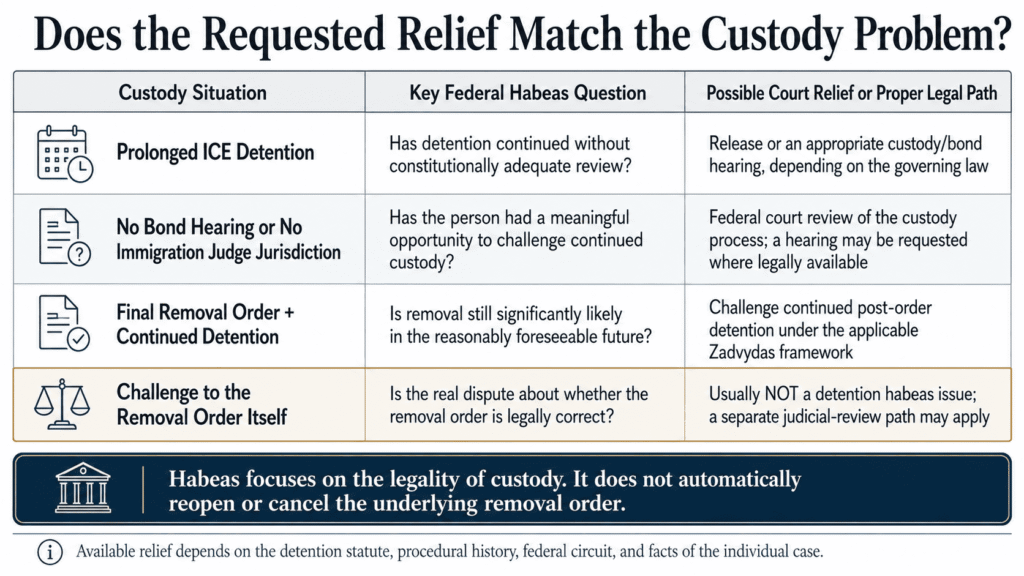
5. Does the Requested Relief Match the Custody Problem?
A federal habeas case also needs a workable answer to a practical question: what exactly should the federal court order?
Depending on the claim and governing law, requested relief may involve release, an individualized custody or bond process, or another order directed at the allegedly unlawful detention. The requested remedy should correspond to the legal problem identified in the petition.
At the same time, habeas should not be confused with direct review of a removal order. Congress has established a separate judicial-review structure for removal orders in 8 U.S.C. § 1252. A person may therefore have a serious detention issue even though the merits of the underlying removal case must proceed on a different track.
| Problem Being Evaluated | Question for Habeas Counsel |
|---|---|
| Continued physical custody | Is the detention itself authorized and constitutional under the present facts? |
| No meaningful custody process | Can federal court require an appropriate review or hearing? |
| Post-order detention | Is removal still significantly likely in the reasonably foreseeable future? |
| Underlying removal decision | Is this actually a separate petition-for-review or immigration-court issue rather than a custody habeas claim? |
6. Why Location and Circuit Law Can Change the Analysis
Where the person is detained can matter before a petition is filed. In traditional habeas challenges to present physical confinement, the Supreme Court has emphasized the importance of the immediate custodian and the district of confinement. That makes the current detention location relevant to identifying the proper federal court and respondent.
A transfer can therefore be more than a change of address. It can affect the federal district, the controlling court of appeals, legal access, and the law counsel must analyze. Families dealing with an unexpected move can use our ICE transfer checklist to preserve location and transfer records quickly.
Circuit law can also change while a person remains detained. A recent Fifth Circuit example shows why nationwide rules should be stated cautiously. On July 10, 2026, the Fifth Circuit granted rehearing en banc in consolidated detention cases and expressly vacated its July 2 panel opinion. The court later stayed the district court judgments while rehearing remained pending. The vacated panel opinion therefore cannot simply be treated as current binding precedent.
Readers with a loved one detained in Texas, Louisiana, or Mississippi can review our current Fifth Circuit bond-hearing update. The broader lesson applies nationwide: an ICE detention habeas review should account for the federal district and circuit governing the case at the time counsel evaluates filing.
7. Habeas Readiness: What Lawyers Need to Be Able to Answer
Rather than asking only whether the case looks “strong,” a more useful approach is to ask whether the key parts of the federal custody dispute can now be identified. The following matrix can help families understand the questions that often shape an ICE detention habeas review.
| Readiness Question | Why It Matters |
|---|---|
| What law is ICE relying on for custody? | It identifies the statutory framework that must be analyzed. |
| How long has detention lasted? | Duration provides important context but rarely decides the case by itself. |
| What custody review has occurred? | It shows what process was available and what decisions have already been made. |
| Why does the government say detention should continue? | The answer helps identify the actual custody dispute rather than a generalized objection to detention. |
| Is there a final removal order? | It can change the governing detention statute and the relevance of removal feasibility. |
| If there is a final order, is removal actually progressing? | Travel documents, consular responses, failed removal efforts, and government activity may become important. |
| What would the federal court be asked to order? | The remedy must fit the alleged custody violation. |
| Where is the person detained now? | Location can affect the proper court, respondent, and controlling appellate precedent. |
No single answer on this table proves that a habeas petition should be filed. The value comes from viewing the answers together. A long detention with no identifiable legal defect may require a different strategy from a shorter detention involving a concrete statutory dispute or unavailable custody process.
When a Case May Need More Review Before Filing
Sometimes the correct answer after an initial review is not “file immediately” or “habeas is unavailable.” It is that important facts or legal questions still need to be clarified.
- The detention authority is unclear. Counsel may need custody paperwork, charging documents, or procedural records before identifying the correct statute.
- The custody-review history is incomplete. A bond decision, ICE review, appeal, or other record may materially change the analysis.
- The removal posture is uncertain. It may not yet be clear whether an order is final or whether removal efforts are actually progressing.
- The requested remedy does not fit the problem. If the real goal is to reverse the removal order or obtain immigration relief, another procedure may be required.
- A transfer has created a forum question. Counsel may need to confirm the current facility before determining the proper court and respondent.
- The law is changing in the relevant circuit. A recent opinion, rehearing order, or stay may require additional research before filing.
That is why readiness is different from simply labeling a case “strong” or “weak.” A careful federal habeas assessment asks whether the legal theory, factual record, forum, and requested remedy are sufficiently clear to proceed responsibly.
Frequently Asked Questions
Do you have to wait six months before filing a habeas petition?
No universal six-month waiting rule applies to every ICE detention case. Six months has particular significance in the Zadvydas framework for certain post-removal-order cases, but other detention disputes can raise different questions at different stages. Timing should be evaluated under the actual custody statute and controlling law.
Does someone have to lose a bond hearing before seeking federal habeas review?
Not necessarily. Some detainees may have had a bond hearing, while others may be told that the immigration judge lacks jurisdiction or that a particular detention statute does not allow the ordinary bond process. Whether prior administrative review is required or strategically important depends on the claim and jurisdiction.
Can a case be ready for habeas review if there is a final removal order?
Yes, in appropriate circumstances. A final removal order does not automatically eliminate federal habeas review of continued custody. Post-order cases can require analysis of § 1231, the government’s removal efforts, the length of detention, and whether removal remains significantly likely in the reasonably foreseeable future.
Can a federal habeas judge cancel the removal order?
A detention habeas petition generally focuses on the legality of custody rather than direct review of the final removal order. Challenges to removal orders are governed by a separate judicial-review framework, so counsel must distinguish the custody problem from the underlying immigration case.
Can an ICE transfer change the habeas strategy?
Yes. A transfer can affect the person’s district of confinement, the proper respondent, controlling circuit law, attorney access, and the practical timing of a federal filing. Families should preserve the old and new facility information and notify counsel quickly.
Does being “habeas-ready” mean a judge will order release?
No. Readiness means the case is developed enough for counsel to evaluate a federal habeas strategy. It does not predict the result. A court may deny relief, require additional proceedings, order a custody process, or grant other relief depending on the claim, facts, and controlling law.
Federal Habeas Readiness Depends on the Whole Custody Record
No single fact tells a family that an ICE detention case is ready for federal habeas review. The more useful analysis asks how the person entered custody, which statute governs, what review has occurred, how long detention has continued, why it continues, whether removal is realistically progressing, what federal court could hear the case, and what relief that court would be asked to provide.
Families do not need to answer every legal question themselves. They can help by preserving custody documents, bond and court decisions, transfer information, final-order records, ICE communications, and a clear timeline. A habeas lawyer can then evaluate whether those facts have developed into a federal custody claim and whether filing now is appropriate.
Is your loved one’s ICE detention ready for federal habeas review?
Send us the A-Number, current detention facility, custody start date, bond or custody decisions, removal-order history, transfer information, and any ICE communications available. Our team can review the detention authority, procedural history, federal forum, and possible habeas options.
Phone: (+1) 862-799-2200
Email: info@gozellaw.com
Legal Disclaimer: This article is provided for general informational purposes only and does not constitute legal advice. Every immigration case has unique circumstances. For legal guidance specific to your situation, we recommend consulting with an experienced immigration attorney. The information in this article reflects laws and policies as of the publication date; subsequent changes may affect its accuracy. Prior results do not guarantee a similar outcome.
Sources
- 28 U.S.C. § 2241 — Power to Grant Writ
- 8 U.S.C. § 1226 — Apprehension and Detention of Aliens
- 8 U.S.C. § 1231 — Detention and Removal of Aliens Ordered Removed
- 8 U.S.C. § 1252 — Judicial Review of Orders of Removal
- Zadvydas v. Davis, 533 U.S. 678 (2001)
- Jennings v. Rodriguez, 583 U.S. 281 (2018)
- Johnson v. Arteaga-Martinez, 596 U.S. 573 (2022)
- Rumsfeld v. Padilla, 542 U.S. 426 (2004)
- U.S. Court of Appeals for the Fifth Circuit — Order Granting Rehearing En Banc and Vacating July 2, 2026 Panel Opinion, July 10, 2026
Every day in detention is a day away from your family.
If the immigration system has failed you, federal court may be the only answer. Let us review your case for free.
Get a Free Case Evaluation