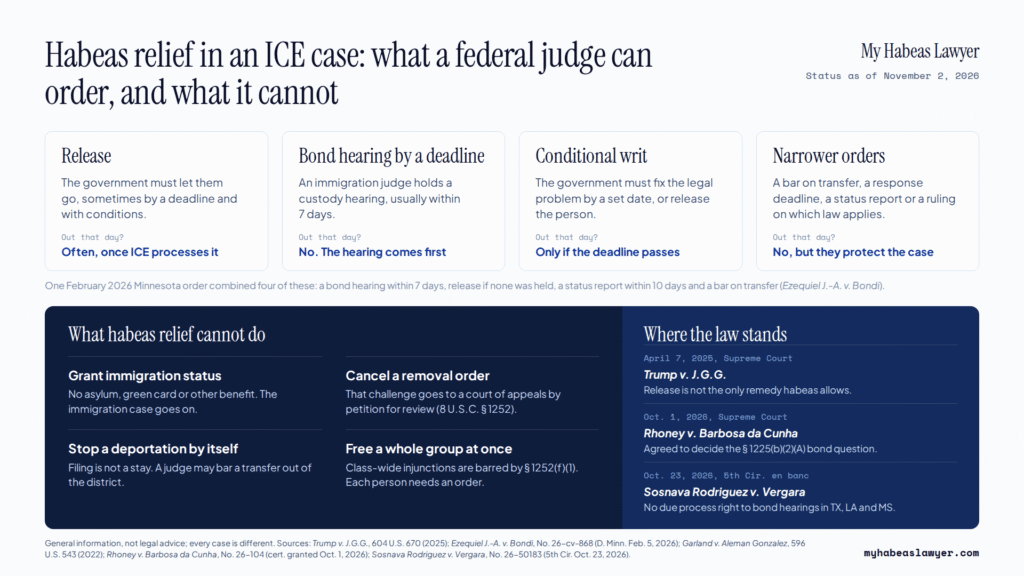
Habeas relief is the order a federal judge issues after finding that someone is being held unlawfully. In an ICE case it usually takes one of four forms: release, a bond hearing by a deadline, a conditional order that ends in release if ICE does not act, or a narrower order such as a ban on transfer. It does not decide the immigration case itself.
This guide explains what each kind of order requires and what it means for your family. If the judge has already ruled and you have the order in hand, our guide to reading the order after habeas is granted picks up from there.
For many families, the news arrives as a single word over the phone: granted. It is natural to hear that as “they are coming home today.” Sometimes that is what the order says. More often it sets a hearing, a deadline or a condition first. The Supreme Court made the same point in April 2025, noting that immediate physical release is not the only remedy the writ of habeas corpus allows (Trump v. J.G.G.).
Last updated: November 2, 2026. Based on court decisions current on that date.
In This Article · Habeas Relief

What “Habeas Relief” Means in an ICE Case
Habeas relief is what a federal court orders once it finds that a person is “in custody in violation of the Constitution or laws or treaties of the United States,” the standard in 28 U.S.C. § 2241(c)(3). The statute then gives the judge real flexibility: under § 2243, the court disposes of the matter “as law and justice require.” Our guide to habeas corpus in ICE detention covers the full process; this page focuses on the result.
Relief Is About Custody, Not Immigration Status
The judge reviews one question: does the government have a lawful basis to keep your loved one detained? The judge does not take over the immigration case, decide an asylum claim or approve a green card. Winning in federal court can change custody while the removal case continues in immigration court. That is why a family can win habeas on a Monday and still have an immigration hearing the following month.
Immigration Habeas (§ 2241) vs. Criminal Habeas (§ 2254 and § 2255)
Search for “habeas relief” and most results describe a different proceeding: a prisoner challenging a criminal conviction or sentence. State prisoners file under § 2254 and federal prisoners under § 2255 (28 U.S.C. chapter 153), with one-year deadlines, exhaustion rules and strict limits on second petitions. A person in ICE detention usually files under § 2241 and challenges the detention itself, not a conviction.
There is no one-year clock for an immigration petition, although some courts expect the person to try an available step first, such as asking an immigration judge for bond, unless that step would be pointless. If what you are reading talks about trial errors or the AEDPA deadline, it is about criminal habeas; our page on habeas corpus vs. appeal covers that track.
The Orders a Federal Judge Can Issue
Orders in ICE habeas cases in 2026 follow recognizable patterns, and a February 2026 order from Minnesota shows most of them in a single document. The man had lived in the United States since 1995. The judge declared that he was not subject to mandatory detention, ordered a bond hearing within seven days, required his release if no hearing was held, set terms for any release, asked for a status report within ten days and barred ICE from moving him out of Minnesota before the hearing (Ezequiel J.-A. v. Bondi).
Release, With or Without Conditions
A release order directs the government to let your loved one go. It may take effect immediately or by a deadline, and it may come with conditions such as reporting, supervision or attending every immigration court date. Judges can also limit what ICE adds: the Minnesota order required release in Minnesota, with documents and phone returned, without an ankle monitor and with advance notice to the lawyer. Read the conditions line by line, because they bind your relative after the release.
A Bond Hearing Within a Set Number of Days
This is the most common order in 2026. The federal judge sends the custody decision back to an immigration judge, usually with seven days to hold an individualized bond hearing. The federal judge does not set bond. The immigration judge decides whether to release your loved one and on what amount, based on evidence of family ties, work, a fixed address and a sponsor. A bond hearing order means preparation, not pickup.
Our page on challenging a denied bond hearing explains when this order is available, and our guide to bond amounts after a habeas order covers what usually follows.
The Conditional Writ: Act by a Deadline or Release
A conditional writ gives the government a choice and a clock: fix the legal problem by a set date or release the person. Many bond hearing orders are written this way. In September 2026, a magistrate judge in the Western District of Oklahoma recommended exactly that structure, a bond hearing within seven days or release (Izquierdo v. Figueroa).
For the family, the date is everything. If it passes with no hearing, the order itself may require release, and the lawyer can go back to the judge with a motion to enforce the order.
Narrower Orders That Protect the Case
Some relief is smaller but can decide what happens next: an order barring transfer out of the district while the case is pending, a short deadline for the government’s response (§ 2243 sets three days, with up to 20 more for good cause), a required status report, or a declaration about which detention law applies.
When a transfer is the main risk, our page on emergency filings to stop an ICE transfer explains that step.
Did the judge rule, but your loved one is still detained?
Send us the order or the federal case number. We will tell you what it requires, whether a deadline has passed and what can be filed next. The initial evaluation is free.
Release or a Bond Hearing: What Tips the Order
When the problem is that your loved one was denied a hearing the law provides, most courts treat that hearing as the fitting remedy. The Oklahoma recommendation called a bond hearing the proper remedy and noted that judges in that district had consistently declined to shift the burden of proof to the government. Our guide to asking a habeas court for a bond hearing explains why that request often succeeds, and why who carries the burden at the hearing can matter as much as winning it.
Release becomes more likely in a few recurring situations:
- ICE took back an earlier release without new facts. Judges in Oklahoma have ordered release where ICE improperly revoked a bond an immigration judge had already set, as the September recommendation notes.
- The government missed a court deadline. A conditional order can turn into a release requirement when no hearing is held in time.
- Removal is not reasonably foreseeable after a final order. This is the six-month principle from Zadvydas v. Davis.
- Detention has become unreasonably prolonged, in the circuits that recognize that claim.
Small facts can tip the result. In the Minnesota case, the judge declined to order immediate release partly because ICE had produced an arrest warrant and its timing was not challenged. The legal theory also has to fit the statute: in Johnson v. Arteaga-Martinez (2022), the Supreme Court reversed a ruling that § 1231(a)(6) itself requires a bond hearing after six months of detention.
Where Your Loved One Is Detained Changes the Answer
On October 1, 2026, the Supreme Court agreed to decide whether § 1225(b)(2)(A) requires detention without bond for people who entered without inspection and were later arrested inside the country (Rhoney v. Barbosa da Cunha, No. 26-104). On October 23, the full Fifth Circuit ruled 10 to 7 that three longtime Texas residents had no due process right to individualized bond hearings, reversing the habeas relief they had won in district court (Sosnava Rodriguez v. Vergara, as reported by Davis Vanguard).
In Texas, Louisiana and Mississippi, the orders described above are now much harder to obtain on these theories. Our circuit bond map tracks where each circuit stands.
Quick Comparison: What Each Order Means for Your Family
Families usually hear the result before they see the order. This table translates each type of habeas relief into what happens next.
| Order | What it requires | Do they leave detention that day? | What your family does now |
|---|---|---|---|
| Release | The government must release the person, sometimes by a deadline and with conditions | Often, once ICE processes it, which can take hours | Arrange pickup, bring identification and read every condition |
| Bond hearing | An immigration judge must hold a custody hearing, often within seven days | No. The hearing comes first | Gather a sponsor letter, proof of address, work records and family ties; plan for the bond payment |
| Conditional writ | The government must act by a date or release the person | Not unless the deadline passes | Mark the deadline and tell the lawyer the moment it passes |
| Transfer bar or status report | Keeps the person in the district and makes the government report back | No | Keep checking the locator and report any move at once |
| Denial | The court finds the detention lawful on this record | No | Review the reasons with your lawyer before deciding the next step |
Before the call with the lawyer ends, ask four questions:
- What exactly does the order require, and by what date?
- Is release immediate, conditional or tied to a hearing?
- Does it bar a transfer or set conditions for release?
- What should we gather in the next 48 hours?
What Habeas Relief Cannot Do
Knowing the limits saves families time and money, and it keeps expectations honest.
It Cannot Grant Status or Cancel a Removal Order
A habeas judge does not grant asylum, approve a green card or reverse a removal order. Under 8 U.S.C. § 1252, a challenge to a removal order generally goes to a federal court of appeals through a petition for review, not to a district court in habeas. The Supreme Court drew the line in 2020: a man who used habeas to seek a new chance to apply for asylum, rather than release, was asking for something outside the traditional scope of the writ (DHS v. Thuraissigiam). Our guide to habeas after a final deportation order explains how that line works in practice.
It Is Not a Stay of Deportation
Filing a petition does not pause a removal. A judge can sometimes order that the person not be moved out of the district while the petition is pending, which protects the case, but stopping a removal itself usually requires a separate request in the immigration case or in the court of appeals. The Alien Enemies Act is the notable exception: in J.G.G., the Supreme Court held that challenges to removal under that law must be brought in habeas, in the district of confinement.
It Usually Cannot Be Won for a Whole Group at Once
Habeas relief is individual: each detained person generally needs an order of their own. In Garland v. Aleman Gonzalez (2022), the Supreme Court held that 8 U.S.C. § 1252(f)(1) bars lower courts from issuing class-wide injunctions against the operation of the detention provisions, while leaving relief for individuals available. That is why a favorable ruling in someone else’s case, or a court of appeals decision in your circuit, does not by itself release your loved one. It strengthens the petition you file.
If the Petition Is Denied
A denial means the judge did not find the detention unlawful on the record and the arguments in front of the court. It is not always the end. The reason matters most: the court may find the detention currently authorized, the petition premature, the wrong respondent or district named, or a required step not yet taken. Some denials leave room for a new petition if detention drags on or the facts change.
Depending on the reason, next steps can include an appeal, a renewed petition, fixing a filing problem or building a stronger record. Read a short denial and a detailed one differently, because the reasoning shows what a second attempt would need. Our guide to appeal options after a habeas hearing explains the timing.
Frequently Asked Questions
What is the definition of habeas relief?
It is the order a federal court issues when it finds that a person is being held unlawfully. In an ICE case that can be release, a bond hearing by a deadline, a conditional order or a narrower order that protects the case, such as a ban on transfer.
Can a federal judge order ICE to release someone?
Yes, in the right case. The order may take effect immediately or set a deadline and conditions. In 2026 many courts order a bond hearing first instead of direct release.
Is a bond hearing order the same as winning release?
No. It gives your loved one a custody hearing before an immigration judge, who decides whether to set bond and in what amount.
What is a conditional writ?
An order that gives the government a deadline to fix the legal problem, such as holding a bond hearing, and requires release if it does not act in time.
Can habeas relief stop a deportation?
Usually not. Habeas challenges the detention, not the removal order. A judge may bar a transfer out of the district while the petition is pending, but stopping a removal usually requires a separate request.
Does a ruling in someone else’s case free my relative?
Generally no. Each person needs a petition and an order of their own, although a favorable ruling in your circuit can make that petition stronger.
What to Do Next When the Order Arrives
An order granting habeas relief helps only if your family knows exactly what it requires. Ask the lawyer for the written order the day it issues, because the label “granted” matters less than what the order says. Mark every deadline it sets, prepare for either a pickup or a bond hearing, and report any transfer at once. If ICE has not acted when a deadline passes, that is a reason to go back to the judge, not to wait. Our federal habeas team page explains who handles these petitions and where we file.
Is a loved one in ICE detention?
Time is critical. A habeas corpus petition can be a powerful tool to challenge unlawful detention. Reach out to us now: call +1 (862) 799-2200 or email info@gozellaw.com.
Legal Disclaimer
This article is provided for general informational purposes only and does not constitute legal advice. Every immigration case has unique circumstances. For legal guidance specific to your situation, we recommend consulting with an experienced immigration attorney. The information in this article reflects laws and policies as of the publication date; subsequent changes may affect its accuracy. Prior results do not guarantee a similar outcome.
Review Note
Prepared November 2, 2026. Court positions follow the decisions cited as of that date: Trump v. J.G.G., 604 U.S. 670 (2025); DHS v. Thuraissigiam, 591 U.S. 103 (2020); Johnson v. Arteaga-Martinez, 596 U.S. 573 (2022); Garland v. Aleman Gonzalez, 596 U.S. 543 (2022); Ezequiel J.-A. v. Bondi, No. 26-cv-868 (D. Minn. Feb. 5, 2026); Izquierdo v. Figueroa, No. 5:26-cv-01891 (W.D. Okla. Sept. 1, 2026) (report and recommendation); Sosnava Rodriguez v. Vergara, No. 26-50183 (5th Cir. Oct. 23, 2026) (en banc); and Rhoney v. Barbosa da Cunha, No. 26-104 (certiorari granted Oct. 1, 2026). Rulings can be appealed and policies change; check current sources before relying on them.
Sources
- Trump v. J.G.G., 604 U.S. 670, Supreme Court of the United States. April 7, 2025.
- Department of Homeland Security v. Thuraissigiam, 591 U.S. 103, Supreme Court of the United States. June 25, 2020.
- 28 U.S. Code Chapter 153, Habeas Corpus (§§ 2241–2255), Cornell Legal Information Institute; accessed November 2, 2026.
- Ezequiel J.-A. v. Bondi, No. 26-cv-868 (DWF/SGE), Memorandum Opinion and Order, U.S. District Court for the District of Minnesota, via CourtListener. February 5, 2026.
- Izquierdo v. Figueroa, No. 5:26-cv-01891, Report and Recommendation, U.S. District Court for the Western District of Oklahoma, via Midpage. September 1, 2026.
- Johnson v. Arteaga-Martinez, 596 U.S. 573, Supreme Court of the United States, via Justia. June 13, 2022.
- Garland v. Aleman Gonzalez, 596 U.S. 543, Supreme Court of the United States, via Justia. June 13, 2022.
- Rhoney v. Barbosa da Cunha, No. 26-104, docket, Supreme Court of the United States; certiorari granted October 1, 2026.
- Fifth Circuit Rules Immigrants Who Entered without Inspection Have No Right to Bond Hearings, Davis Vanguard. October 25, 2026.
Every day in detention is a day away from your family.
If the immigration system has failed you, federal court may be the only answer. Let us review your case for free.
Get a Free Case Evaluation