“Six months.” That number reaches almost every family with someone in ICE detention. Someone at the facility mentions it. A relative who went through this repeats it. A search result confirms it. The message is always the same: hold on until the six month mark, and then the government has to let them go.
So is there a 6-month rule for ICE detention? There is one. It is real, it comes from the Supreme Court, and for most families reading this it is the answer to a question they are not asking.
The six month rule belongs to a specific situation: detention that continues after a removal order is already final. If your loved one’s immigration case is still open, a different body of law applies, and there is no national clock inside it. What exists instead is a set of standards that change at the border of each federal circuit. This guide explains where the number came from, why it does not travel, and what the court holding your loved one actually requires.

Where the Six Month Rule Actually Comes From
The number is not a myth. It comes from a real Supreme Court decision, and that decision describes a stage of the case most detained people have not reached.
The rule applies after a removal order is already final
Once a removal order becomes final, the government gets a ninety day removal period under 8 U.S.C. § 1231(a) to carry it out. Detention past that window runs on § 1231(a)(6), which on its face sets no limit at all.
In Zadvydas v. Davis, 533 U.S. 678 (2001), the Supreme Court read an implicit limit into that provision, reasoning that a statute authorizing permanent civil detention would raise serious constitutional problems. The Court fixed six months as the presumptively reasonable period. After that, if the person shows good reason to believe removal is not significantly likely in the reasonably foreseeable future and the government cannot rebut it, release is required.
That is a genuine rule with a genuine number in it. Our guide to habeas corpus after a final deportation order covers how it works in practice, and what evidence shows removal is not reasonably foreseeable deals with the proof side.
If the immigration case is still open, that rule is not yours
Most people currently in ICE custody do not have a final removal order. Their case is pending, which means detention is authorized by 8 U.S.C. § 1226: either § 1226(a), where an immigration judge can set bond, or § 1226(c), mandatory detention based on certain criminal grounds.
Neither section contains a clock. Zadvydas construed a different statute governing a different stage, and courts have declined to import its six month figure into § 1226. This is the most common misunderstanding families bring into a first consultation, and it costs time. A family waiting for a deadline that does not exist is a family not filing.
The National Rule That No Longer Exists
For several years there almost was a national rule. The Ninth Circuit had read the detention statutes to require a bond hearing every six months, and district courts elsewhere were following the same logic. Families who heard about the six month rule in that period were not imagining it.
In Jennings v. Rodriguez, 583 U.S. 281 (2018), the Supreme Court reversed. It held that §§ 1225(b), 1226(a) and 1226(c) cannot be read to require periodic bond hearings, because the text does not say so and the canon of constitutional avoidance cannot be used to write a hearing schedule into a statute that has none.
Jennings answered the statutory question and deliberately left the constitutional one open, sending it back to the lower courts. That one move is why a map exists at all. With no statutory clock, whether prolonged detention violates the Fifth Amendment became a question each court of appeals answers for itself.
Eight years later they have not converged. Some circuits recognize the claim and have set out how to litigate it. One rejected the framework outright. Several never issued a controlling decision at all.
What Your Circuit Actually Requires
The table below summarizes where each federal circuit stands on prolonged detention while a removal case is pending. Two columns matter most: whether the circuit recognizes the claim at all, and who has to prove what at any hearing that results. The second column decides more cases than families expect.
| Circuit | States covered | Can prolonged detention itself require a bond hearing? | Who carries the burden | Leading authority |
|---|---|---|---|---|
| First | ME, MA, NH, RI, PR | Yes, case by case. No fixed period. | Government, including at ordinary § 1226(a) hearings | Reid v. Donelan (2021); Hernandez-Lara v. Lyons (2021) |
| Second | CT, NY, VT | Yes, under a Mathews balancing test | Government, by clear and convincing evidence | Black v. Decker (2024), now before the Supreme Court |
| Third | DE, NJ, PA, VI | Yes, under a multi-factor test. No presumption either way. | Government, by clear and convincing evidence | German Santos v. Warden Pike County (2020) |
| Fourth | MD, NC, SC, VA, WV | Not foreclosed, but the court upheld existing procedures | The detained person | Miranda v. Garland (2022) |
| Fifth | LA, MS, TX | Unsettled. A favorable panel opinion was vacated in July 2026. | Undecided pending en banc rehearing | Buenrostro-Mendez v. Bondi (2026) |
| Sixth | KY, MI, OH, TN | A reasonableness limit was recognized in 2003 on statutory grounds | Not settled after Jennings | Ly v. Hansen (2003) |
| Seventh | IL, IN, WI | No controlling post-Jennings rule | Varies by district | District court practice |
| Eighth | AR, IA, MN, MO, NE, ND, SD | No. The court rejected any reasonableness test. | Not applicable | Banyee v. Garland (2024) |
| Ninth | AK, AZ, CA, HI, ID, MT, NV, OR, WA | Available in principle, but the court has narrowed it | The detained person at § 1226(a) hearings | Rodriguez Diaz v. Garland (2022) |
| Tenth | CO, KS, NM, OK, UT, WY | No controlling post-Jennings rule | Varies by district | District court practice |
| Eleventh | AL, FL, GA | No controlling rule. The earlier favorable opinion was vacated. | Varies by district | Sopo v. U.S. Att’y Gen., vacated (2018) |
Circuits that will weigh the length of detention
The First, Second and Third Circuits all accept that mandatory detention can become unreasonably prolonged and that due process then requires a bond hearing. None of them adopted a fixed number. The Third Circuit expressly declined to presume that any particular duration is reasonable or unreasonable, and the Second Circuit joined that position in 2024.
What they did settle is the part that decides outcomes. At the hearing that follows, the government must justify continued custody by clear and convincing evidence. The detained person is no longer the one who has to earn their way home. New Jersey sits in the Third Circuit, and our post on when ICE detention becomes too long in New Jersey works through how those factors are applied there.
Circuits that have narrowed or closed the argument
The Eighth Circuit is the clearest of these. In Banyee v. Garland it held that Zadvydas and Demore v. Kim leave no room for a multi-factor reasonableness test, and that the government may detain under § 1226(c) for as long as removal proceedings remain pending.
The Fourth and Ninth Circuits have not gone that far, but both declined to shift the burden of proof onto the government at ordinary bond hearings. Virginia sits in the Fourth Circuit, and our guide to how Virginia federal courts analyze prolonged ICE detention covers Miranda v. Garland in detail.
The Fifth Circuit is its own category right now. A panel held in July 2026 that detention beyond ninety days requires a hearing, and eight days later the full court vacated that opinion and set the case for rehearing en banc. Texas, Louisiana and Mississippi currently have no settled answer. Our post on what changed in the Fifth Circuit in July 2026 traces the sequence.
Circuits where the district judge decides
In the Sixth, Seventh, Tenth and Eleventh Circuits there is no controlling post-Jennings rule. The Eleventh Circuit’s earlier favorable decision in Sopo was vacated as moot in 2018 and no longer binds anyone. The Sixth Circuit’s Ly v. Hansen recognized a reasonableness limit back in 2003, but it rested on the kind of statutory reading Jennings rejected.
This does not mean the argument fails in those circuits. It means the individual district judge assigned to the petition is the one deciding, and practice varies from district to district inside a single circuit. Assessing that is part of what our post on when a case is ready for federal habeas review addresses.
Not sure which circuit holds your loved one?
Send us the facility name and the date ICE took custody. We will tell you which court of appeals governs, what that circuit currently requires, and whether the detention has reached a point worth acting on. No cost.
Why Eight Months Means Two Different Things
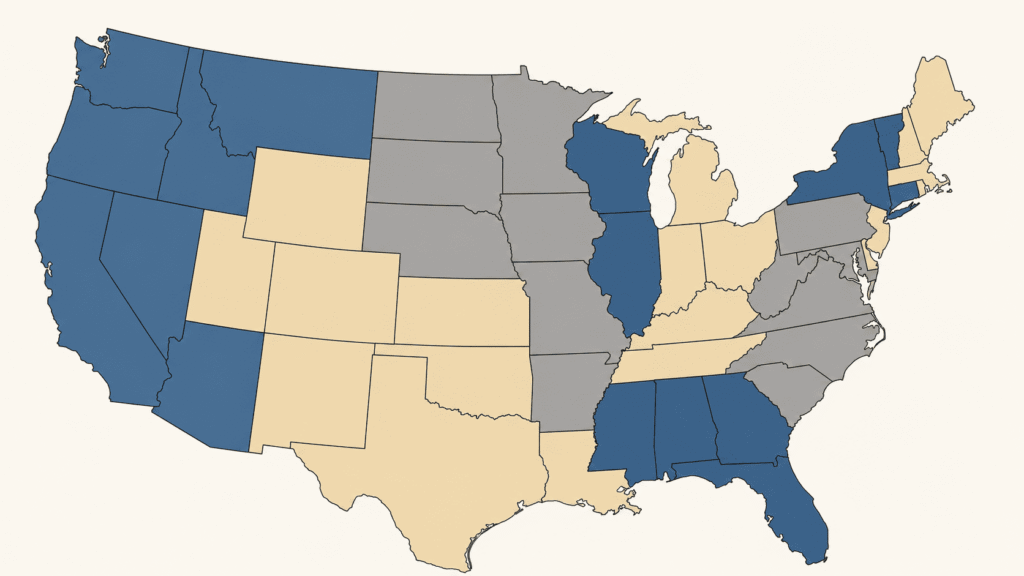
The federal circuit covering the detention facility supplies the governing law.Consider two people with identical facts. Both entered ICE custody the same day, both have been held eight months with no bond hearing, and both have a U.S. citizen spouse and children.
One is held in Elizabeth, New Jersey. The Third Circuit recognizes the claim, so a habeas petition asks the district court to find the detention unreasonably prolonged, and if it agrees, the government has to justify further custody by clear and convincing evidence at the hearing that follows.
The other is held in Omaha, Nebraska. Under Banyee, the Eighth Circuit has said the length of detention does not by itself create a due process entitlement while removal proceedings continue. Same eight months, same family, a materially different petition. Counsel there would need to build the case on other grounds, such as the wrong detention statute being applied or a specific procedural failure.
Which is also why a transfer is a legal event and not merely a logistical one. Where the petition must be filed and which precedent binds that court are covered in where to file habeas after an ICE transfer. A separate question, whether the government has applied the correct detention statute in the first place, is covered in our post on what § 1225(b)(2) means for your family.
What the Supreme Court Is About to Decide
This patchwork may not survive the year. On June 15, 2026 the Supreme Court granted certiorari in Genalo v. Black, No. 25-886, reviewing the Second Circuit’s decision in Black v. Decker. The case involves two lawful permanent residents held under § 1226(c) for seven months and twenty-one months without a bond hearing.
The questions presented are precisely the two that divide the circuits: whether there is a point at which § 1226(c) detention becomes unreasonably prolonged such that due process requires a bond hearing, and if so, whether the government must justify continued detention by clear and convincing evidence.
The case is set for argument in the Court’s October 2026 sitting, with a decision expected before the term ends in June 2027. An affirmance would give families in restrictive circuits a constitutional floor. A reversal would remove the theory in the circuits that currently recognize it.
Two things follow. First, any statement about what your circuit requires is accurate as of today and not necessarily next spring. Second, waiting for the ruling is not a strategy. Detention continues during the wait, and a petition filed now is decided under the law that exists now.
What Carries Weight in Every Circuit
Wherever a court is willing to weigh reasonableness, it looks at roughly the same things. These factors are worth documenting from the first week of custody, long before anyone decides whether to file.
- How long custody has actually lasted, measured from the day ICE took the person, not from the date of the most recent hearing.
- How much longer it is likely to last. A pending appeal with no hearing date reads very differently from a case nearing decision.
- Who caused the delay. Government continuances, repeated rescheduling, and administrative inaction weigh differently from delays the detained person requested.
- Whether any individualized review has ever happened. Custody never examined by any decisionmaker is the strongest version of this claim.
- Whether the challenge to removal is substantial. Courts weigh detention differently when the person has a real prospect of winning relief.
- Conditions and medical circumstances, including denial of care, interrupted access to counsel, and the effect on dependent family members.
A family that can hand counsel a dated timeline with the paperwork attached is in a materially stronger position than one describing events from memory. Our guide to the records that strengthen a habeas case sets out what to collect.
Frequently Asked Questions
Is there a 6-month rule for ICE detention?
There is a six month rule, but it applies only after a removal order is already final. Under Zadvydas v. Davis, detention under 8 U.S.C. § 1231(a)(6) is presumptively reasonable for six months, after which release may be required if removal is not significantly likely in the reasonably foreseeable future. If the immigration case is still pending, detention runs under 8 U.S.C. § 1226 instead, and no national six month rule applies to it.
Does ICE have to release my husband after six months if his case is still open?
No. If his removal case is still pending, there is no statutory deadline requiring release at six months or at any other point. What may be available is a constitutional argument that the detention has become unreasonably prolonged, and whether that argument is recognized depends on the federal circuit covering the facility where he is held.
Why does the answer depend on which state my loved one is detained in?
Because a habeas petition is filed in the federal district court covering the place of confinement, and that court is bound by its own court of appeals. In Jennings v. Rodriguez the Supreme Court held the detention statutes do not require periodic bond hearings and left the constitutional question to the lower courts. Those courts have reached different answers, so the governing standard changes at circuit lines.
Which circuits recognize a prolonged detention claim?
The First, Second and Third Circuits recognize that detention under 8 U.S.C. § 1226(c) can become unreasonably prolonged and that due process then requires a bond hearing, with the government bearing the burden of justifying continued custody. The Eighth Circuit rejected any reasonableness test in Banyee v. Garland. The Fourth and Ninth Circuits recognize narrower versions. The Sixth, Seventh, Tenth and Eleventh Circuits have no controlling post-Jennings rule, so district courts decide.
How many months does it take before a court will consider the detention unreasonable?
No circuit has adopted a fixed number. The Third Circuit expressly declined to presume that any particular duration is reasonable or unreasonable, and the Second Circuit took the same position. Courts weigh the length of custody together with the likely remaining duration, who caused any delay, and whether the person has ever received individualized review.
Who has to prove what if the court orders a bond hearing?
It depends on the circuit and on the legal basis for the order. At an ordinary custody redetermination under 8 U.S.C. § 1226(a), the detained person generally carries the burden. At a hearing ordered because detention became unreasonably prolonged, the First, Second and Third Circuits require the government to justify continued custody, with the Second and Third applying a clear and convincing evidence standard. The Supreme Court is reviewing that question in Genalo v. Black.
Could the Supreme Court change all of this?
Yes. The Court granted certiorari in Genalo v. Black on June 15, 2026 to decide whether § 1226(c) detention can become unreasonably prolonged and, if so, whether the government must justify it by clear and convincing evidence. Argument is set for the October 2026 sitting and a decision is expected by June 2027. Because detention continues while the case is pending, most families act under current law rather than wait.
The Number Is Not the Rule. The Map Is.
If your family has been counting toward six months, the counting was not wasted. Duration is the first thing any court looks at, and long custody with no individualized review is the strongest version of this claim anywhere it is heard. What the six month figure does not do is trigger anything automatically while the immigration case is still open.
The variable that changes the answer is the one nobody chose: the federal circuit covering the facility. That is worth knowing before anyone decides whether it is too early to call a lawyer, and it is the first thing we check. Our habeas corpus and ICE detention guide covers the wider picture, and prolonged detention is the service page for this situation.
How long has your loved one been held, and where?
Those two facts decide most of the analysis. Send us the facility name, the date ICE took custody, and the detention statute listed on the paperwork. We will identify the controlling circuit, tell you what it currently requires, and give you an honest read on whether a petition under 28 U.S.C. § 2241 is worth filing now.
Phone: (+1) 862-799-2200
Email: info@gozellaw.com
Legal Disclaimer: This article is provided for general informational purposes only and does not constitute legal advice. Reading it does not create an attorney-client relationship. Immigration detention law is changing rapidly, and the circuit landscape described here reflects authority reviewed as of August 28, 2026. Whether relief is available in a particular case depends on the detention location, the statute ICE is relying on, the procedural history, and controlling federal precedent. Prior results do not guarantee a similar outcome. Consult qualified counsel for advice regarding a specific case.
Sources
- 8 U.S.C. § 1226, Apprehension and detention of aliens, Cornell Legal Information Institute.
- 8 U.S.C. § 1231, Detention and removal of aliens ordered removed, Cornell Legal Information Institute.
- 28 U.S.C. § 2241, Power to grant writ of habeas corpus, Cornell Legal Information Institute.
- Zadvydas v. Davis, 533 U.S. 678 (2001), Supreme Court of the United States, June 28, 2001.
- Jennings v. Rodriguez, 583 U.S. 281 (2018), Supreme Court of the United States, February 27, 2018.
- Demore v. Kim, 538 U.S. 510 (2003), Cornell Legal Information Institute.
- Black v. Decker, 103 F.4th 133 (2d Cir. 2024), U.S. Court of Appeals for the Second Circuit, May 31, 2024.
- Genalo v. Black, No. 25-886, Questions Presented, Supreme Court of the United States, certiorari granted June 15, 2026.
- German Santos v. Warden Pike County Correctional Facility, 965 F.3d 203 (3d Cir. 2020), U.S. Court of Appeals for the Third Circuit.
- Reid v. Donelan, 17 F.4th 1 (1st Cir. 2021), and Hernandez-Lara v. Lyons, 10 F.4th 19 (1st Cir. 2021), U.S. Court of Appeals for the First Circuit.
- Miranda v. Garland, 34 F.4th 338 (4th Cir. 2022), U.S. Court of Appeals for the Fourth Circuit.
- Banyee v. Garland, 115 F.4th 928 (8th Cir. 2024), U.S. Court of Appeals for the Eighth Circuit.
- Rodriguez Diaz v. Garland, 53 F.4th 1189 (9th Cir. 2022), U.S. Court of Appeals for the Ninth Circuit.
- Sopo v. U.S. Attorney General, 825 F.3d 1199 (11th Cir. 2016), vacated as moot, 890 F.3d 952 (11th Cir. 2018).
- ICE Online Detainee Locator System, U.S. Immigration and Customs Enforcement.
Every day in detention is a day away from your family.
If the immigration system has failed you, federal court may be the only answer. Let us review your case for free.
Get a Free Case Evaluation