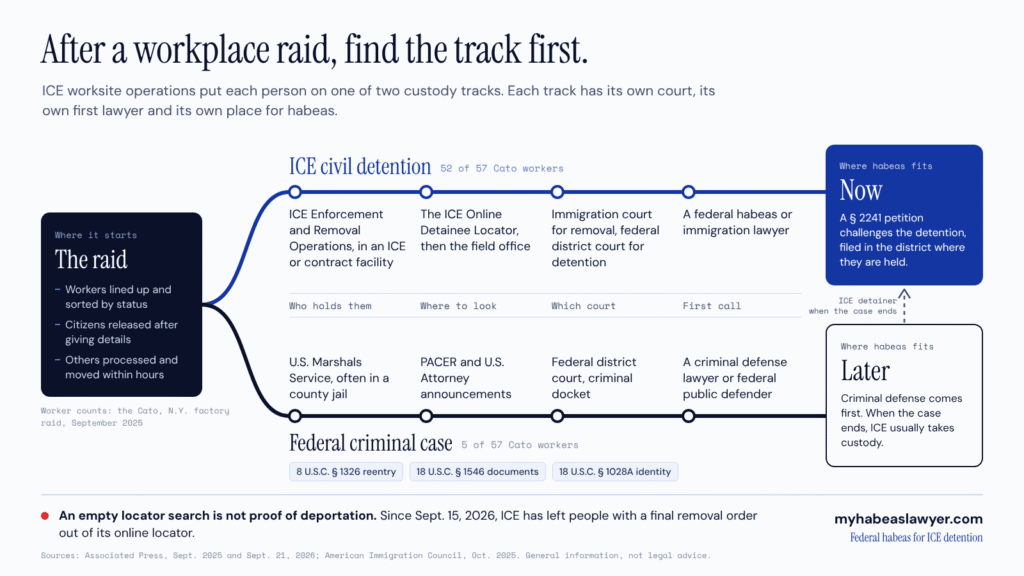
In September 2025, federal agents raided a snack-bar factory in Cato, New York, lined up the workers, separated U.S. citizens from everyone else and arrested 57 people. Five were charged with a federal crime; the other 52 were held by ICE. If someone you love was detained in an ICE workplace raid, that split is the first thing to find out, because it decides which court, which lawyer and which filing comes next.
This guide covers arrests inside a workplace or during an operation aimed at one: a plant, farm, construction site or day-labor pickup point. If the arrest came during an ordinary traffic stop, see what happens when someone is detained by ICE after a traffic stop. For detention in general, start with what to do if your loved one is detained by ICE.
Last updated: November 16, 2026. Arrest figures from DHS’s November 12, 2026 release; locator policy as reported by the Associated Press on September 21, 2026.
In This Article · ICE Workplace Raids
- What Happens in the First Hours After an ICE Workplace Raid
- ICE Detention or Criminal Charges? The Two Custody Tracks
- Why the ICE Locator May Show Nothing After a Raid
- Which Detention Rule Applies to Your Loved One
- What ICE Could and Could Not Do at the Workplace
- Records Only a Workplace Raid Case Has
- When a Habeas Petition Fits After a Workplace Raid
- Frequently Asked Questions
- What to Do Next After an ICE Workplace Raid

What Happens in the First Hours After an ICE Workplace Raid
ICE reported more than 491,000 arrests in fiscal year 2026, a record for the agency. Worksite enforcement operations are usually run by Homeland Security Investigations, ICE’s criminal investigations arm, and they usually start with a criminal search warrant aimed at the employer, not the workers. Then three things move fast:
- Sorting. In Cato, body camera video published by the Associated Press showed officers covering the exits, lining employees up and separating citizens from potential noncitizens before asking about status and entry. Citizens gave contact details and were let go.
- Paperwork. Forms such as voluntary departure can appear within hours, and some Cato workers were deported, including two who later sued. Our guide to the first 24 hours after an ICE arrest explains what not to sign.
- Movement. People are processed on site or at a staging point, then bused to a detention center that may be hours away. Workers arrested at the Hyundai battery plant in Georgia in September 2025 were taken to an immigration detention center in Folkston.
ICE Detention or Criminal Charges? The Two Custody Tracks
After a workplace raid, most workers are held by ICE on civil immigration charges. A smaller group is charged with a federal crime and held by the U.S. Marshals. The track decides where to look, which court hears the case, which lawyer to call first and whether a habeas petition can help now.
| ICE civil detention | Federal criminal case | |
|---|---|---|
| Who holds them | ICE Enforcement and Removal Operations, in an ICE or contract facility | U.S. Marshals Service, often in a county jail under contract |
| Typical basis | Unlawful presence, a visa violation or a prior removal order | Reentry after removal (8 U.S.C. § 1326), document fraud (18 U.S.C. § 1546) or aggravated identity theft (18 U.S.C. § 1028A) |
| Where to look | ICE Online Detainee Locator, then the ICE field office | PACER, U.S. Attorney’s Office announcements and the Marshals’ district office |
| Which court | Immigration court for removal; federal district court for a habeas petition | Federal district court, criminal docket |
| First lawyer | An immigration or federal habeas lawyer | A criminal defense lawyer or federal public defender |
| Where habeas fits | Now, if the detention is unlawful | Later; the criminal case comes first |
The split is usually lopsided. In Cato, five workers who had been deported before were charged with illegal reentry, and the other 52 were held for immigration proceedings. In a June 2026 raid at a metal casting plant in Abbeville, South Carolina, ICE detained 48 workers on immigration violations, while two managers and four people accused of selling fake IDs faced state charges.
The tracks also connect. When a criminal case ends, ICE usually lodges a detainer and takes custody, so the person lands on the first track anyway. A guilty plea can carry deportation consequences, and since Padilla v. Kentucky (2010) defense lawyers must warn clients about them, so the criminal and immigration lawyers should talk before any plea.
Why the ICE Locator May Show Nothing After a Raid
An empty search after a raid does not mean your relative has been deported. Three causes are common:
- Transport. The locator does not list people while they are being moved, and records can lag after a large operation.
- A criminal charge. Someone in Marshals custody will not appear in ICE’s locator at all.
- An old removal order. Since September 15, 2026, ICE has left people with final removal orders out of the locator, and, according to the American Immigration Council, even those appealing their orders. Workers with a past deportation, or an old order issued after a missed hearing, are exactly who this affects.
Our guides to finding someone in ICE detention and to what to do when the locator and facility calls fail walk through the search step by step.
Was a family member detained in a workplace raid?
Send us the worksite, the date and any papers ICE gave your relative. We will check which track they are on and what can be filed in federal court now, free of charge.
Which Detention Rule Applies to Your Loved One
Once you know ICE is holding your relative, the next question is which detention law it is using. That depends on their immigration history, not on the raid:
| Situation | What usually applies | Read more |
|---|---|---|
| Entered without inspection, no prior order | ICE treats many as subject to mandatory detention; whether a bond hearing is possible depends on the federal circuit | The 2026 circuit bond map |
| Prior removal order, reinstated | Detention under 8 U.S.C. § 1231, with no bond hearing by default; prolonged detention can still be challenged | The six-month rule in ICE detention |
| Work permit or pending application | Arrest is still possible; the pending case often shapes the custody fight | Detained with a valid work permit |
| Visa overstay or visa waiver entry | Fast removal or voluntary departure is common; most South Korean workers held after the Hyundai raid flew home about a week later | Ask the lawyer before accepting departure |
| U.S. citizen held during sorting | ICE has no authority to detain a citizen | U.S. citizen detained by ICE |
What ICE Could and Could Not Do at the Workplace
Does ICE Need a Warrant to Enter a Business?
Not for public areas. Agents can walk into a store floor, lobby or dining room like any customer. Private areas, such as offices, break rooms, back kitchens and closed production floors, require a judicial warrant signed by a judge or the employer’s consent. According to the New York Attorney General, an administrative warrant signed by an immigration officer does not authorize that entry.
Search Warrants, Blackie’s Warrants and I-9 Audits
Large raids usually rest on a criminal search warrant against the employer. It limits where agents may search and what they may seize, but once inside, agents can arrest workers they believe are violating immigration law. The American Immigration Council notes that the Hyundai warrant named four targets, yet 475 people were arrested. ICE has also sought broad civil inspection warrants, called Blackie’s warrants, and a federal court in southern Texas rejected one in May 2025. An I-9 audit is different: ICE must give the employer at least three days’ notice.
This matters to your family later. If agents searched beyond the warrant or held people without reasonable suspicion, those facts can support motions in immigration court and civil claims. A lawsuit filed in September 2026 over the Cato raid makes that argument, saying officers exceeded their search warrants.
Arrests Outside the Gate
Not every operation happens inside. In southwest Kansas in September 2026, agents patrolled and parked near meatpacking plants and a large dairy, while DHS said it was not conducting worksite raids. An arrest on the road to work usually follows the rules for a traffic stop arrest.
Records Only a Workplace Raid Case Has
A raid leaves a paper and video trail that most arrests do not. Ask the lawyer to collect or request:
- The warrant. Employers can ask agents for a copy, and criminal search warrants can be unsealed on the federal court docket after the operation. It shows what agents were allowed to do.
- Body camera video and the arrest report. Officers in Cato recorded the raid, and that footage became evidence in court. The Form I-213 records what your relative told officers; our guide to ICE detention records explains how to request it.
- Payroll and time records. Pay stubs, W-2s and time-clock data showing years of steady work support community ties in a bond or habeas argument.
- An employer letter. A short letter confirming the dates of employment, the role and whether the job is still open.
- Witnesses and phone video. Names of coworkers who saw the raid, and recordings made inside or outside the site.
- Official statements. ICE and U.S. Attorney press releases often name the operation, the agencies and any charges.
One caution: if your relative worked under someone else’s name or with false papers, do not give those records to the employer, ICE or anyone else until a lawyer has reviewed them. They can become evidence in a criminal case.
When a Habeas Petition Fits After a Workplace Raid
Once your relative is in ICE custody, a petition under 28 U.S.C. § 2241 asks a federal judge whether ICE has lawful authority to hold them. It is filed in the district where they are held, naming the official with day-to-day custody, so the facility matters. Our page on where to file after an ICE transfer explains that rule.
Speed matters because people move. The American Immigration Council reports that more than one in ten people arrested by ICE are moved out of state within 24 hours, and the locator change makes those moves harder for families to see. Our transfer prevention work focuses on that window.
In a group raid, each person needs their own petition built on their own history; a coworker’s result does not carry over. Habeas also has limits. It challenges detention, not the raid itself. It does not cancel a removal order or grant status, money damages are a separate civil claim, and for someone in criminal custody, the criminal case comes first.
Frequently Asked Questions
Is ICE arresting people with work permits?
Yes. A valid work permit does not prevent an arrest in a workplace raid, though it can matter in the fight over custody, especially when an application is still pending.
Will workers arrested in a raid face criminal charges?
Most do not. Charges usually involve reentry after a prior deportation, fake documents or another person’s identity. For aggravated identity theft, prosecutors must prove the worker knew the number belonged to a real person, as the Supreme Court held in 2009.
Can the employer get my family member released?
No. Release decisions belong to ICE or a judge. An employer can help by confirming the employment in writing and keeping the job open, which supports community ties.
Can a U.S. citizen be detained in a workplace raid?
Agents sometimes hold citizens while they sort workers, but ICE has no authority to keep a citizen in immigration custody. Gather proof of citizenship right away and send it to the ICE office.
How fast can ICE move someone after a raid?
Within hours. More than one in ten people arrested by ICE are moved out of state within a day, so find the facility first and file in the right district before another transfer.
What to Do Next After an ICE Workplace Raid
Today, find out which track your relative is on: search the ICE locator, and if they are not there, check U.S. Attorney announcements and the federal court docket. Make sure they sign nothing before a lawyer reviews it. Collect pay records, an employer letter and any copy of the warrant. If ICE is holding them, ask a federal habeas lawyer to file in the district where they are held before another transfer. Our guide to how federal habeas works in ICE detention explains the full process, and you can see who files these petitions, and where.
Is a loved one in ICE detention?
Time is critical. A habeas corpus petition can be a powerful tool to challenge unlawful detention. Reach out to us now.
Phone: +1 (862) 799-2200
Legal Disclaimer: This article is provided for general informational purposes only and does not constitute legal advice. Every immigration case has unique circumstances. For legal guidance specific to your situation, we recommend consulting with an experienced immigration attorney. The information in this article reflects laws and policies as of the publication date; subsequent changes may affect its accuracy. Prior results do not guarantee a similar outcome. Sources were reviewed as of November 2026.
Update Log
- November 16, 2026: First published. Arrest figures from DHS’s November 12, 2026 release; locator policy as reported by the Associated Press on September 21, 2026; the Cato lawsuit as reported by the Associated Press on September 11, 2026.
Sources
- Body camera video offers a rare look inside an immigration raid at Cayuga County factory, Associated Press via WRVO Public Media; September 11, 2026.
- Prosecutor in New York warns of more raids after 57 detained making snack bars, Associated Press; September 2025.
- South Carolina probe into fake IDs leads to ICE detention of 48 immigrants; 6 other people indicted, Associated Press via WTOP; June 2026.
- ICE hides locations of thousands of detainees with final removal orders, Associated Press; September 21, 2026.
- ICE Begins Electronically ‘Disappearing’ People in Custody: What You Need to Know, American Immigration Council; September 23, 2026.
- Understanding ICE Raids at American Workplaces, American Immigration Council; October 9, 2025.
- Dealing with ICE in the workplace, Office of the New York State Attorney General; issued September 2025.
- ICE Breaks Records in Fiscal Year 2026, With Most Arrests and Deportations in Agency’s History, U.S. Department of Homeland Security; November 12, 2026.
- South Korean workers return home after days in detention following US immigration raid, Associated Press via PBS News; September 12, 2025.
- Meatpacking groups, DHS at odds over SW Kan. ICE arrests, Associated Press via Little Apple Post; September 27, 2026.
Every day in detention is a day away from your family.
If the immigration system has failed you, federal court may be the only answer. Let us review your case for free.
Get a Free Case Evaluation