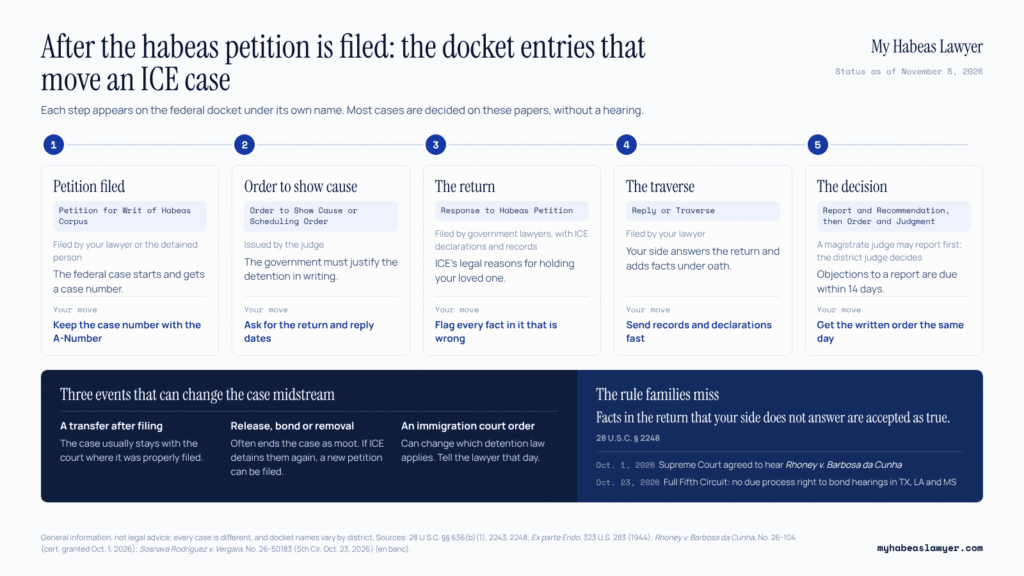
What happens after a habeas petition is filed? The habeas corpus process in federal court follows a fixed order: the court orders the government to explain the detention, the government files a written answer called a return, your side replies with a traverse, and the judge decides, usually on those papers. Each step appears on the federal docket under its own name, and each one gives your family something to do.
This guide covers the case once it is in federal court. If the petition has not been filed yet, our step-by-step guide to preparing and filing a habeas petition starts earlier. For how long each stage usually takes, see our day-by-day habeas timeline.
Families rarely see the courtroom. They see a docket: entries named Order to Show Cause, Response and Reply, written for lawyers. ProPublica counted 91,246 immigration habeas cases filed in federal courts from January 2025 through late October 2026 (ProPublica habeas tracker). Most move through the same filings, because one statute, 28 U.S.C. § 2243, sets the order.
Last updated: November 5, 2026. Based on statutes, court orders and decisions current on that date.
In This Article · After the Petition Is Filed
- Reading the Docket: What Each Entry Means
- The Order to Show Cause
- The Government’s Return: What ICE’s Lawyers Usually Argue
- The Traverse: Your Answer to the Government
- How the Decision Gets Made
- Events That Can Change the Case Midstream
- After the Judge Rules
- What Your Family Can Do While the Case Is Pending
- Frequently Asked Questions
- The Docket Tells You Where the Case Stands

Reading the Docket: What Each Entry Means
The docket is the court’s running list of everything filed in the case. Entry names vary by district; the table gives the ones you are most likely to see. Our guide to habeas corpus in ICE detention shows where these steps fit in the larger process.
| What you may see on the docket | Who files it | What it means | What your family can do |
|---|---|---|---|
| Petition for Writ of Habeas Corpus; Filing Fee Received | Your lawyer or the detained person | The federal case has started and has a case number | Keep the case number with your loved one’s A-Number |
| Order to Show Cause, or Scheduling Order Directing Respondents to Show Cause | The judge | The government must justify the detention in writing | Ask the lawyer for the return and reply dates the order sets |
| Response, or Response to Habeas Petition (the return), often with declarations | Government lawyers, usually the U.S. Attorney’s Office | ICE’s legal reasons and records for continuing the detention | Go through the facts it states with the lawyer and flag anything wrong |
| Reply, or Traverse | Your lawyer | Your side’s answer to the return | Send records and declarations quickly |
| Notice of transfer or imminent removal | Government lawyers | ICE intends to move your loved one | Call the lawyer the same hour |
| Report and Recommendation | A magistrate judge | A proposed decision for the district judge | Ask whether an objection will be filed, and by when |
| Order; Judgment | The district judge, or a magistrate judge the parties consented to | The decision, and the entry that closes the case | Get the written order the day it issues |
Expect to see the entries but not always the documents. In immigration cases, Rule 5.2(c) of the Federal Rules of Civil Procedure keeps most filings, including the petition and the government’s exhibits, off remote public access, while court orders usually stay online, as ProPublica’s tracker notes explain. Your lawyer has the full filings.
The Order to Show Cause
The first order that matters is the order to show cause. Under 28 U.S.C. § 2243, a judge who receives a habeas application must either grant the writ or order the government to show cause why the writ should not be granted, unless the petition itself shows the person is not entitled to relief. The order goes to whoever has custody of your loved one, and from that moment the government has to defend the detention in writing.
What the Order Requires the Government to Do
Read the order itself, not only the docket title. A Nevada judge handling Rojas-Lara v. United States required the government to file every document “referenced or relied upon” in its return, along with any arrest warrant. In the Western District of Washington, the standard scheduling order under General Order 08-26 also covers notice before a transfer; our page on the Tacoma habeas procedure walks through it.
If No Order Has Been Issued Yet
Some courts issue the order automatically when a judge is assigned; others review the petition first. If the docket stays quiet, the lawyer can ask the court to issue it. Our timeline guide explains when courts usually issue it.
The Government’s Return: What ICE’s Lawyers Usually Argue
The return is the government’s answer. Section 2243 requires the custodian to make a return “certifying the true cause of the detention.” In practice, an Assistant U.S. Attorney files it on behalf of ICE and the facility, usually with a declaration from an ICE officer and records from the immigration file.
The records matter as much as the arguments. In the Nevada case, the judge noted that ICE necessarily holds the documents it used to arrest and detain someone: the Notice to Appear (Form I-862), the arrest record (Form I-213), the custody determination (Form I-286) and usually an arrest warrant. The same judge observed that the government had filed near-identical arguments in essentially every return in dozens of similar cases. A return is a standard defense, not a judgment about your family.
Which Detention Law ICE Says Applies
Most returns start here: § 1225(b)(2)(A), which the government reads as detention without bond; § 1226(c), the criminal-history provision; or § 1231, after a final removal order. The statute ICE names decides which arguments are open. Our page on challenging mandatory detention explains the difference.
The Court and the Respondent
A return may argue that the petition names the wrong court or custodian, that 8 U.S.C. § 1252 sends the question elsewhere, or that your loved one should have asked an immigration judge for bond first. Our guide to the immediate custodian rule explains these arguments, and our page on what a habeas lawyer files covers what the petition must contain.
Whether There Is Anything Left to Decide
If ICE has released your loved one, held a bond hearing or carried out a removal, the return may ask the court to dismiss the case as moot, meaning there is no detention left to rule on. In May 2026, a federal court in Florida did exactly that after the petitioner was deported, while noting he could file again if returned to custody (M.D. Fla. order).
What Your Circuit Has Decided
Returns lean on appellate decisions, so where your loved one is held matters. On October 1, 2026, the Supreme Court agreed to decide whether § 1225(b)(2)(A) requires detention without bond for people who entered without inspection and were later arrested inside the country (Rhoney v. Barbosa da Cunha, No. 26-104). On October 23, the full Fifth Circuit ruled 10 to 7 that three longtime Texas residents had no due process right to individualized bond hearings (Sosnava Rodriguez v. Vergara, as reported by Davis Vanguard), so returns in Texas, Louisiana and Mississippi will cite it. Our circuit bond map tracks the rest of the country.
Has the government filed its return?
Send us the federal case number. We will read the return, tell you what it argues and which records would answer it. The initial evaluation is free.
The Traverse: Your Answer to the Government
The traverse is your side’s reply to the return. Section 2243 lets the detained person, under oath, deny any fact in the return or add other material facts. Dockets often label it simply Reply. It is frequently where the case is won or lost, because it is your side’s only answer to the government’s account.
Why § 2248 Makes the Reply Matter
Under 28 U.S.C. § 2248, the allegations in a return that are not traversed are accepted as true, except where the judge finds from the evidence that they are not. In a 2013 parole case, a federal court in Washington, D.C., did just that after the petitioner filed no reply (Herndon v. U.S. Parole Commission). If the return says your relative missed a hearing, has a conviction or arrived recently, and that is wrong, the traverse is where it gets corrected.
What Families Can Supply
Lawyers write the legal argument. Families usually hold the facts that answer the return:
- Proof of time in the United States: leases, tax returns, school and medical records.
- Proof of compliance: check-in sheets, hearing notices and receipts for applications filed.
- Declarations from family, employers or clergy about ties, work and caregiving.
- Medical records if your loved one’s health is part of the case.
Send them in date order and early; the reply deadline in the court’s order does not wait for a complete file. Our guide to records that matter in a habeas case lists more.
How the Decision Gets Made
On the Written Record, or at a Hearing
Most immigration habeas petitions are decided on the papers: the petition, the return, the traverse and the exhibits. Section 2243 contemplates a hearing, and judges hold one when facts are disputed or the question is close. If a hearing is set, our guide to what to expect at a habeas corpus hearing walks through it.
When a Magistrate Judge Writes a Report
Many districts refer habeas cases to a magistrate judge. Unless the parties consent to let that judge decide, the magistrate writes a report and recommendation, a proposed decision, and the district judge makes the final call. Under 28 U.S.C. § 636(b)(1), either side has 14 days after service to object in writing, and failing to object can limit later review. The government can object too, so a favorable recommendation is not yet an order.
Consent can speed things up. In the Western District of Washington, the U.S. Attorney’s Office has given general consent, so a magistrate judge assigned to the case can decide it directly if the petitioner consents too.
Events That Can Change the Case Midstream
Three events can change the case before the judge rules.
A Transfer After Filing
If ICE moves your loved one after a proper filing, the case generally stays with the original court. In Ex parte Endo (1944), the Supreme Court held that a move did not defeat the court’s power when an official with authority over the custody remained within its reach. A transfer before filing is different. Our guide to what happens when ICE transfers someone after filing explains both, and our page on emergency filings to stop a transfer covers prevention.
Release, a Bond Hearing or a Departure
A release can end the case as moot. In 2026, a federal court in Northern Texas dismissed a petition once an immigration judge released the petitioner on bond (N.D. Tex. order). Removal, including a departure the person agrees to, usually ends it too, so anyone offered voluntary departure or asked to sign papers should talk to the lawyer first.
A mootness dismissal is no shield against a new arrest: if ICE detains your loved one again, a new petition can generally be filed. Our page on when re-detention may be unlawful explains the options.
A New Order in Immigration Court
A final removal order can move detention to a different statute, and a grant of protection can make continued detention harder to defend. Tell the lawyer about any immigration court notice the day it arrives.
After the Judge Rules
The ruling arrives as an order, often followed by a separate judgment. What an order can require is explained in our guide to the orders a federal judge can issue. If it orders release, reading the order after habeas is granted covers the next 48 hours, and if ICE does not comply, the lawyer can file a motion to enforce the order. Either side can appeal, and an appeals court can pause a district court’s order while it reviews the case.
What Your Family Can Do While the Case Is Pending
You do not need to understand every filing to help the case. Five steps help the most:
- Get the federal case number and the assigned judge’s name, and keep them with your loved one’s A-Number.
- Ask the lawyer for the two dates in the order to show cause: when the return is due and when the reply is due.
- Gather records for the traverse in date order, and send what you have without waiting for every document.
- Report any transfer, any immigration court notice and any request to sign papers the same day.
- Keep your phone number, mailing address and email current with the lawyer and the immigration court.
Frequently Asked Questions
Does filing a habeas petition stop ICE from transferring or deporting someone?
Not by itself. Some courts require notice before a transfer, and a judge can order that the person stay in the district, but stopping a removal usually takes a separate emergency request.
What is the difference between a return and a traverse?
The return is the government’s written explanation of why it can keep holding your loved one. The traverse is your side’s reply, which can deny facts in the return or add new ones under oath.
What happens if no traverse is filed?
Under 28 U.S.C. § 2248, the facts in the return are accepted as true unless the judge finds from the evidence that they are not. A missing reply can decide the case.
Can ICE release someone to end the case?
A release often makes the case moot, and courts usually dismiss it. If ICE detains the person again, a new petition can generally be filed.
The Docket Tells You Where the Case Stands
After the petition is filed, the case follows a sequence you can track: the order to show cause, the return, the traverse and the decision, sometimes with a magistrate judge’s report first. For every new entry, ask the lawyer what it requires and by when, then answer fast with records and news. Our federal habeas team page explains who handles these cases and where we file.
Is a loved one in ICE detention?
Time is critical. A habeas corpus petition can be a powerful tool to challenge unlawful detention. Reach out to us now: call +1 (862) 799-2200 or email info@gozellaw.com.
Legal Disclaimer
This article is provided for general informational purposes only and does not constitute legal advice. Every immigration case has unique circumstances. For legal guidance specific to your situation, we recommend consulting with an experienced immigration attorney. The information in this article reflects laws and policies as of the publication date; subsequent changes may affect its accuracy. Prior results do not guarantee a similar outcome.
Review Note
Prepared November 5, 2026. Statutes as in force on that date: 28 U.S.C. §§ 636(b)(1), 2243 and 2248. Court positions follow the decisions and orders cited as of that date: Ex parte Endo, 323 U.S. 283 (1944); Herndon v. U.S. Parole Commission, 961 F. Supp. 2d 138 (D.D.C. 2013); Rojas-Lara v. United States, No. 2:25-cv-02544 (D. Nev.), minute order of January 6, 2026; order dismissing the petition of Brulan Letaille as moot (M.D. Fla. May 19, 2026); Sosnava Rodriguez v. Vergara, No. 26-50183 (5th Cir. Oct. 23, 2026) (en banc); and Rhoney v. Barbosa da Cunha, No. 26-104 (certiorari granted Oct. 1, 2026). Docket names and local procedures vary by district and change often; check the order in your own case.
Sources
- 28 U.S.C. § 2243, Issuance of writ; return; hearing; decision, U.S. Government Publishing Office, United States Code, 2023 Edition; accessed November 5, 2026.
- 28 U.S.C. § 2248, Return or answer; conclusiveness, Justia, United States Code, 2022 Edition; accessed November 5, 2026.
- 28 U.S.C. § 636, Jurisdiction, powers, and temporary assignment, Office of the Law Revision Counsel, laws in effect through October 9, 2026.
- General Order 08-26, In re Immigration Habeas Petitions Under 28 U.S.C. § 2241, U.S. District Court for the Western District of Washington. July 7, 2026.
- Rojas-Lara v. United States, No. 2:25-cv-02544, docket, U.S. District Court for the District of Nevada, via Habeas Dockets. December 19, 2025 to January 28, 2026.
- Tracking the Rise of Immigration-Related Habeas Corpus Cases, ProPublica. Data as of October 27, 2026.
- Order dismissing habeas petition as moot (Letaille), U.S. District Court for the Middle District of Florida, Fort Myers Division. May 19, 2026.
- Order dismissing habeas petition as moot after release on bond, U.S. District Court for the Northern District of Texas, via CourtListener. 2026.
- Ex parte Endo, 323 U.S. 283, Supreme Court of the United States, via Justia. December 18, 1944.
- Rhoney v. Barbosa da Cunha, No. 26-104, docket, Supreme Court of the United States; certiorari granted October 1, 2026.
- Fifth Circuit Rules Immigrants Who Entered without Inspection Have No Right to Bond Hearings, Davis Vanguard. October 25, 2026.
Every day in detention is a day away from your family.
If the immigration system has failed you, federal court may be the only answer. Let us review your case for free.
Get a Free Case Evaluation