If ICE detained your loved one in Maryland, Virginia or North Carolina, a September 10, 2026 ruling may give them the right to ask for bond. In Lopez Garcia v. Guadian, the Fourth Circuit held that people who entered without inspection and have lived in the country for years can seek a bond hearing before an immigration judge. For families, bond hearings in the Fourth Circuit now turn on that decision. The difficulty is geography. A Banner analysis of ICE records found that 94% of people first detained in Maryland are moved out of state, and more than 3,000 Marylanders were first sent to Louisiana, where a different appeals court reads the same law the other way.
This article explains where the Fourth Circuit’s rule stops, why the filing date can matter as much as the ruling, and what families can do before and after a move. It covers which detention statute applies, not how long detention can last; that question is covered in our guide to prolonged detention in Virginia.
Last updated: October 14, 2026. Covers the Fourth Circuit’s September 10, 2026 decision, Fifth Circuit rulings through July 10, 2026, and the Supreme Court’s order of October 1, 2026.
In This Article · Bond Hearings in the Fourth Circuit
- Bond Hearings in the Fourth Circuit: What Lopez Garcia Decided
- Why So Many Families From Maryland and Virginia End Up in Louisiana
- What Changes Once Your Loved One Is Held in Louisiana
- Timing Decides Which Court’s Rule Applies
- Not Every Move Ends the Right to a Bond Hearing
- What the Supreme Court’s Barbosa da Cunha Review Could Change
- What to Do Before ICE Moves Your Loved One, and After
- Frequently Asked Questions
- The Line Holds Until the Supreme Court Rules

Bond Hearings in the Fourth Circuit: What Lopez Garcia Decided
Oscar Lopez Garcia came to the United States from Guatemala as a child in 1996 and lived in Washington, D.C., for more than thirty years. Juan Jose Rivera came from El Salvador in 2005. ICE detained both men in October 2025 and held them in Virginia without a bond hearing, because since July 2025 the government has treated everyone who entered without inspection as subject to mandatory detention.
On September 10, 2026, a divided panel affirmed the federal district court in Alexandria, which had granted both men habeas relief. The majority held that 8 U.S.C. § 1226, which allows release on bond, governs people who have lived here for years, and that § 1225(b)(2)(A), which requires detention, does not. Judge Rushing dissented. Our guide to the two detention statutes behind the dispute explains both.
The Fourth Circuit was the ninth federal court of appeals to reject the government’s reading. The Fifth and Eighth Circuits accept it, so the count stood at nine to two when this article was last updated. Counts in older articles reflect the date they were written.
Who the Ruling Covers
The decision protects people in a specific situation: they entered without inspection, they were arrested inside the country rather than at the border, and they are in removal proceedings. It does not change mandatory detention under § 1226(c) for certain criminal grounds, detention after a final removal order under § 1231, or the rules for people stopped at or soon after the border.
What a Bond Hearing Does Not Guarantee
A hearing is a chance to ask for release, not release itself. In a footnote, the court corrected the district court on one point: under existing Fourth Circuit precedent, the detained person must show they are not a danger to the community or a flight risk. Both men in the case were released on bond in November 2025, after immigration judges heard their evidence. Our page on who carries the burden at a § 1226(a) hearing explains what that showing usually involves.
Why So Many Families From Maryland and Virginia End Up in Louisiana
Maryland has no long-term immigration detention center. A 2021 state law barred local jails from holding people for ICE, so most people arrested in the state are processed in short-term holding rooms in Baltimore or Salisbury and then moved. Capital News Service found that three out of four are sent to Louisiana or Texas, and The Banner found that a person first detained in Maryland is typically moved more than 1,200 miles. Our Maryland page lists the state’s holding sites.
Virginia does have detention centers, including the Caroline Detention Facility, whose warden was named in Lopez Garcia, but people held there can still be moved out of the state. In North Carolina, which has no long-term facility, a move may run south to Georgia instead, and the next sections explain why that matters.
What Changes Once Your Loved One Is Held in Louisiana
Louisiana is in the Fifth Circuit. In February 2026, in Buenrostro-Mendez v. Bondi, that court adopted the government’s reading: people who entered without inspection are held under § 1225(b)(2)(A) and have no statutory right to a bond hearing. Federal judges in Louisiana must follow that precedent, so the argument that won in Lopez Garcia generally fails there.
A July 2, 2026 panel decision briefly required bond hearings after a set period of detention, but the full Fifth Circuit vacated it on July 10 and agreed to rehear the case. The en banc court was scheduled to hear argument on September 24, and no decision had been published when we last checked on October 14. Until it rules, petitions in Louisiana rest on due process arguments about the individual case rather than on the statute. Our coverage of how the Fifth Circuit’s July rulings unfolded traces each step, and our guide to the federal court that hears most Louisiana cases covers filing there.
Is your loved one still held in Maryland, Virginia or North Carolina?
If a move to Louisiana looks possible, the filing date may decide which rule applies. Send us the facility name and the A-Number, and we will tell you what can be filed now, free of charge.
Timing Decides Which Court’s Rule Applies
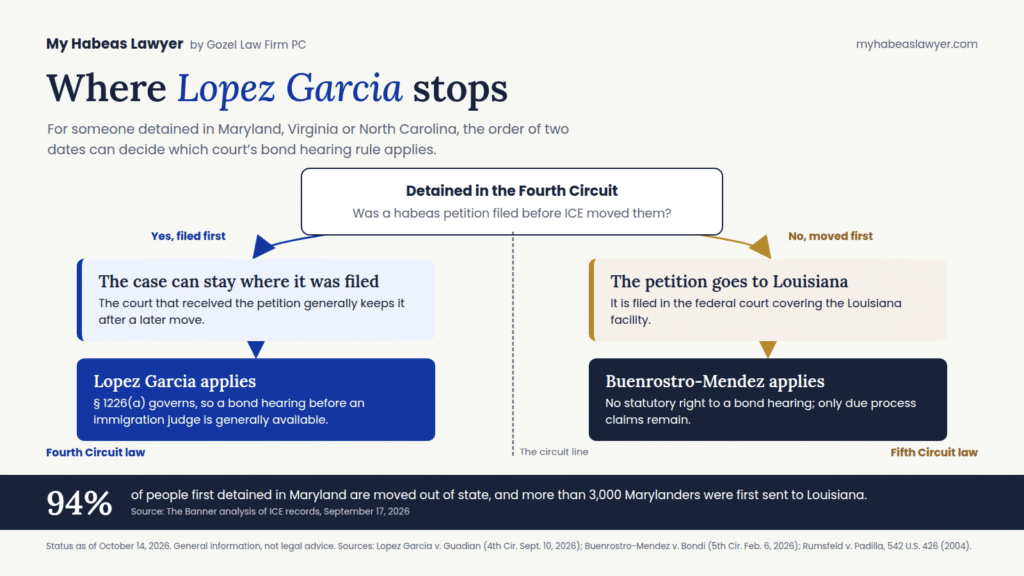
A habeas petition is filed in the federal district where the person is held on the day it is filed. That single fact decides which court hears the case, which circuit’s precedent it applies, and whether a Fourth Circuit bond hearing argument is still available.
If the Move Happened Before a Petition Was Filed
The petition belongs in the federal district covering the Louisiana facility, which for most ICE facilities in the state is the Western District of Louisiana. That court follows Buenrostro-Mendez, so the statutory argument from Lopez Garcia is not available, even if the petition was drafted while your loved one was still in Maryland.
If a Petition Was Filed Before the Move
In Rumsfeld v. Padilla, the Supreme Court recognized that when the government moves someone after a petition is properly filed, the court that received it keeps jurisdiction and can decide the case under Fourth Circuit law. This is why immigration lawyers interviewed by The Banner said the strategy is less likely to work when the move comes before the papers are filed. The details, including who must be named as respondent, are in our guide on how filing timing affects which court decides.
Not Every Move Ends the Right to a Bond Hearing
ICE does not move everyone to Louisiana. Where a move lands decides whether the bond hearing argument survives, because each destination applies its own circuit’s precedent.
| If ICE moves them to | Federal circuit | Reading of § 1225(b)(2)(A) | Bond hearing before an immigration judge? |
|---|---|---|---|
| Pennsylvania | Third | Rejects (Buele Morocho, Aug. 28, 2026) | Generally yes, under Third Circuit law |
| New Jersey | Third | Rejects (Buele Morocho, Aug. 28, 2026) | Generally yes, under Third Circuit law |
| Georgia | Eleventh | Rejects (Alvarez, May 6, 2026) | Generally yes, under Eleventh Circuit law |
| Louisiana or Texas | Fifth | Adopts (Buenrostro-Mendez, Feb. 6, 2026) | No; constitutional claims only |
The full picture for all eleven numbered circuits is in our map of where every federal circuit stands. Prolonged detention and mandatory detention on criminal grounds follow different rules and are not covered by this table.
What the Supreme Court’s Barbosa da Cunha Review Could Change
On October 1, 2026, the Supreme Court agreed to hear Rhoney v. Barbosa da Cunha, No. 26-104, a case from the Second Circuit. The question is limited to the statute: whether § 1225(b)(2)(A) requires detention of people present in the United States without having been admitted. A ruling would answer that question nationwide, and the line between the Fourth and Fifth Circuits would no longer decide it.
The ruling could go either way, and no argument date had been set when this article was last updated. Until then, Lopez Garcia binds federal courts in Maryland, Virginia, West Virginia, North Carolina and South Carolina, and a petition filed today is decided under today’s law.
What to Do Before ICE Moves Your Loved One, and After
What preserves the Fourth Circuit rule mostly happens in the first days after an arrest. If your loved one is still held in Maryland, Virginia or North Carolina:
- Confirm the facility every day in the ICE Online Detainee Locator and by phone, because the locator can lag behind a move.
- Find the Notice to Appear and check the charge. Entry without inspection usually appears as INA § 212(a)(6)(A)(i).
- Keep any written order in which the immigration judge said there was no jurisdiction to set bond.
- Gather proof of years in the country: tax returns, leases, pay stubs, school records and ICE check-in receipts.
- Contact federal habeas counsel before a move, not after. Our page on emergency federal filings before a move and our guide to what can be done when a move is threatened explain the options.
If the move has already happened, write down the date it happened and the date of any petition. Those two dates, side by side, tell a lawyer which court and which rule now apply.
Frequently Asked Questions
Does Lopez Garcia still help if my relative is already in Louisiana?
Usually not on the statutory question. If the move came before any petition was filed, the case goes to a Louisiana federal court that follows the opposite rule. A petition there can still raise due process arguments based on the circumstances of the detention.
If we filed in Maryland before the move, which court decides?
When the petition was properly filed while your relative was held in Maryland, the federal court there generally keeps the case after a later move and applies Fourth Circuit law.
Is there a 90-day bond hearing rule?
Not in the Fourth Circuit. That rule came from a July 2, 2026 Fifth Circuit panel decision, which the full court vacated on July 10. Lopez Garcia sets no time limit; it decides which statute applies. Our coverage of the Fifth Circuit’s vacated 90-day ruling explains what happened.
Does a bond hearing mean release?
No. It gives your loved one the chance to show an immigration judge that they are not a danger or a flight risk, and in the Fourth Circuit that burden is on them. If bond is granted, the statutory minimum is $1,500.
Can ICE still move someone after a petition is filed?
Yes. Filing a petition does not by itself stop a move. A lawyer can ask the court for a separate emergency order, and whether one is granted depends on the facts. What filing first does protect is which court hears the case.
Would a Supreme Court ruling apply everywhere?
Yes. A decision in Rhoney v. Barbosa da Cunha would settle the statutory question for every federal court, including those in Louisiana. Until it comes, each circuit’s own precedent controls.
The Line Holds Until the Supreme Court Rules
Lopez Garcia made bond hearings in the Fourth Circuit a real option for many families, but that option is tied to place and time. It holds across the five Fourth Circuit states and generally does not survive a move to Louisiana that comes before a petition is filed. If your loved one is still held in the Fourth Circuit, the most useful step is a prompt review of whether a petition can be filed now. Our guide to how federal habeas works in ICE detention explains the full process, and you can see who files these petitions, and where.
Is a loved one in ICE detention?
Time is critical. A habeas corpus petition can be a powerful tool to challenge unlawful detention. Reach out to us now.
Phone: +1 (862) 799-2200
Legal Disclaimer: This article is provided for general informational purposes only and does not constitute legal advice. Every immigration case has unique circumstances. For legal guidance specific to your situation, we recommend consulting with an experienced immigration attorney. The information in this article reflects laws and policies as of the publication date; subsequent changes may affect its accuracy. Prior results do not guarantee a similar outcome. Sources were reviewed as of October 14, 2026.
Update Log
- October 14, 2026: First published. Covers Lopez Garcia v. Guadian (September 10, 2026), Fifth Circuit rulings through July 10, 2026, and the Supreme Court’s October 1, 2026 grant of review in Rhoney v. Barbosa da Cunha. Pending: the Fifth Circuit’s en banc decision in Sosnava Rodriguez v. Ortega.
Sources
- Lopez Garcia v. Guadian, No. 25-7044, U.S. Court of Appeals for the Fourth Circuit, September 10, 2026; accessed October 14, 2026.
- Buenrostro-Mendez v. Bondi, No. 25-20496, U.S. Court of Appeals for the Fifth Circuit, February 6, 2026; accessed October 14, 2026.
- Sosnava Rodriguez v. Ortega, No. 26-50183, Order Granting Rehearing En Banc, U.S. Court of Appeals for the Fifth Circuit, July 10, 2026; accessed October 14, 2026.
- Docket No. 26-104, Rhoney v. Barbosa da Cunha, Supreme Court of the United States, petition granted October 1, 2026; accessed October 14, 2026.
- ICE sent her 2,000 miles from her Maryland home. She’s far from alone., The Banner, September 17, 2026; accessed October 14, 2026.
- What comes after the ICE arrest video?, Capital News Service via Maryland Matters, January 11, 2026; accessed October 14, 2026.
- A Circuit Split Ripe for Review: Mandatory Detention Under INA § 235(b)(2)(A), Catholic Legal Immigration Network (CLINIC), updated September 11, 2026; accessed October 14, 2026.
- Appeals court cites detention of Japanese Americans in ruling blasting Trump immigration policy, Associated Press via WAVY, September 10, 2026; accessed October 14, 2026.
- Rumsfeld v. Padilla, 542 U.S. 426 (2004), Cornell Legal Information Institute; accessed October 14, 2026.
- ICE Online Detainee Locator System, U.S. Immigration and Customs Enforcement; accessed October 14, 2026.
Every day in detention is a day away from your family.
If the immigration system has failed you, federal court may be the only answer. Let us review your case for free.
Get a Free Case Evaluation